การทำงานร่วมกัน
ศิลปะ
ความงามและสุขภาพ
งานฝีมือ
วัฒนธรรมและประวัติศาสตร์
ความบันเทิง
สิ่งแวดล้อม
อาหารและเครื่องดื่ม
วิศวกรรมย้อนรอย
วิทยาศาสตร์
กีฬา
เทคโนโลยี
อุปกรณ์สวมใส่
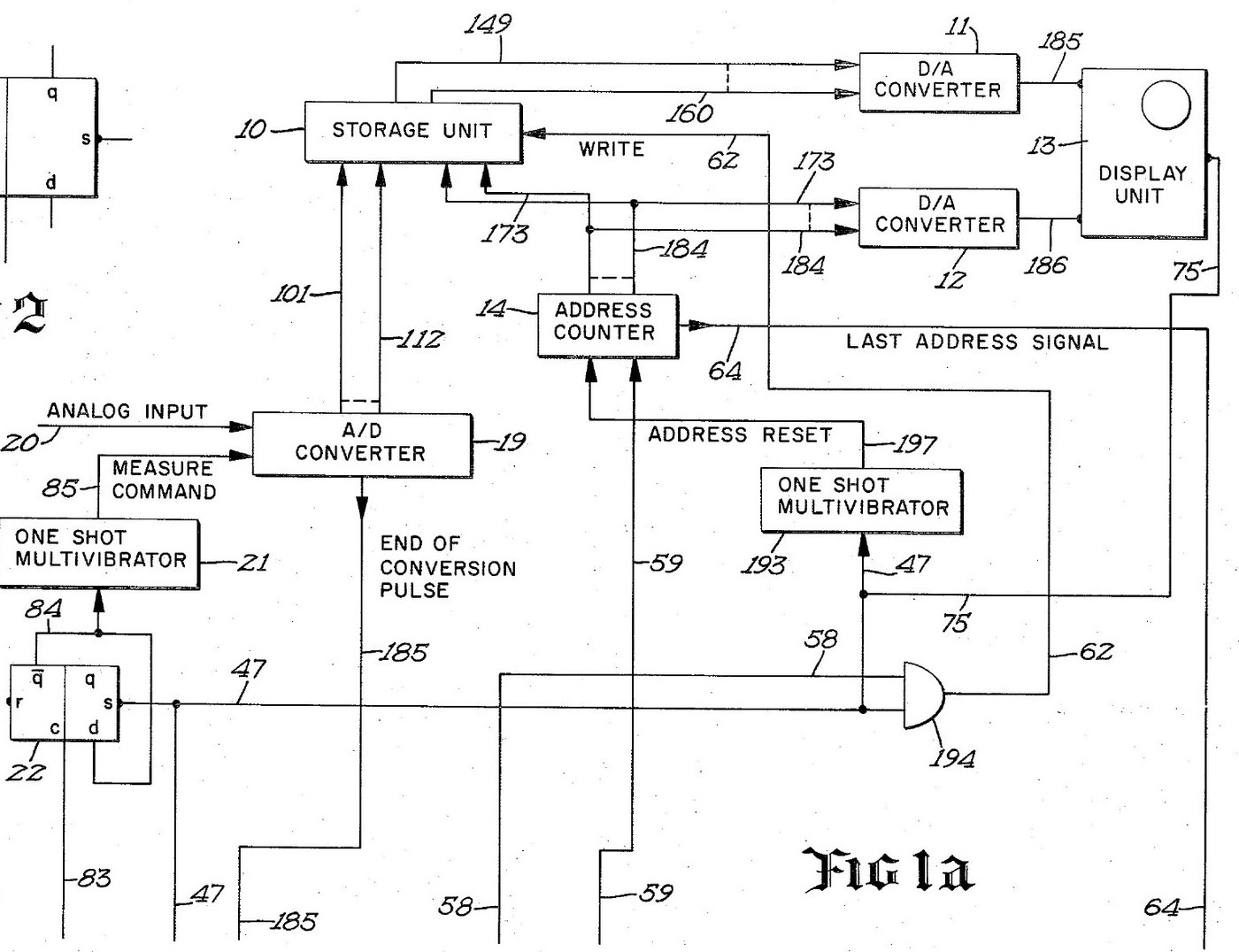


Digital Oscilloscope: Waveform Stored in Memory and Shown on a CRT (Schumann, Nicolet, US 3,816,815, 1974)
An oscilloscope with a memory. After a trigger, an analog-to-digital converter measures the input at regular intervals and writes each reading into its own memory register, replacing the old one. The screen then shows the memory: each register's number sets the beam's height, its address sets the beam's place across. The last waveform can be held on the screen as long as you like.
Result: a digital storage oscilloscope with 4,096 points of 12 bits, refresh and hold modes and single-shot capture.
Source: R. W. Schumann (Nicolet), US 3,816,815 (1974). Unknown: sample rate, bandwidth, voltages and the parts used. Picture: the patent drawing.
ผู้เชี่ยวชาญ
Unknown
คำแนะนำ
1
1
Sample and convert the input
Sample and convert the input
Bring the analog input to an analog-to-digital converter, through a BNC socket. A sampling oscillator, divided by four by two flip-flops so the first reading comes soon after the sweep starts, fires a one-shot multivibrator that gives the converter its measure command. The converter holds each 12-bit result on its output lines and signals the end of each conversion. Ours: a BNC socket. Not given: the sample rate.
วัสดุสำหรับขั้นตอนนี้:
 ตัวแปลงสัญญาณแอนะล็อกเป็นดิจิทัล1 12-bit converter
 ออสซิลเลเตอร์สัญญาณนาฬิกา1 sampling oscillator
 ชุดไอซีลอจิกคละแบบ1 flip-flops, one-shots, gates
 ชุดขั้วต่อโคแอกเชียล (BNC / SO-239)1 input socket
เครื่องมือที่ต้องใช้:
 หัวแร้งบัดกรี
 คีมปอกสายไฟ
2
2
Store each reading in memory
Store each reading in memory
Wire an integrated-circuit memory of 4,096 registers, 12 bits each, that can be read without changing it. A 12-bit address counter picks the register. On each write command the register at the current address takes the last reading from the converter, and the counter steps on. When the sweep starts, a one-shot resets the counter to zero. When it reaches the last address, its last-address signal ends the sweep.
วัสดุสำหรับขั้นตอนนี้:
 หน่วยความจำวงจรรวม1 4,096 x 12-bit store
เครื่องมือที่ต้องใช้:
หัวแร้งบัดกรีคีมปอกสายไฟ3
3
Drive the CRT from the memory
Drive the CRT from the memory
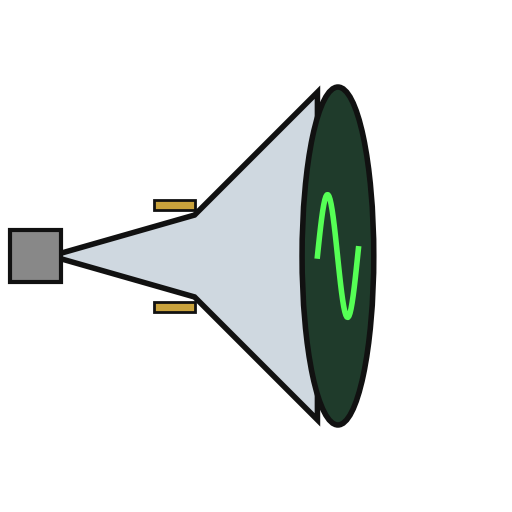
Feed the addressed register's number to one digital-to-analog converter and the address to a second. Their outputs drive the vertical and horizontal deflection plates of a cathode-ray tube, so the beam always stands at the height of the stored reading and at the place of its address. Wire the sweep line to the tube's intensifier, to brighten the trace while a waveform is being taken.
วัสดุสำหรับขั้นตอนนี้:
 ตัวแปลงดิจิทัลเป็นแอนะล็อก2 vertical and horizontal
 หลอดรังสีแคโทด1 display tube
เครื่องมือที่ต้องใช้:
หัวแร้งบัดกรีคีมปอกสายไฟ4
4
Wire the trigger and the modes
Wire the trigger and the modes
A trigger input, usually from the leading edge of the input waveform, starts the sweep, once a measure flip-flop has armed it. Put a two-position mode switch on the face: MODE I and MODE II. Add a push button in the probe, a switch on the panel and an external initiate input; each goes through a flip-flop that removes contact bounce. Two more oscillators step the memory round to refresh the display between waveforms. Mount it all in a case with its supply. Ours: toggle switches, an aluminium case, a DC supply. Not given: the supply voltages.
วัสดุสำหรับขั้นตอนนี้:
ออสซิลเลเตอร์สัญญาณนาฬิกา2 display sequencing oscillators สวิตช์โยก2 mode and panel switches
 ปุ่มกด1 probe switch
 กล่องอะลูมิเนียม1 case
เครื่องมือที่ต้องใช้:
 แหล่งจ่ายไฟกระแสตรง
 สว่านแท่นหัวแร้งบัดกรี
5
5
Capture and hold a waveform
Capture and hold a waveform
In MODE I, refresh: each new triggered waveform replaces the last on the screen. Press the probe or panel switch to hold: new waveforms are rejected and the last one stays on the screen. In MODE II the screen normally holds; on command, it takes the first waveform after the command, stores it and shows it steadily. Test it with a known signal.
เครื่องมือที่ต้องใช้:
 เครื่องกำเนิดสัญญาณ
วัสดุ
10- 1 12-bit converterตัวยึดตำแหน่ง
- 2 display sequencing oscillatorsตัวยึดตำแหน่ง
- 1 flip-flops, one-shots, gatesตัวยึดตำแหน่ง
- 1 input socketตัวยึดตำแหน่ง
- 1 4,096 x 12-bit storeตัวยึดตำแหน่ง
- 2 vertical and horizontalตัวยึดตำแหน่ง
- 1 display tubeตัวยึดตำแหน่ง
- ตัวยึดตำแหน่ง
- ตัวยึดตำแหน่ง
- 1 caseตัวยึดตำแหน่ง
พิมพ์เขียวนี้สร้าง

บลูพริ้นท์ที่เกี่ยวข้อง
บลูพริ้นท์เหล่านี้แบ่งปันความรู้ — เทคนิค วัสดุ หรือหลักการ
CC0 สาธารณสมบัติ
พิมพ์เขียวนี้เผยแพร่ภายใต้ CC0 คุณสามารถคัดลอก แก้ไข แจกจ่าย และใช้งานผลงานนี้เพื่อวัตถุประสงค์ใดก็ได้ โดยไม่ต้องขออนุญาต
สนับสนุนเมกเกอร์โดยซื้อสินค้าผ่านพิมพ์เขียวของพวกเขา ซึ่งพวกเขาจะได้รับ ค่าคอมมิชชันเมกเกอร์ ที่ผู้ขายกำหนด หรือสร้างเวอร์ชันใหม่ของพิมพ์เขียวนี้และรวมเป็นการเชื่อมต่อในพิมพ์เขียวของคุณเพื่อแบ่งรายได้