
Making Black Powder from Saltpeter, Sulfur, and Charcoal — The Mixture That Changed the World
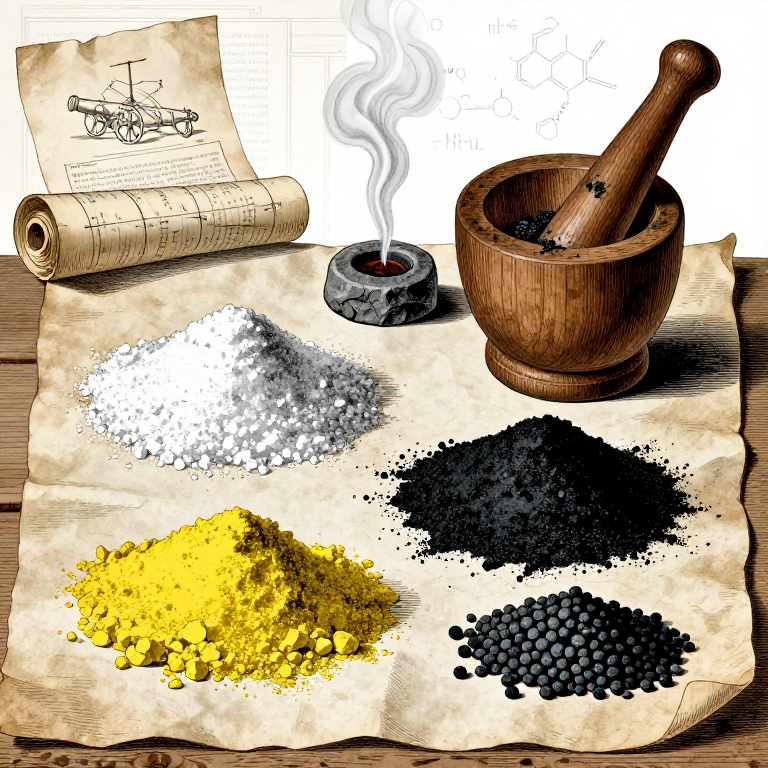
Black powder is the most historically consequential chemical mixture ever created. Three common substances — potassium nitrate (saltpeter), charcoal, and sulfur — combined in the ratio 75:15:10 by weight produce a self-oxidizing mixture that burns rapidly and generates approximately 300 volumes of hot gas for every volume of solid. This single recipe, discovered in China during the Tang Dynasty (9th century CE) and documented in the Wujing Zongyao military compendium of 1044, reshaped human civilization: it ended the age of castles, opened mountains for mining and tunneling, launched the first rockets, and powered every firearm until the invention of smokeless powder in the 1880s.
The chemistry is elegant. Potassium nitrate (KNO₃) is the oxidizer — it supplies oxygen for combustion even in the absence of air. Charcoal (carbon) is the primary fuel. Sulfur lowers the ignition temperature from approximately 400 °C (charcoal + saltpeter alone) to approximately 300 °C, and increases the burn rate by acting as a secondary fuel that melts and flows into contact with the other ingredients. The simplified reaction: 2 KNO₃ + S + 3 C → K₂S + N₂↑ + 3 CO₂↑. In practice, the products are more complex, including potassium carbonate, potassium sulfate, and various sulfides — the white smoke of black powder is a visible aerosol of these solid potassium salts.
This blueprint covers the complete process from raw ingredients to corned (granulated) black powder suitable for historical demonstration. The quantities described produce approximately 100 grams — enough for several small burn tests.
HAZARD — READ COMPLETELY BEFORE STARTING: Black powder is a low explosive classified as a deflagrating mixture. It is sensitive to spark, open flame, friction, and impact. All mixing must be done with non-sparking tools (wood, ceramic, or brass — never iron or steel). Work outdoors, away from any ignition source. Wear safety goggles and cotton clothing (synthetic fabrics melt onto skin). Keep quantities small. Check and comply with all local laws regarding the manufacture and possession of black powder — it is a regulated substance in many jurisdictions.
คำแนะนำ
Understand black powder chemistry and safety
Black powder is a mechanical mixture, not a chemical compound — the three ingredients retain their individual identities until ignited. The standard ratio by weight is 75% potassium nitrate, 15% charcoal, 10% sulfur. This ratio, refined over centuries, balances maximum gas production against complete combustion. Ratios with less saltpeter burn slower and leave more residue; ratios with more saltpeter are harder to ignite.
Potassium nitrate (KNO₃) provides the oxygen for combustion. At 400 °C it decomposes: 2 KNO₃ → 2 KNO₂ + O₂. This liberated oxygen ignites the charcoal and sulfur. Sulfur melts at just 115 °C and flows across the other particles, dramatically increasing the contact area between fuel and oxidizer. This is why sulfur-free mixtures (charcoal + saltpeter only) burn much slower.
Non-negotiable safety rules: Use only non-sparking tools — wooden mortar and pestle, wooden spoons, ceramic bowls. Never use iron, steel, or aluminum tools near the mixture. Work outdoors on a clear day. No open flames, no smoking, no synthetic clothing. Keep water nearby. Mix only small quantities (under 100 grams). Never grind or mill the completed mixture dry — always dampen with water first.
Purify the potassium nitrate by recrystallization
Crude saltpeter from niter beds or purchased potassium nitrate often contains impurities (sodium chloride, calcium salts, organic matter) that reduce performance and increase smoke. Purify by dissolving in hot water and recrystallizing. Dissolve 100 grams of crude saltpeter in 150 ml of boiling water — KNO₃ is very soluble in hot water (approximately 250 g/100 ml at 100 °C) but much less soluble in cold water (approximately 32 g/100 ml at 20 °C).
Filter the hot solution through a fine cloth to remove insoluble impurities. Let the clear filtrate cool slowly to room temperature. Long, needle-like crystals of pure potassium nitrate form as the solution cools. Pour off the remaining liquid (which contains the more soluble impurities like NaCl). Spread the crystals on a clean cloth and dry thoroughly in sunlight or in a warm (not hot) oven. The purified crystals should be bright white and translucent.
วัสดุสำหรับขั้นตอนนี้:
Potassium Nitrate (saltpeter)100 gramsเครื่องมือที่ต้องใช้:
Glass Beaker (Borosilicate, 500ml)Grind the potassium nitrate to fine powder
Grind the potassium nitrate to fine powder
Grind the dried, purified saltpeter crystals in a wooden or ceramic mortar and pestle. Grind each ingredient separately — never grind the completed mixture. Potassium nitrate alone is not explosive and can be ground vigorously. Reduce the crystals to a fine powder with the consistency of powdered sugar — no visible grains. The finer the powder, the more intimate the contact between ingredients in the final mixture, and the faster and more completely it burns.
Weigh out exactly 75 grams of the finely ground saltpeter. Set aside in a clean, dry ceramic or glass container. Label it clearly.
เครื่องมือที่ต้องใช้:
Mortar and Pestle
Precision Scale (0.01g)Grind the sulfur to fine powder
Grind the sulfur to fine powder
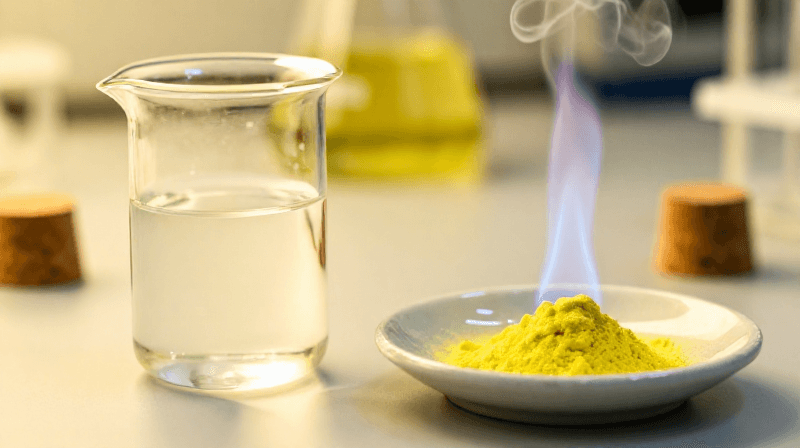
Grind sulfur in a separate mortar and pestle (or wash the mortar thoroughly between ingredients). Sulfur is soft (Mohs hardness 2) and grinds easily to a fine yellow powder. If starting with flowers of sulfur (commercially available sublimed sulfur), it may already be fine enough — but check by rubbing between fingers. It should feel smooth, not gritty.
Sulfur dust is mildly irritating to the lungs. Work in a well-ventilated area and avoid inhaling the fine powder. Weigh out exactly 10 grams and set aside in a separate clean container.
วัสดุสำหรับขั้นตอนนี้:
Native Sulfur (collected)15 gramsเครื่องมือที่ต้องใช้:
Mortar and Pestle
Precision Scale (0.01g)Grind charcoal to fine powder
Grind charcoal to fine powder
The type of charcoal matters. Willow and alder charcoal produce the fastest-burning powder because they are light, porous, and low in mineral ash. Hardwood charcoal (oak, maple) works but burns slightly slower due to higher density and ash content. Avoid briquettes — they contain clay binders that produce excessive residue.
Grind the charcoal in a mortar and pestle to the finest powder possible. Charcoal dust is messy but non-toxic. The powder should pass through a fine-mesh sieve (at least 100 mesh) without visible grains. Charcoal is the hardest of the three ingredients to grind fine enough — this step takes the most time and effort. Weigh out exactly 15 grams.
วัสดุสำหรับขั้นตอนนี้:
Charcoal20 gramsเครื่องมือที่ต้องใช้:
Mortar and Pestle
Fine Mesh Sieve (60-80 mesh)Combine the charcoal and sulfur first
Combine the charcoal and sulfur first
Mix the 15 grams of charcoal powder and 10 grams of sulfur powder together in a wooden or ceramic bowl. This binary mixture (charcoal + sulfur) without the oxidizer is not explosive — it is simply a fuel blend. Stir with a wooden spoon or spatula until the color is uniform: a dark greyish-yellow. This pre-mixing ensures the two fuels are intimately blended before the oxidizer is added.
Pre-mixing the fuels separately is a traditional safety precaution. The charcoal-sulfur blend can be handled, stirred, and even dropped without risk. Adding the oxidizer (saltpeter) transforms it into a sensitive energetic mixture that demands much greater care.
Add potassium nitrate to the fuel blend
Add the 75 grams of ground potassium nitrate to the charcoal-sulfur blend. From this point forward, the mixture is a sensitive energetic material. Use only wooden or ceramic utensils. Do not scrape, grind, or compress the dry mixture — static electricity, friction, or impact could cause ignition.
Stir gently with a wooden spoon to begin incorporating the three ingredients. The mixture at this stage is called 'serpentine' — a loose, dry blend of the three powders. Serpentine was the form used before the 15th century, but it is inconsistent: the heavy saltpeter settles to the bottom during transport, and the loose powder packs too tightly in a barrel or tube, slowing the burn.
Dampen the mixture with water
Add water sparingly — approximately 5–8 ml (one teaspoon at a time) — and mix thoroughly after each addition. The goal is a uniformly damp mixture with the consistency of brown sugar or damp sand. It should clump when squeezed but not drip water. Too wet and it takes too long to dry; too dry and you lose the safety benefit of dampening.
Dampening serves two critical purposes. First, safety: wet powder cannot ignite from friction or static during the intensive mixing that follows. Second, quality: the water dissolves a small amount of saltpeter on the surface of each particle, and when the mixture dries, the recrystallized saltpeter forms microscopic bridges between fuel and oxidizer particles, improving the intimacy of the mixture far beyond what dry mixing alone can achieve.
Mix the dampened powder thoroughly
Work the damp mixture with a wooden pestle in a wooden mortar, or knead it in a wooden bowl with a wooden spoon, for at least 15–20 minutes. This is the most important step for powder quality. The intimate contact between oxidizer and fuel particles determines the burn rate, power, and consistency of the finished product. Historical powder mills used heavy stone or bronze wheels rolling on a stone bed for hours — the home maker must compensate with time and effort.
The mixture should become uniformly dark grey-black with no visible yellow sulfur streaks or white saltpeter patches. Periodically scrape the sides and bottom of the mortar to incorporate all material. If the mixture dries out during mixing, add a few drops of water to maintain the damp consistency.
เครื่องมือที่ต้องใช้:
Mortar and PestlePress the paste through a screen to corn the powder
Press the paste through a screen to corn the powder
Corning (granulation) was the breakthrough that transformed black powder from an unreliable curiosity into a consistent propellant. Discovered in Europe in the early 15th century, corning produces uniform granules with controlled air gaps between them. These gaps allow flame to propagate through the charge faster and more evenly than serpentine powder, which packs into a solid mass.
Press the damp paste through a coarse screen or sieve (approximately 10–20 mesh, 1–2 mm openings) using a wooden block or the flat of your hand. The paste extrudes through the mesh as small worm-like shapes that break into granules. Catch them on a clean cloth or tray below. Do not force the paste — let it extrude gently. If it is too dry to pass through, add a few drops of water. If too wet, let it air-dry slightly before pressing.
เครื่องมือที่ต้องใช้:
Fine Mesh Sieve (60-80 mesh)Dry the granules slowly
Dry the granules slowly
Spread the wet granules in a thin, single layer on a clean cloth or wooden tray. Dry in the shade outdoors — never in direct sunlight (UV can cause localized heating) and never near any heat source or flame. The drying process takes 4–8 hours depending on humidity and air circulation. Turn the granules occasionally to ensure even drying.
The powder is ready when the granules feel dry and hard, and no longer stick together when pressed. A properly dried granule snaps cleanly when broken rather than deforming. Residual moisture degrades powder performance: even 1–2% moisture significantly slows the burn rate and increases residue.
Sieve to select uniform grain size
Pass the dried granules through two sieves of different mesh sizes. The first sieve (coarse, approximately 10 mesh / 2 mm) removes oversized lumps — these can be re-dampened and re-corned. The second sieve (fine, approximately 40 mesh / 0.4 mm) separates usable granules from fine dust that falls through. The dust ('meal powder') can be re-dampened and re-corned.
The granules retained between the two sieves are the finished corned powder. Uniform grain size ensures consistent burn rate. Historically, different grain sizes were graded for different applications: fine grain (FFFg) for priming and pistols, medium (FFg) for muskets, coarse (Fg) for cannons. This sieving step is what determines the grade.
เครื่องมือที่ต้องใช้:
Fine Mesh Sieve (60-80 mesh)Perform a small burn test
Perform a small burn test
Outdoors only. Clear area of all flammable materials. Wear safety goggles. Place a small quantity (approximately 1 gram — a pinch) of the finished powder on a non-flammable surface (a flat stone or a ceramic tile). Stand back and ignite it with a long match, a fuse, or a burning splint held at arm's length. Do not lean over the powder.
Good black powder ignites instantly with a bright flash and a puff of dense white smoke, leaving minimal solid residue. The burn should be complete in under one second for a 1-gram sample. If it burns slowly with a sputtering orange flame and leaves black residue, the mixing was insufficient or the ingredients were not fine enough. If it barely ignites, the saltpeter may be impure or the ratio incorrect. Compare the performance against the expected behavior and repeat the mixing or purification steps as needed.
เครื่องมือที่ต้องใช้:
Safety GogglesStore in an airtight container away from heat
Store in an airtight container away from heat
Transfer the finished corned powder to a clean, dry glass jar with an airtight lid. Black powder is hygroscopic — it absorbs moisture from the air, which degrades performance over time. An airtight container in a cool, dry location preserves the powder indefinitely. Store away from heat sources, direct sunlight, and ignition sources. Label the container clearly with the contents and date.
Never store more than you intend to use in the near future. Keep quantities small and separated — never consolidate large amounts in a single container. Black powder should be stored in a location where accidental ignition would not threaten people or structures. A detached shed or outdoor lockbox is traditional.
วัสดุสำหรับขั้นตอนนี้:
Glass Storage Jar with Lid1 ชิ้นUnderstand the historical context and what came next
Understand the historical context and what came next
The mixture you have created is identical in composition to the powder that ended feudalism. Before gunpowder, a castle wall could withstand years of siege. After gunpowder, a cannon reduced the same wall in hours. The social consequences were enormous: fortified nobility lost their military advantage, centralized nation-states with artillery armies replaced fragmented feudal territories, and the age of global exploration began because gunpowder weapons gave European ships decisive advantages in distant waters.
The chemistry of black powder remained unchanged for nearly a thousand years — from 9th century China to the 1880s, every firearm, every mine blast, every rocket, and every firework used this same three-ingredient mixture. It was replaced as a military propellant only by smokeless powder (nitrocellulose-based), but black powder remains in use today for historical firearms, fireworks, blasting, and fuse cord. Understanding this mixture is understanding one of the pivotal chemical discoveries in human history.
วัสดุ
4- 100 gramsตัวยึดตำแหน่ง
- 15 gramsตัวยึดตำแหน่ง
- ตัวยึดตำแหน่ง
วัสดุจากพิมพ์เขียวที่เชื่อมต่อ
บลูพริ้นท์ที่เกี่ยวข้อง
บลูพริ้นท์เหล่านี้แบ่งปันความรู้ — เทคนิค วัสดุ หรือหลักการ
Related blueprints
Other builds that share materials, tools, or techniques with this one.


CC0 สาธารณสมบัติ
พิมพ์เขียวนี้เผยแพร่ภายใต้ CC0 คุณสามารถคัดลอก แก้ไข แจกจ่าย และใช้งานผลงานนี้เพื่อวัตถุประสงค์ใดก็ได้ โดยไม่ต้องขออนุญาต
สนับสนุนเมกเกอร์โดยซื้อสินค้าผ่านพิมพ์เขียวของพวกเขา ซึ่งพวกเขาจะได้รับ ค่าคอมมิชชันเมกเกอร์ ที่ผู้ขายกำหนด หรือสร้างเวอร์ชันใหม่ของพิมพ์เขียวนี้และรวมเป็นการเชื่อมต่อในพิมพ์เขียวของคุณเพื่อแบ่งรายได้