การทำงานร่วมกัน
ศิลปะ
ความงามและสุขภาพ
งานฝีมือ
วัฒนธรรมและประวัติศาสตร์
ความบันเทิง
สิ่งแวดล้อม
อาหารและเครื่องดื่ม
วิศวกรรมย้อนรอย
วิทยาศาสตร์
กีฬา
เทคโนโลยี
อุปกรณ์สวมใส่
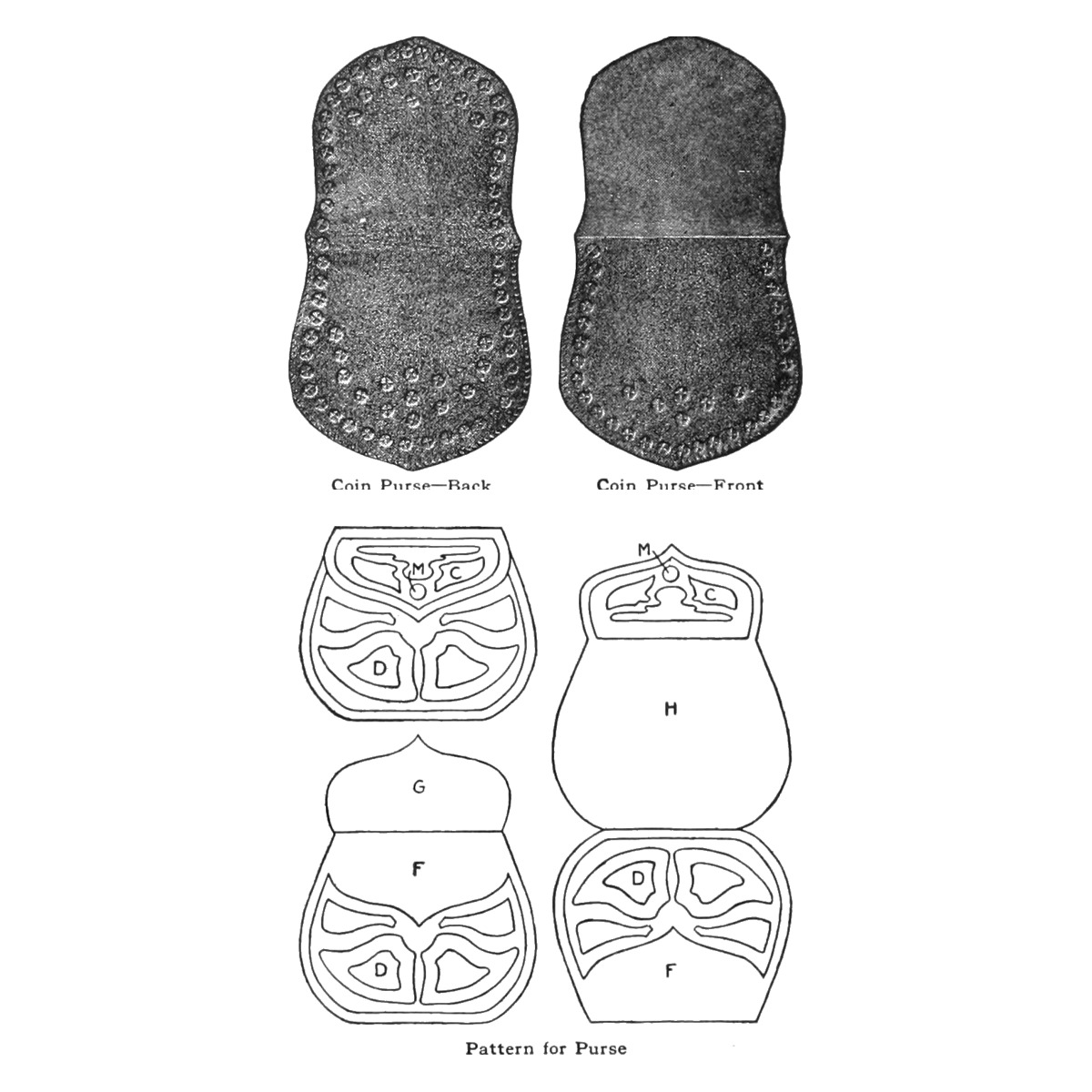


Tooled Calfskin Coin Purse: Lined, Flap Over Front, Design Split Between Flap and Front (Boy Mechanic, 1915)
The first piece in Mary C. Scovel's leather course (The Boy Mechanic, Book 2, 1915): a coin purse of Russian calfskin from a 4 by 8 in piece, its design traced, lined and tooled or stamped, split so half sits on the flap and half on the front below it, then lined with silk and stitched.
เริ่มต้น
About 3 hours
คำแนะนำ
1
1
Her sizes in centimetres
Her sizes in centimetres
กำลังโหลดสมุด Jupyter…
2
2
Read The Boy Mechanic, Book 2
Read The Boy Mechanic, Book 2
Her outfit: "two special tools costing 50 cents each, one with a narrow edge for lining patterns, and one with broad ends for tooling; and a piece of tin, plate glass, or very smooth hard wood, which should not be smaller than 9 by 12 in. A soft sponge, a triangle, a rule, tracing paper and a hard pencil are also needed." Russian calfskin is best for tooling and stamping.
3
3
Make the paper pattern
Make the paper pattern
The purse has three parts: front, back and flap. Fold paper to the proportions you want, with the design for the front D on the same side of the paper as the flap C; the space F under the flap has no design. Fold F behind H, then C behind H and F, and turn the pattern over to see the purse. Cut a piece of leather 4 by 8 in, which leaves 1/4 in outside the pattern for pinning.
วัสดุสำหรับขั้นตอนนี้:
 หนังลูกวัว1 ชิ้น
เครื่องมือที่ต้องใช้:
 กระดาษลอกลาย
 ดินสอ
 กรรไกร
 ไม้บรรทัด
4
4
Damp the leather and transfer the design
Damp the leather and transfer the design
Draw the whole design for the purse on tracing paper. Wet the leather on the wrong (unfinished) side with a soft sponge: pat it to moisten, not soak, it; too wet and the tool sticks and leaves an uneven background. Pin the design firmly on the leather, tack the leather down on its outer margin to the glass or board, and go over every line with a hard pencil, with firm, even pressure. Lift the paper and go over the lines with the narrow lining tool, with a strong, firm stroke. A line design can stop here.
วัสดุสำหรับขั้นตอนนี้:
หนังลูกวัว1 ชิ้นเครื่องมือที่ต้องใช้:
 ฟองน้ำกระดาษลอกลายดินสอ
 หมุดปักกระดาษ (กล่อง 50 ตัว)
 แผ่นแก้ว
 เครื่องมือแกะลายหนัง
5
5
Tool or stamp the background
Tool or stamp the background
Leave at least 1/8 in between the edge of the pattern and the design. To tool, press the background down with the broad end in even, long strokes; if it will not go down, the leather is too dry, so take it off and damp the back again. Keep the edges sharp between pressed and raised parts. To stamp instead, strike a small carpenter's nail set lightly with a wooden mallet in rows of circles; too hard a blow cuts the leather.
เครื่องมือที่ต้องใช้:
เครื่องมือแกะลายหนัง เหล็กส่งตะปู
 ค้อนไม้ฟองน้ำ
6
6
Line and stitch
Line and stitch
Fold the parts together, line with silk to match the leather, and stitch the front and back parts close to the edge. Stitch on a sewing machine with a long stitch, a large needle and silk as heavy as the needle takes; try it on a scrap first, and put tissue paper over the leather if the foot marks it. Without a machine, prick holes with an awl and sew with needle and silk, running or over-and-over; going over-and-over to the end and back gives an X stitch. She has the catch M put on by a shoemaker or trunk store; a snap fastener is used here.
วัสดุสำหรับขั้นตอนนี้:
 ผ้าไหม1 ชิ้น
 ด้ายไหม1 ชิ้น
 กาวแป้งสาลี1 ชิ้น
 กระดุมแป๊ก1 ชิ้น
เครื่องมือที่ต้องใช้:
กรรไกร จักรเย็บผ้า
 เหล็กหมาด (สว่านเจาะรูมือ)
 เข็มเย็บอานม้าสองเล่ม
7
7
Troubleshooting
Troubleshooting
Tooled leather troubleshooting.
Flow
Loading...
8
8
History and honest limits
History and honest limits
From Mary C. Scovel, "Arts-Crafts Leather Work", in **The Boy Mechanic, Book 2**, Popular Mechanics, 1915 (Project Gutenberg 44585; checked on the archive.org scan boymechanicbook200chic2, pp. 432-441), Part I. She gives the piece size but no finished purse size; the shape comes from her pattern. The snap fastener, tools and metric figures are ours.
วัสดุ
5- 2 ชิ้นตัวยึดตำแหน่ง
- 1 ชิ้นตัวยึดตำแหน่ง
- 1 ชิ้นตัวยึดตำแหน่ง
- 1 ชิ้นตัวยึดตำแหน่ง
- 1 ชิ้นตัวยึดตำแหน่ง
เครื่องมือที่จำเป็น
13- ตัวยึดตำแหน่ง
- 1 vendor sell this, none ship to you yetตัวยึดตำแหน่ง
- ตัวยึดตำแหน่ง
- ตัวยึดตำแหน่ง
- ตัวยึดตำแหน่ง
- ตัวยึดตำแหน่ง
- ตัวยึดตำแหน่ง
- ตัวยึดตำแหน่ง
- ตัวยึดตำแหน่ง
- ตัวยึดตำแหน่ง
- ตัวยึดตำแหน่ง
- ตัวยึดตำแหน่ง
- ตัวยึดตำแหน่ง
พิมพ์เขียวนี้สร้าง
บลูพริ้นท์ที่เกี่ยวข้อง
บลูพริ้นท์เหล่านี้แบ่งปันความรู้ — เทคนิค วัสดุ หรือหลักการ
CC0 สาธารณสมบัติ
พิมพ์เขียวนี้เผยแพร่ภายใต้ CC0 คุณสามารถคัดลอก แก้ไข แจกจ่าย และใช้งานผลงานนี้เพื่อวัตถุประสงค์ใดก็ได้ โดยไม่ต้องขออนุญาต
สนับสนุนเมกเกอร์โดยซื้อสินค้าผ่านพิมพ์เขียวของพวกเขา ซึ่งพวกเขาจะได้รับ ค่าคอมมิชชันเมกเกอร์ ที่ผู้ขายกำหนด หรือสร้างเวอร์ชันใหม่ของพิมพ์เขียวนี้และรวมเป็นการเชื่อมต่อในพิมพ์เขียวของคุณเพื่อแบ่งรายได้