ศิลปะ
ความงามและสุขภาพ
งานฝีมือ
วัฒนธรรมและประวัติศาสตร์
ความบันเทิง
สิ่งแวดล้อม
อาหารและเครื่องดื่ม
วิศวกรรมย้อนรอย
วิทยาศาสตร์
กีฬา
เทคโนโลยี
อุปกรณ์สวมใส่



The Reversible Sad-Iron Stand: Feet That Lock to the Board
A hot iron has to rest somewhere between strokes. On a board that tips, the stand can slide off with it.
Susan T. Inesly of New York received US 148,706, dated 17 March 1874 (filed 10 December 1873), for a sad-iron holder "constructed with feet on one side and a vertical rim or flange on its other, whereby said holder can be reversed to present either face for supporting the iron". Bars screwed to the ironing board take the feet, so the holder "is not liable to slide off the same if the board be tilted".
This rung works out the tilt at which a stand starts to slide, and the force the bars must then take. You then make a stand with locating feet and test it on a tilted board.
เริ่มต้น
About 2 hours
คำแนะนำ
1
1
The tilt that starts a slide
The tilt that starts a slide
กำลังโหลดสมุด Jupyter…
2
2
What the stand holds
What the stand holds
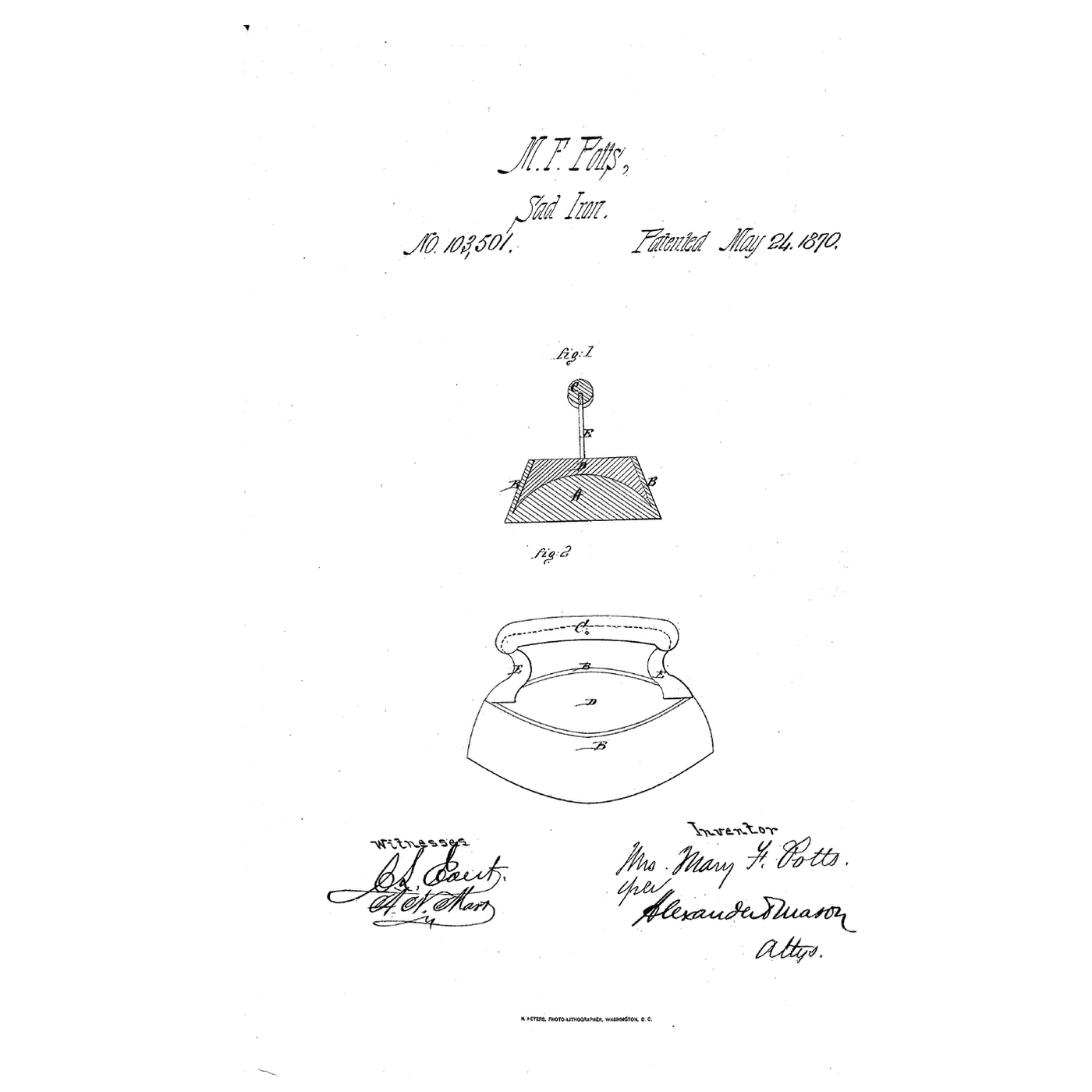
The embedded blueprint covers the sad iron itself: a heavy iron heated on the stove, set down between strokes.
3
3
Read US 148,706
Read US 148,706
"The object of this invention is to furnish a sad-iron holder which is capable of the uses of the ordinary holders, and which can be reversed or either side turned up to support the iron, while it may be securely held in place on an ironing board or table, if desired."
"The said brackets or bars D are intended to be used on ironing-boards for the purpose of preventing the holder from sliding off the same, as when putting on or taking off a skirt, when the board must be tilted; but for ordinary table-use they are not essential."
4
4
Make a stand with locating feet and tilt it
Make a stand with locating feet and tilt it
Cut an iron-shaped plate from steel sheet with the tin snips and file the edges smooth. Rivet two short folded strips under it as feet. Along the edge of the other face, rivet a strip bent up as a low rim, so the plate can be used either way up.
Screw two short wooden bars to a board, with holes drilled to take the feet.
First set the stand on the bare board, load it with a weight and tilt the board slowly. Read the angle on the protractor when it starts to slide; the tangent of that angle is your friction coefficient. Then drop the feet into the bars and tilt again. Compare with the notebook.
วัสดุสำหรับขั้นตอนนี้:
 แผ่นเหล็ก1 ชิ้น
 หมุดย้ำแบบดึง8 ชิ้น
 แผ่นไม้สน1 ชิ้น
 สกรูไม้4 ชิ้น
เครื่องมือที่ต้องใช้:
 ที่รองหม้อ
 กรรไกรตัดแผ่นโลหะ
 ตะไบโลหะ
 สว่านไร้สาย
 ไม้โปรแทรกเตอร์
 ตุ้มถ่วง
5
5
A stand that slides, rocks or scorches
A stand that slides, rocks or scorches
Iron stand troubleshooting.
Flow
Loading...
6
6
History and honest limits
History and honest limits
**Susan T. Inesly** of New York filed US 148,706 on 10 December 1873; it is dated 17 March 1874.
**Honest limits.** The notebook uses one friction coefficient for starting and sliding, and treats the stand as a block. A real stand can tip before it slides. The masses, friction values and angles are examples. Your tilt measurements are the measurement.
วัสดุ
4- 1 ชิ้นตัวยึดตำแหน่ง
- 8 ชิ้นตัวยึดตำแหน่ง
- 1 ชิ้นตัวยึดตำแหน่ง
- 4 ชิ้นตัวยึดตำแหน่ง
เครื่องมือที่จำเป็น
6- ตัวยึดตำแหน่ง
- ตัวยึดตำแหน่ง
- ตัวยึดตำแหน่ง
- 1 vendor sell this, none ship to you yetตัวยึดตำแหน่ง
- ตัวยึดตำแหน่ง
- ตัวยึดตำแหน่ง
บลูพริ้นท์ที่เกี่ยวข้อง
บลูพริ้นท์เหล่านี้แบ่งปันความรู้ — เทคนิค วัสดุ หรือหลักการ



CC0 สาธารณสมบัติ
พิมพ์เขียวนี้เผยแพร่ภายใต้ CC0 คุณสามารถคัดลอก แก้ไข แจกจ่าย และใช้งานผลงานนี้เพื่อวัตถุประสงค์ใดก็ได้ โดยไม่ต้องขออนุญาต
สนับสนุนเมกเกอร์โดยซื้อสินค้าผ่านพิมพ์เขียวของพวกเขา ซึ่งพวกเขาจะได้รับ ค่าคอมมิชชันเมกเกอร์ ที่ผู้ขายกำหนด หรือสร้างเวอร์ชันใหม่ของพิมพ์เขียวนี้และรวมเป็นการเชื่อมต่อในพิมพ์เขียวของคุณเพื่อแบ่งรายได้