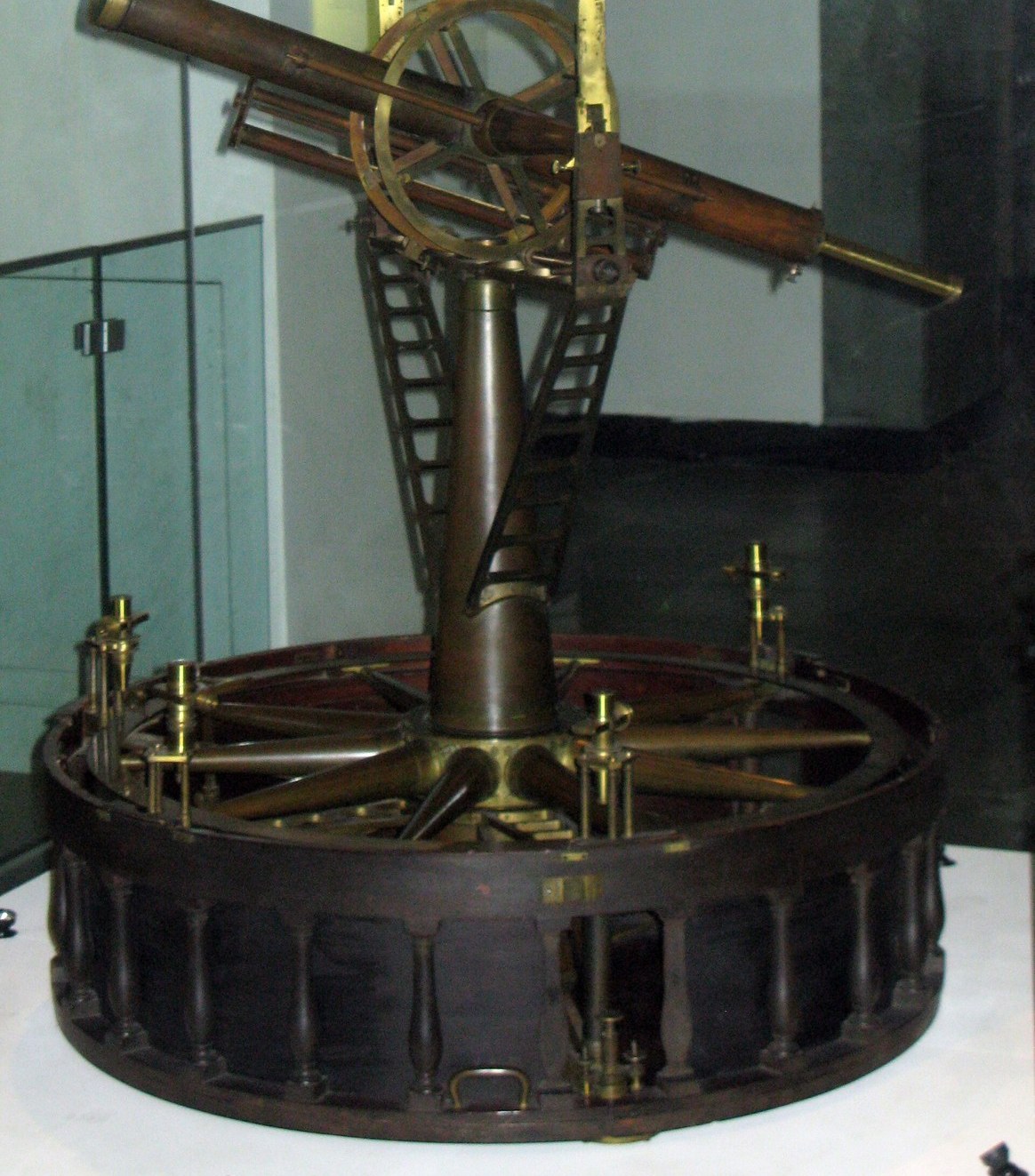


The Theodolite
Nothing large gets built until somebody has decided, on the ground, exactly where it goes. A theodolite is the instrument that decides. It measures one thing supremely well: the angle between two directions — horizontally and vertically — from a point you have fixed over a mark.
That is enough to build a country. Measure one distance carefully — a baseline — then measure only angles from its two ends to a distant third point, and trigonometry gives you the other two sides without walking them. Use that new side as the next baseline, and the survey spreads across a landscape as a mesh of triangles. This is triangulation, and it is why one painstakingly measured line can position a whole nation.
The instrument that made it precise was built by Jesse Ramsden between 1784 and 1787 and delivered in July 1787 to William Roy, for the Anglo-French Survey — a project of the Royal Society to fix the relative positions of the Greenwich and Paris observatories. Its horizontal circle was three feet across and read to one second of arc. It weighed about 200 lb (91 kg), and its accessories and cases weighed as much again.
The name is older than the precision. It first appears as theodelitus in Pantometria, the surveying book Thomas Digges published in 1571 from his father Leonard's papers. Digges never wrote down where he got the word, and nobody has since worked it out.
Build a working one from a protractor, a tripod and a sighting tube, and survey something you cannot walk to.
คำแนะนำ
Build the horizontal circle
Build the horizontal circle
Glue a 180° protractor flat to a small board, centre upward. Drill the centre and fit a bolt so a second board rotates freely on top, carrying an index mark that reads against the scale.
Mount the whole assembly on a tripod.
The rotating part must turn without wobble and without shifting the scale. Any play here becomes an angular error you cannot detect later.
วัสดุสำหรับขั้นตอนนี้:
 แผ่นไม้สน1 ชิ้น
 ไม้โปรแทรกเตอร์1 ชิ้น
 สลักเกลียวหกเหลี่ยม 1/4"-20 x 2"1 ชิ้น
เครื่องมือที่ต้องใช้:
 เลื่อยมือ
 ขาตั้งกล้อง (คาร์บอนไฟเบอร์ หัวบอล)
Add the sight and the vertical circle
Add the sight and the vertical circle
Fix a length of dowel or a narrow tube to the rotating board as a sighting line. Add a second protractor on edge, with the sight pivoting against it, to read vertical angles.
Sight a distant fixed object and rotate a full turn back to it. It must read the same both times.
If it does not, the sight is not passing through the rotation centre — the commonest fault in a home-made instrument.
วัสดุสำหรับขั้นตอนนี้:
 เดือยไม้1 ชิ้นไม้โปรแทรกเตอร์1 ชิ้น
เครื่องมือที่ต้องใช้:
 กาวไม้ PVA
Level it and centre it over the mark
Level it and centre it over the mark
Level the base with a spirit level in two directions at right angles. Hang a plumb bob from the centre bolt and move the tripod until the bob hangs over your ground mark.
Re-check the level — moving the legs disturbs it.
Levelling and centring are not setup fuss, they are the measurement. A theodolite reports angles at a point; if the instrument is not over that point, every angle is right about somewhere else.
เครื่องมือที่ต้องใช้:
 ระดับน้ำ
 ลูกดิ่ง
Measure a baseline
Measure a baseline
Choose two ground marks, A and B, on level open ground, 20-30 m apart. Measure A-B with a tape three times and average.
Record the three readings, not just the average.
This one distance sets the scale of everything that follows. Roy's team measured five miles at Hounslow Heath with deal rods, then re-measured it with glass rods to remove the effect of damp on the wood.
เครื่องมือที่ต้องใช้:
 ตลับเมตร
 สมุดบันทึกภาคสนามทุกสภาพอากาศ
Triangulate to something you cannot reach
Triangulate to something you cannot reach
Pick a target C you cannot walk to — a chimney, a tree across water. From A, measure the angle between B and C. Move to B and measure the angle between A and C.
Solve the triangle: the three angles sum to 180°, and the sine rule gives AC and BC from the known AB.
Check the result against a map or a satellite view.
เครื่องมือที่ต้องใช้:
 เครื่องคิดเลข
 กระดาษกราฟ
Close the triangle and find your own error
Close the triangle and find your own error
Measure all three angles of a triangle, including the one at C if you can get there. Add them.
They will not sum to exactly 180°. The shortfall or excess is your closing error, and it is the only honest measure of how good your instrument is.
Repeat with the sight reversed and average the two — this cancels errors that are fixed in the instrument rather than random.
Surveying does not eliminate error, it measures it and distributes it. Ramsden's circle read to one arcsecond so that the closing errors of a national mesh stayed small enough to adjust.
History & Context
History & Context
The word arrives before the precision. Theodelitus appears in Pantometria (1571), which Thomas Digges assembled and published from the papers of his father Leonard, of Kent. The instrument described there is a divided circle with a sighting rule — the idea, not yet the accuracy. The middle vowel later drifted from e to o for reasons nobody has been able to establish, and Digges never recorded where he got the word at all.
What changed in the 1780s was not the concept but the dividing. A circle is only as good as the accuracy with which its degree marks are cut, and hand-dividing a large circle was the bottleneck of the whole instrument trade. Jesse Ramsden's dividing engine mechanised it, and that is the real reason his theodolite could read to one second of arc. The instrument's precision is the precision of a machine tool, one step removed.
The Anglo-French Survey (1784-1790) existed to settle a concrete question: how far apart, and in what direction, were the observatories at Greenwich and Paris? Roy measured the baseline on Hounslow Heath — about five miles, across ground now largely under Heathrow Airport — and Ramsden's theodolite carried the angles from there to the Channel, where the chain was joined to the French survey. Roy died in 1790. The work he started grew into the Principal Triangulation of Great Britain and, from it, the Ordnance Survey.
The honest limits. A theodolite measures angles, never distances — it needs a measured baseline to have any scale at all, and an error in that one line scales the entire network. It needs intervisible stations, so mountain tops and church towers dictate the geometry rather than convenience. Refraction bends light through the atmosphere, so a long horizontal sight is not quite a straight line and the correction is a model, not a measurement. And it assumes you know which point you are standing on: the largest surveying blunders in history are not bad angles, they are angles measured perfectly from the wrong mark.
What replaced it did not replace the idea. Electronic distance measurement, and then GNSS, removed the need to build a triangle chain — you can now measure the sides directly. But every construction site still sets out from fixed marks, still closes its traverses, and still reports a closing error. The instrument changed; the discipline of proving your own accuracy did not.
วัสดุ
4- 1 ชิ้นตัวยึดตำแหน่ง
- 1 ชิ้นตัวยึดตำแหน่ง
- ตัวยึดตำแหน่ง
- 1 ชิ้นตัวยึดตำแหน่ง
เครื่องมือที่จำเป็น
9- ตัวยึดตำแหน่ง
- ตัวยึดตำแหน่ง
- ตัวยึดตำแหน่ง
- ตัวยึดตำแหน่ง
- ตัวยึดตำแหน่ง
- 1 vendor sell this, none ship to you yetตัวยึดตำแหน่ง
- ตัวยึดตำแหน่ง
- ตัวยึดตำแหน่ง
- ตัวยึดตำแหน่ง
วัสดุจากพิมพ์เขียวที่เชื่อมต่อ


บลูพริ้นท์ที่เกี่ยวข้อง
บลูพริ้นท์เหล่านี้แบ่งปันความรู้ — เทคนิค วัสดุ หรือหลักการ

CC0 สาธารณสมบัติ
พิมพ์เขียวนี้เผยแพร่ภายใต้ CC0 คุณสามารถคัดลอก แก้ไข แจกจ่าย และใช้งานผลงานนี้เพื่อวัตถุประสงค์ใดก็ได้ โดยไม่ต้องขออนุญาต
สนับสนุนเมกเกอร์โดยซื้อสินค้าผ่านพิมพ์เขียวของพวกเขา ซึ่งพวกเขาจะได้รับ ค่าคอมมิชชันเมกเกอร์ ที่ผู้ขายกำหนด หรือสร้างเวอร์ชันใหม่ของพิมพ์เขียวนี้และรวมเป็นการเชื่อมต่อในพิมพ์เขียวของคุณเพื่อแบ่งรายได้