
İşbirliği
SANAT
GÜZELLİK & SAĞLIK
ZANAAT
KÜLTÜR & TARİH
EĞLENCE
ÇEVRE
YİYECEK & İÇECEK
TERS MÜHENDİSLİK
BİLİMLER
SPOR
TEKNOLOJİ
GİYİLEBİLİR ÜRÜNLER
Five-Foot Bait-Casting Rod: Hand-Tapered Dagame Stick, Cork Grasps and Agate Guides (Boy Mechanic, 1915)
Woody

Oluşturan

Woody

13. Kasım 2026NO
9
0
0
0
0

Five-Foot Bait-Casting Rod: Hand-Tapered Dagame Stick, Cork Grasps and Agate Guides (Boy Mechanic, 1915)

Stillman Taylor's first rod for a beginner, from The Boy Mechanic, Book 2 (1915): a one-piece 5 ft bait-casting rod planed by hand from a 5/8 in square stick of dagame to his calipered taper (1/2 in at the grasp to 1/8 in at the tip), with a double cork grasp around the reel seat, two agate guides and an agate tip, whipped in silk and varnished. He made it with "a saw, plane, jackknife, file, and sandpaper".
Orta
About 2 weeks (glue and varnish drying)

Talimatlar

1

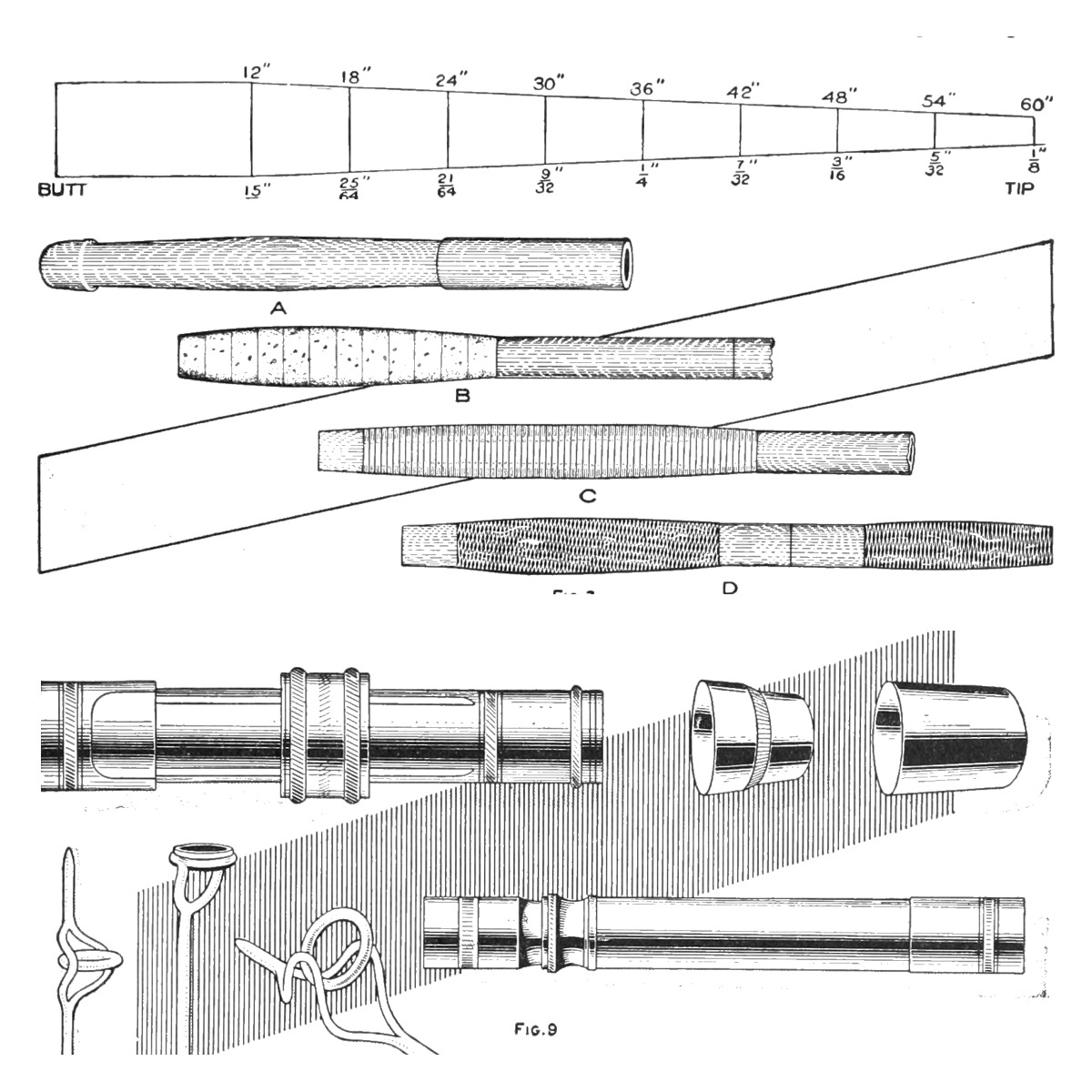
Fig. 5: the taper, station by station

Jupyter defteri yükleniyor…
2

Read The Boy Mechanic, Book 2

"The short one-piece bait-casting rod with but one ferrule is the easiest rod to make." His materials: 1 dagame or greenheart stick, 5 ft long and 5/8 in square; 1 reel seat with straight hood, 3/4 in; 1 butt cap, 1 in; 1 taper, small end 15/32 in; 1 offset agate top, 3/32 in, and 2 narrow agate guides, 1/2 in, all in German silver; 2 doz. corks, 1-1/4 by 1-1/8 in; two 50 yd spools of silk, red and green, 00 size.
3

Make the gauge and grooved board

On a strip of paper draw the rod full length: a 1/2 in line for the butt, a centre line 60 in long, a 1/8 in line at the tip, and join the ends. From 12 in, mark a crossline every 6 in and write his diameters on them (see the notebook). File nine slots in a thin strip of brass to these diameters as a gauge. Plane a groove, gradually shallower toward one end, in a 5 ft tongue-and-groove pine board about 1 in thick, and nail it to the bench edge, groove up.

Bu adım için malzemeler:

Pirinç LevhaPirinç Levha1 adet
Çam tahtaÇam tahta1 adet
ÇivilerÇiviler1 adet

Gerekli aletler:

Kahverengi ambalaj kâğıdıKahverengi ambalaj kâğıdı
Kurşun kalemKurşun kalem
Eğeler (El Eğesi)Eğeler (El Eğesi)
Tezgah MengenesiTezgah Mengenesi
KumpasKumpas
El rendesiEl rendesi
ÇekiçÇekiç
Şerit MetreŞerit Metre
4

Plane the stick square and tapered

Plane along each side and from both ends of a 5/8 in square dagame strip to find the grain. Drill two holes about 1/4 in from the butt end and hook them over a brad in the bench corner, so you plane with the grain. Plane it straight and true to 1/2 in square, evenly from all sides, ignoring kinks. Knife-mark the hand grasp 12 in from the butt (11 in for a single grasp). Then plane an even taper from butt to tip, checking with caliper and gauge at every 6 in mark and planing the thick spots lightly. Bend the tip on the floor: if it stays bent, the wood needs a few weeks' seasoning in a warm place.

Bu adım için malzemeler:

Dagame ağacıDagame ağacı1 adet
ÇivilerÇiviler1 adet

Gerekli aletler:

El rendesiEl rendesi

Blok rendeBlok rende
Bileği TaşıBileği Taşı
El matkabıEl matkabı
KumpasKumpas
Maket BıçağıMaket Bıçağı
ÇekiçÇekiç
5

Round the rod

Lay the rod in the grooved board, a corner up, and take each corner off with a finely set small plane to make it eight-sided, calipering every 6 in mark and keeping the eight sides even, until it is almost round and tapers evenly from the grasp mark to the tip. File grooves across the edge of a cabinetmaker's steel scraper with a round file, sharpen them, and scrape the rod perfectly round; sandpaper it smooth. Tie on the tip and guides and string the reel on to try a few casts, then smooth it with No. 0 sandpaper.

Bu adım için malzemeler:

Zımpara KağıdıZımpara Kağıdı1 adet

Gerekli aletler:

Blok rendeBlok rende

Çelik raspaÇelik raspa
Eğeler (El Eğesi)Eğeler (El Eğesi)
KumpasKumpas
6

Build the lower grasp and reel-seat sleeve

Cut a hole in the corks with a sharpened tube turned like a wad cutter. Cut the butt off square about 1 in from the end, to remove the holes. Glue on a cork with hot glue, then cork after cork, about 10, for a grasp a trifle over 5 in long. For the reel-seat sleeve, bore a 15/32 in hole through white pine about 3/4 in thick and 5 in long, plane the outside to slip inside the reel seat, taper one end to match it, and make it about 1/4 in shorter than the reel seat. Glue it down on top of the last cork and leave the glue a day or two.

Bu adım için malzemeler:

Mantar halkalarMantar halkalar10 adet
Hayvansal tutkalHayvansal tutkal1 adet
Çam tahtaÇam tahta1 adet

Gerekli aletler:

Pirinç boruPirinç boru
Eğeler (El Eğesi)Eğeler (El Eğesi)
El TesteresiEl Testeresi
El matkabıEl matkabı
Blok rendeBlok rende
7

Fit the butt cap and reel seat

Trim the grasp to about 1-1/16 in diameter (1-1/4 in corks need little trimming), leaving the top cork as a shoulder, and fit the lower corks to the butt cap's taper. Heat the cap moderately, rub melted ferrule cement inside and force it on; when hard, drive a small brass pin or brad through and file it flush. Cut the 4-1/2 in reel seat down to 3-7/8 in and fit it with the hood at the lower end, worked into the cork for a tight joint. Cement the sleeve, push the reel seat home and drive a small pin through the hood into the wood a short way only, not through the rod.

Bu adım için malzemeler:

Kamış dip kapağıKamış dip kapağı1 adet
Makine yuvasıMakine yuvası1 adet
Yüksük yapıştırıcısıYüksük yapıştırıcısı1 adet

Gerekli aletler:

Maket BıçağıMaket Bıçağı
Eğeler (El Eğesi)Eğeler (El Eğesi)
Propan PürmüzPropan Pürmüz
ÇekiçÇekiç
8

Build the upper grasp and finish the wood

Cement corks above the reel seat, the first pressed against the seat and turned so the metal enters it, then shape them into a smooth swelled grasp and cement on the winding check. Sand the rod, wet it to raise the grain, and sand again with old paper; for a finer polish rub with pumice and oil and an oiled rag. File the tip to fit the agate top, smear on melted ferrule cement and push the top home. Rub the wood over with a cloth wet with varnish to fill the pores, and wipe off the surplus.

Bu adım için malzemeler:

Mantar halkalarMantar halkalar6 adet
Hayvansal tutkalHayvansal tutkal1 adet
Tutamak bitiş halkasıTutamak bitiş halkası1 adet
Kamış uç halkasıKamış uç halkası1 adet
Yüksük yapıştırıcısıYüksük yapıştırıcısı1 adet
Zımpara KağıdıZımpara Kağıdı1 adet
Araba verniğiAraba verniği1 adet

Gerekli aletler:

Maket BıçağıMaket Bıçağı
Eğeler (El Eğesi)Eğeler (El Eğesi)
Propan PürmüzPropan Pürmüz
9

Whip on the guides

Place the first guide 19-1/2 in from the metal taper above the upper grasp and the second 15-1/2 in further on; round the sharp edges of their bases with a fine file and hold them with a few turns of common thread. Whip with 00 silk using the invisible knot: tuck the end under the first coil, wind tightly by turning the rod, lay a waxed loop of silk about 4 in long under the last turns, wind about 1/8 in beyond the pointed flange, cut the silk and pull its end back under with the loop. About a dozen turns make a winding; edgings of three or four turns go on after, in red with green or yellow.

Bu adım için malzemeler:

Kamış halkasıKamış halkası2 adet
Kamış sarma ipeğiKamış sarma ipeği1 adet
Keten iplikKeten iplik1 adet
BalmumuBalmumu1 adet

Gerekli aletler:

Eğeler (El Eğesi)Eğeler (El Eğesi)
Maket BıçağıMaket Bıçağı
10

Shellac and varnish

Clip any fuzzy ends and give the silk two light coats of white shellac dissolved in grain alcohol, warmed and laid on with a small camel's-hair brush; let it dry a couple of days. Warm the coach varnish in a pot of hot water for five minutes and brush it on evenly with a brush about 1/2 in wide, in a warm place (about 75 deg F). Hang the rod by the tip in a dust-free room; allow three days between coats; two coats protect it, three give complete protection.

Bu adım için malzemeler:

Gomalak vernikGomalak vernik1 adet
Araba verniğiAraba verniği3 adet

Gerekli aletler:

Geniş boya fırçasıGeniş boya fırçası
11

Troubleshooting

Casting rod troubleshooting.

Flow

Loading...
12

History and honest limits

From "Fishing-Rod Making and Angling, Part I -- A One-Piece Casting Rod" by Stillman Taylor, in **The Boy Mechanic, Book 2**, Popular Mechanics, 1915 (Project Gutenberg 44585; checked on the archive.org scan boymechanicbook200chic2, pp. 59-66). His text says about 10 corks for the lower grasp; his list allows 2 dozen for both grasps. The block plane, vernier caliper and other modern tool names, and the metric figures, are ours; his tools were "a saw, plane, jackknife, file, and sandpaper" plus those in his tools section.

Malzemeler

18

Gerekli Aletler

17

İlgili Blueprint'ler

Bu blueprint'ler bilgi paylaşır — teknikler, malzemeler veya ilkeler
CC0 Kamu Malı

Bu plan CC0 lisansıyla yayınlanmıştır. İzin almadan kopyalayabilir, değiştirebilir, dağıtabilir ve herhangi bir amaçla kullanabilirsiniz.

Planı üzerinden ürün satın alarak Maker'ı destekleyin, böylece Maker Komisyonu Satıcılar tarafından belirlenen komisyonu kazanırlar veya bu Planın yeni bir versiyonunu oluşturun ve gelir paylaşımı için kendi Planınıza bağlantı olarak ekleyin.

Tartışma

(0)

Giriş yapın tartışmaya katılmak için

Yorumlar yükleniyor...