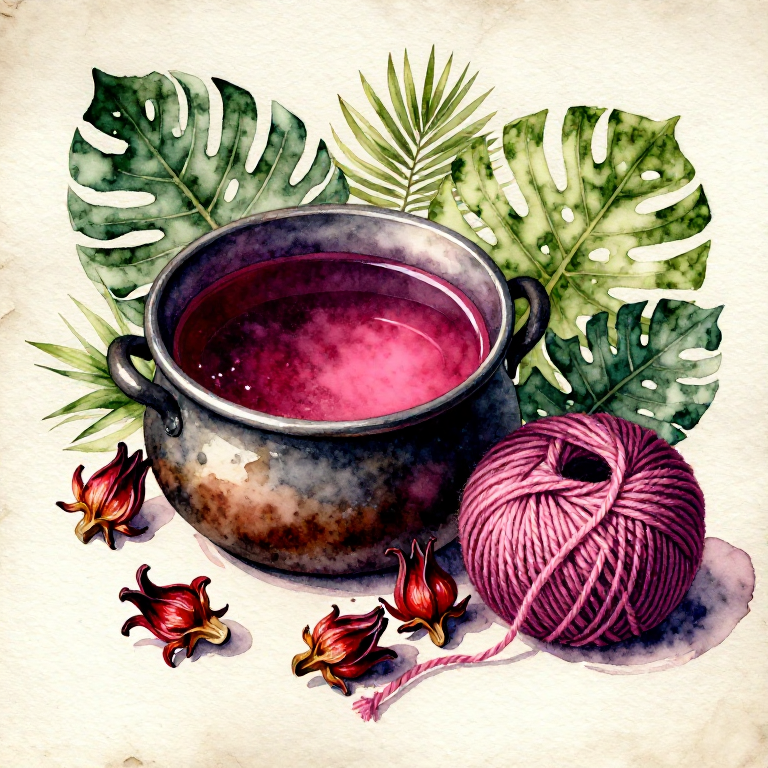


Dyeing Pink-Mauve with Hibiscus — The Tropical Flower Dye of Ancient Egypt
Hibiscus (Hibiscus sabdariffa, commonly known as roselle) is one of the oldest dye plants of the tropical world. Native to West Africa, it was cultivated in ancient Egypt and spread across the tropics via Arab and Indian Ocean trade. The deep red calyces — the fleshy cups surrounding the seed pods, also used for the popular hibiscus tea — contain anthocyanin pigments, primarily delphinidin and cyanidin, that produce pink to mauve shades on alum-mordanted wool.
In West African textile traditions, hibiscus has been used for centuries to dye cotton and bast fibres in shades of pink and purple. The Yoruba of Nigeria and the Wolof of Senegal incorporated hibiscus-dyed threads into woven cloth. In the Caribbean and Central America, where roselle was introduced by enslaved West Africans, the plant continued to serve as both a beverage and dye source.
For the natural dyer, dried hibiscus calyces (sold as hibiscus tea or 'flor de Jamaica' in Latin American groceries) are one of the most accessible tropical dye materials worldwide. The dyeing process is straightforward and the colour — a soft, warm pink to dusty mauve — is gentle and appealing. Like most anthocyanin dyes, the lightfastness is moderate rather than excellent, but the fresh colour is beautiful and the raw material is inexpensive and widely available.
Talimatlar
Weigh the dried hibiscus calyces
Weigh the dried hibiscus calyces
Use 100-200% WOF of dried hibiscus calyces. For 100 g of wool, weigh out 100-200 g of dried calyces. These are sold as hibiscus tea, 'flor de Jamaica', or 'karkade' in grocery stores and tea shops. The calyces should be a deep, vivid red-purple — pale or brownish calyces are old and give weak colour. Whole calyces give a cleaner dye bath than pre-ground tea.
Bu adım için malzemeler:
 Hibiskus çanak yaprakları (kuru)150 g
Gerekli aletler:
 Dijital Mutfak Terazisi
Soak the calyces in warm water for 2-3 hours
Soak the calyces in warm water for 2-3 hours
Place the dried hibiscus calyces in a dye pot with 4 litres of warm water and soak for 2-3 hours. The water will turn a vivid crimson-red within minutes as the anthocyanins dissolve rapidly from the thin, papery calyces. Hibiscus releases dye much faster than bark or root sources. By the end of soaking, the liquid should be a deep, clear ruby-red.
Gerekli aletler:
 Yüksek Tencere
Warm gently to 70°C for 20 minutes
Warm gently to 70°C for 20 minutes
Bring the pot to 70°C and hold for 20 minutes. Do not exceed 75°C — anthocyanins degrade at high temperatures, shifting the colour from pink toward dull brown. Hibiscus extracts so readily that a short, gentle simmer is sufficient. Stir occasionally. The liquid will remain a vivid red. The calyces will have paled to a dull pinkish-brown as their pigment transfers to the water.
Gerekli aletler:
 Mutfak Termometresi
 Ahşap Karıştırma Kaşığı
Strain out the calyces
Strain out the calyces
Strain the dye liquor through a fine mesh strainer into a clean pot. Press the spent calyces gently to extract remaining liquid. The calyces become soft and slimy during soaking — strain thoroughly to avoid fragments sticking to the wool. The strained liquor should be a clear, vivid red.
Gerekli aletler:
 İnce Süzgeç
Dye alum-mordanted wool at 65-70°C for 45 minutes
Dye alum-mordanted wool at 65-70°C for 45 minutes
Pre-wet the alum-mordanted wool in lukewarm water for 15 minutes, squeeze gently, and lower it into the hibiscus dye bath at room temperature. Slowly raise to 65-70°C over 15 minutes, then hold for 45 minutes. Turn gently every 10 minutes. The wool will develop a soft pink to dusty mauve — the red of the dye bath translates to a gentler, more muted pink on the fibre. The alum mordant produces the clearest pink tones and improves washfastness.
Bu adım için malzemeler:
 Yün İplik Çilesi100 g
 Şap (Potasyum Şapı)10 g
Cool overnight, rinse, and dry
Cool overnight, rinse, and dry
Turn off the heat and let the wool cool in the dye bath overnight. Remove, squeeze gently, and rinse in lukewarm water until the runoff is mostly clear. The final colour is a soft pink to dusty mauve — warm and gentle, with the same family of tones as the hibiscus tea the calyces are more commonly used for. Lightfastness is moderate — the pink will soften with sunlight exposure. Washfastness is fair with alum mordanting. Dry in shade.
Malzemeler
3- Yer Tutucu
- 100 gYer Tutucu
- Yer Tutucu
Gerekli Aletler
5- Yer Tutucu
- Yer Tutucu
- Yer Tutucu
- Yer Tutucu
- Yer Tutucu
Bağlı Plan Malzemeleri
İlgili Blueprint'ler
Bu blueprint'ler bilgi paylaşır — teknikler, malzemeler veya ilkeler
CC0 Kamu Malı
Bu plan CC0 lisansıyla yayınlanmıştır. İzin almadan kopyalayabilir, değiştirebilir, dağıtabilir ve herhangi bir amaçla kullanabilirsiniz.
Planı üzerinden ürün satın alarak Maker'ı destekleyin, böylece Maker Komisyonu Satıcılar tarafından belirlenen komisyonu kazanırlar veya bu Planın yeni bir versiyonunu oluşturun ve gelir paylaşımı için kendi Planınıza bağlantı olarak ekleyin.