
Extracting Gallium from Bauxite Residue — The Liquid Metal That Melts in Your Hand
Gallium is element 31 — a soft, silvery metal with one of the most remarkable melting points in the periodic table: 29.76 °C, just below human body temperature. Hold a piece of solid gallium in your hand and it slowly melts into a brilliant, mirror-like liquid. Yet gallium does not boil until 2204 °C — giving it the widest liquid range of any metal (2174 °C), making it invaluable for high-temperature thermometers and as a liquid metal coolant.
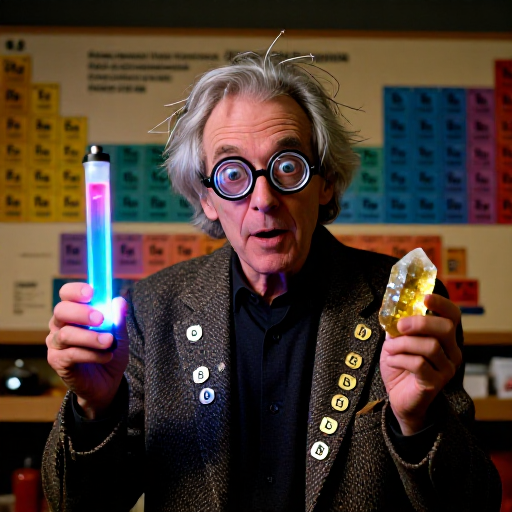
Gallium was predicted by Mendeleev in 1871 as eka-aluminum — the missing element below aluminum in his periodic table. He predicted its atomic weight (68, actual 69.72), density (5.9, actual 5.91), and melting point ('low') with remarkable accuracy. Paul-Émile Lecoq de Boisbaudran discovered it spectroscopically in sphalerite (zinc ore) in 1875 and confirmed Mendeleev's predictions, providing the first dramatic validation of the periodic law.
In nature, gallium does not form its own minerals. Instead, it substitutes for aluminum in bauxite and for zinc in sphalerite, at concentrations of 30–80 ppm. Virtually all commercial gallium is extracted from the Bayer process liquor during aluminum production. This blueprint covers the laboratory extraction of gallium from Bayer process residue or gallium-enriched solutions, demonstrating the mercury-cathode electrolysis and amalgam displacement methods historically used to isolate this extraordinary metal.
HAZARD: Gallium metal itself is non-toxic, but the extraction process involves concentrated NaOH solutions (severe burns), electrolysis (hydrogen gas evolution), and handling of hot liquids. Liquid gallium aggressively wets and embrittles aluminum — keep it away from all aluminum equipment. Wear safety goggles and chemical-resistant gloves.
Talimatlar
Understand gallium's chemistry and Mendeleev's prediction
Understand gallium's chemistry and Mendeleev's prediction
Gallium (Ga, atomic number 31, atomic mass 69.72) sits in Group 13, directly below aluminum. Like aluminum, it forms a stable +3 oxidation state and is amphoteric — dissolving in both acids and strong bases. In acid: Ga + 3HCl → GaCl₃ + 1.5H₂. In base: Ga + 3NaOH + 3H₂O → Na₃[Ga(OH)₆] + 1.5H₂. This amphoteric behavior is the key to its extraction from bauxite: in the Bayer process, aluminum and gallium both dissolve in hot NaOH, while iron and other impurities do not.
Gallium's low melting point (29.76 °C) arises from its unusual crystal structure: orthorhombic, with each atom bonded to one near neighbor at 2.44 Å and six more distant neighbors at 2.70–2.79 Å. This pseudo-molecular structure (Ga₂ dimers) results in weak interatomic bonding and a low melting point. Today, gallium's primary use is in compound semiconductors — gallium arsenide (GaAs) and gallium nitride (GaN) power LEDs, laser diodes, solar cells, and 5G amplifiers. These III-V semiconductors have higher electron mobility than silicon, making them essential for high-speed and optoelectronic applications.
Obtain gallium-bearing source material
Obtain gallium-bearing source material
Commercial gallium extraction begins with the Bayer process liquor — the concentrated sodium aluminate solution (NaAlO₂) produced by digesting bauxite in hot NaOH. Gallium, present at 50–100 ppm in bauxite, dissolves along with aluminum and concentrates in the liquor during the recirculation cycle. If you have access to Bayer process facilities or can obtain a sample of spent Bayer liquor, this is the ideal starting material.
For laboratory-scale work without industrial access, dissolve 100 grams of aluminum hydroxide (Al(OH)₃, available as an antacid) in 200 mL of 30% NaOH solution at 80 °C to simulate Bayer liquor. To this, add 0.5–1.0 grams of gallium metal (available from element collectors or chemical suppliers — gallium metal is non-toxic and legally available). This creates a known gallium-aluminate solution for practicing the extraction and electrolysis steps, with a recoverable amount of gallium.
Bu adım için malzemeler:
 Sodyum Hidroksit — Laboratuvar Saflığı100 g
 Damıtılmış Su200 ml
Gerekli aletler:
 Isıya Dayanıklı Cam Beher
 Borosilikat Cam Çubuk
 Kimyasal Sıçrama Gözlüğü
 Kimyasala Dayanıklı Eldiven
Neutralize to precipitate aluminum and concentrate gallium
Neutralize to precipitate aluminum and concentrate gallium
The key to separating gallium from aluminum in alkaline solution exploits a subtle difference in their hydroxide chemistry. When the strongly alkaline aluminate-gallate solution is carefully neutralized with CO₂ gas or dilute HCl, aluminum precipitates first as Al(OH)₃ (gibbsite) at pH 9–10, while gallium remains in solution as gallate (Ga(OH)₄⁻) down to about pH 7. This difference arises because gallium's +3 ion is slightly smaller and more acidic than aluminum's, making its hydroxo complex more stable.
Bubble CO₂ through the hot sodium aluminate-gallate solution, or slowly add dilute HCl (10%), while monitoring pH. Between pH 7 and 9, most of the aluminum precipitates while gallium stays dissolved. Filter off the bulky white Al(OH)₃ precipitate. The filtrate is now a gallium-enriched solution with a much higher Ga:Al ratio than the starting material. In industrial practice, this concentration step is repeated through multiple cycles of the Bayer process, building up gallium in the circulating liquor until electrolytic extraction becomes economical.
Bu adım için malzemeler:
 Hidroklorik asit, %10 seyreltik100 ml
Gerekli aletler:
Borosilikat Cam Çubuk Turnusol kâğıdı
 Süzgeç Kâğıdı
 Erlenmeyer
Re-dissolve the gallium concentrate in NaOH
Re-dissolve the gallium concentrate in NaOH
If the gallium has partially precipitated during the neutralization step, re-dissolve the filtered residue in a small volume of concentrated NaOH (30–40%) to create a clean, concentrated sodium gallate solution. Add NaOH pellets until the solution is strongly alkaline (pH >13) and all precipitate has dissolved. Heat to 60 °C to ensure complete dissolution.
The goal is a clear, colorless solution with the maximum concentration of gallium. In the industrial Rhône-Poulenc process, the gallium-enriched Bayer liquor is treated with lime to precipitate a gallium-calcium-aluminate cake, which is then re-leached in NaOH to produce the electrolysis feed. For our laboratory scale, the filtered alkaline gallate solution from step 3 is already suitable for direct electrolysis.
Bu adım için malzemeler:
Sodyum Hidroksit — Laboratuvar Saflığı50 gGerekli aletler:
 Borosilikat Beher
 Isıtıcı TablaBorosilikat Cam Çubuk
Electrolyze the gallate solution to deposit gallium metal
Electrolyze the gallate solution to deposit gallium metal
Gallium is deposited from alkaline solution by electrolysis. The cathode reaction is: Ga(OH)₄⁻ + 3e⁻ → Ga + 4OH⁻. The anode reaction evolves oxygen: 4OH⁻ → O₂ + 2H₂O + 4e⁻. Use a stainless steel cathode (a strip of stainless steel immersed in the solution) and a platinum, graphite, or stainless steel anode. Apply 3–5 volts DC from a laboratory power supply.
At 30–50 °C and current density of approximately 50–200 mA/cm², liquid gallium deposits on the cathode as silvery droplets. Because gallium's melting point is 29.76 °C and the electrolysis runs above this temperature, the deposited gallium is liquid and drips to the bottom of the cell. After several hours of electrolysis, collect the liquid gallium droplets from the bottom of the vessel using a plastic pipette. The collected gallium appears as brilliant, mirror-like metallic liquid — mercury-like in appearance but non-toxic.
Gerekli aletler:
Borosilikat BeherIsıtıcı Tabla Cam pipet
 Kapalı Koruyucu Gözlük
Purify the crude gallium by acid washing
Purify the crude gallium by acid washing
The electrodeposited gallium may contain traces of aluminum, zinc, or iron. To purify, wash the collected liquid gallium droplets with dilute HCl (5–10%): the impurity metals dissolve while gallium itself dissolves very slowly in dilute HCl at room temperature (its oxide film provides some protection). Swirl the gallium in the acid for 2–3 minutes, then decant the acid and wash with distilled water.
For higher purity, repeat the acid wash with fresh dilute HCl. The purified gallium should be a bright, highly reflective liquid at temperatures above 30 °C, or a solid with a slightly bluish-grey lustre below 30 °C. Gallium wets glass, so use a plastic or PTFE-lined container for storage. Never store gallium in aluminum containers — liquid gallium penetrates aluminum's grain boundaries and causes catastrophic embrittlement (the aluminum crumbles to powder). This property, called liquid metal embrittlement, makes gallium destructive to aluminum alloys.
Bu adım için malzemeler:
Hidroklorik asit, %10 seyreltik50 mlDamıtılmış Su50 mlGerekli aletler:
Kimyasala Dayanıklı EldivenDemonstrate gallium's melting in the hand
Demonstrate gallium's melting in the hand
The iconic demonstration of gallium: hold a solid piece in your palm. Gallium's melting point of 29.76 °C is just below typical skin surface temperature (33–36 °C). Within 1–2 minutes, the solid begins to soften and melt, transforming from a brittle, slightly blue-grey solid into a brilliant, mirror-like liquid pool in your hand. The metal is non-toxic and safe to handle — though it will temporarily stain skin grey (the stain washes off with soap).
Observe the remarkable supercooling behavior: liquid gallium can remain liquid well below its freezing point if undisturbed. A sample may stay liquid at 20 °C or even 15 °C for hours. Touch the surface with a seed crystal of solid gallium or a sharp point, and crystallization nucleates instantly — the entire pool solidifies within seconds in a visually dramatic front of crystallization. This extreme supercooling (up to 15 °C below the melting point) occurs because gallium's crystal structure is complex and nucleation is kinetically unfavored.
Make a gallium spoon (the disappearing spoon trick)
Make a gallium spoon (the disappearing spoon trick)
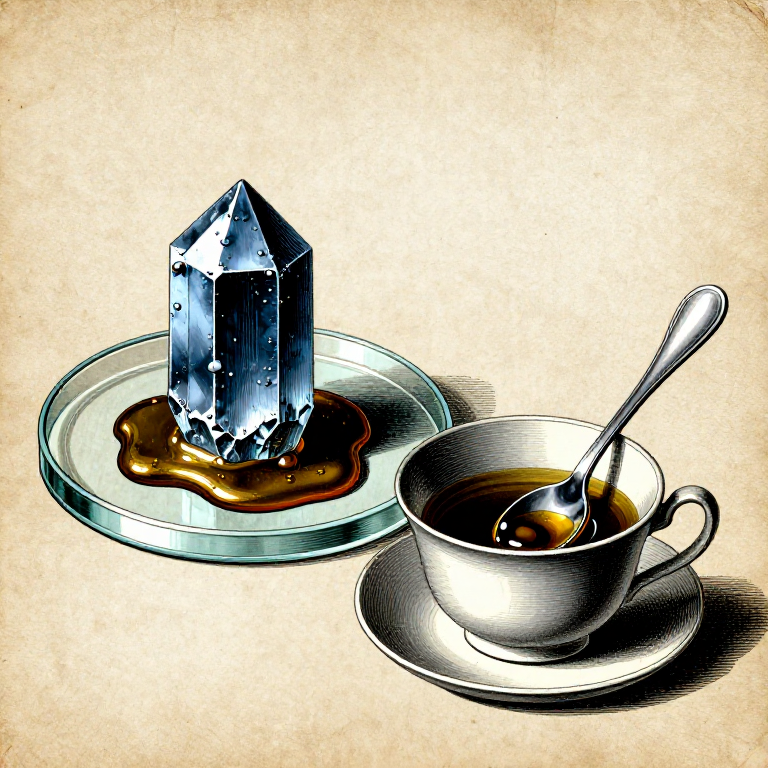
Cast a small spoon from gallium — the classic 'disappearing spoon' demonstration. Create a simple mould by pressing a real teaspoon into modelling clay or plaster to form an impression. Melt gallium by warming to 35–40 °C (a cup of warm water is sufficient), pour the liquid metal into the mould, and allow to cool and solidify at room temperature.
The resulting gallium spoon looks like a normal metal spoon — solid, silvery, and functional. Now stir it into a cup of hot tea or warm water (above 30 °C). The spoon slowly melts and collapses into a puddle of liquid metal at the bottom of the cup, apparently 'dissolving' into the drink. This demonstration, popularized by Sam Kean's book The Disappearing Spoon, beautifully illustrates how a single physical property — melting point — can create seemingly impossible behavior. The tea is safe to drink afterward (gallium is non-toxic), though the metallic residue on the cup should be cleaned.
Demonstrate gallium's aluminum-destroying property
Demonstrate gallium's aluminum-destroying property
Liquid metal embrittlement is one of gallium's most dramatic properties. Apply a small drop of liquid gallium to the surface of a piece of aluminum foil or an aluminum can. Rub the gallium into the surface to break through the protective aluminum oxide layer. Wait 30–60 minutes at room temperature.
The gallium penetrates along the grain boundaries of the aluminum, replacing the strong metallic bonds with weak gallium-aluminum interfaces. The aluminum loses all structural integrity — the once-strong metal crumbles like wet sand when touched. An aluminum can treated with gallium can be torn apart with bare fingers. Aluminum rod snaps like a dry twig. This is not a chemical reaction (no new compounds form) but a physical process: gallium atoms wedge between aluminum grains and prevent them from bonding to each other. This phenomenon is a serious concern in the aerospace industry, where gallium contamination of aluminum airframes would be catastrophic. Record the time to embrittlement and the mechanical behavior of the damaged aluminum.
Gerekli aletler:
Kimyasala Dayanıklı EldivenKapalı Koruyucu GözlükObserve gallium's optical and electrical properties
Observe gallium's optical and electrical properties
Liquid gallium has the second-highest reflectivity of any liquid metal (after mercury), reflecting approximately 70% of visible light. This makes it useful as a non-toxic replacement for mercury in some mirror and telescope applications. Observe the brilliant, mirror-like surface of a pool of liquid gallium — it is far more reflective than any common liquid. The high surface tension (approximately 710 mN/m, nearly 10 times that of water) causes the liquid to form near-perfect spheres when dropped.
Solid gallium is a semiconductor at low temperatures but becomes metallic at room temperature. Its electrical resistivity increases upon melting (unlike most metals, which become more resistive as solids) — this anomalous behavior is another consequence of the unusual pseudo-molecular crystal structure. Note how the crystal expands approximately 3.1% upon freezing (like water ice), meaning solid gallium floats on liquid gallium — one of only a handful of substances that exhibit this property. Never seal gallium in a rigid container near its freezing point, as the expansion upon solidification can crack glass or metal vessels.
Malzemeler
3- Yer Tutucu
- 250 mlYer Tutucu
- Yer Tutucu
Gerekli Aletler
11- Yer Tutucu
- Yer Tutucu
- Yer Tutucu
- Yer Tutucu
- Yer Tutucu
- Yer Tutucu
- Yer Tutucu
- Yer Tutucu
- Yer Tutucu
- Yer Tutucu
- Yer Tutucu
Bağlı Plan Malzemeleri
CC0 Kamu Malı
Bu plan CC0 lisansıyla yayınlanmıştır. İzin almadan kopyalayabilir, değiştirebilir, dağıtabilir ve herhangi bir amaçla kullanabilirsiniz.
Planı üzerinden ürün satın alarak Maker'ı destekleyin, böylece Maker Komisyonu Satıcılar tarafından belirlenen komisyonu kazanırlar veya bu Planın yeni bir versiyonunu oluşturun ve gelir paylaşımı için kendi Planınıza bağlantı olarak ekleyin.