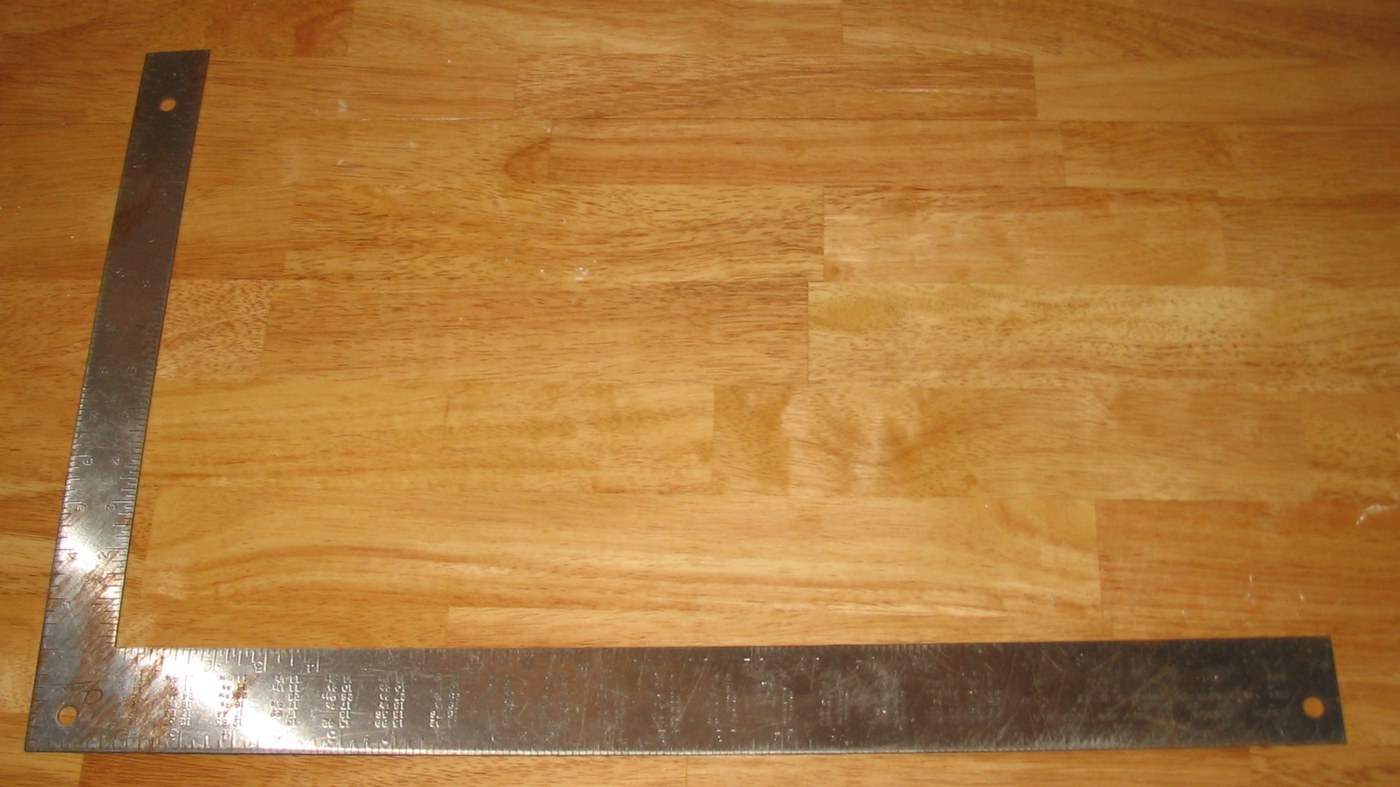


Steel Carpenter's Square
Every other machine-shop tool assumes a right angle already exists. The square is where the right angle comes from — and a square is only as good as the day it was made, because nothing about a bent piece of steel announces that it is bent.
Silas Hawes, a blacksmith of South Shaftsbury, Vermont, was granted a United States patent for a steel carpenter's square on 15 December 1819. The story is that he took two old saw blades in trade from a peddler, welded them into an L, and found he had made something better than the wooden squares every carpenter then used.
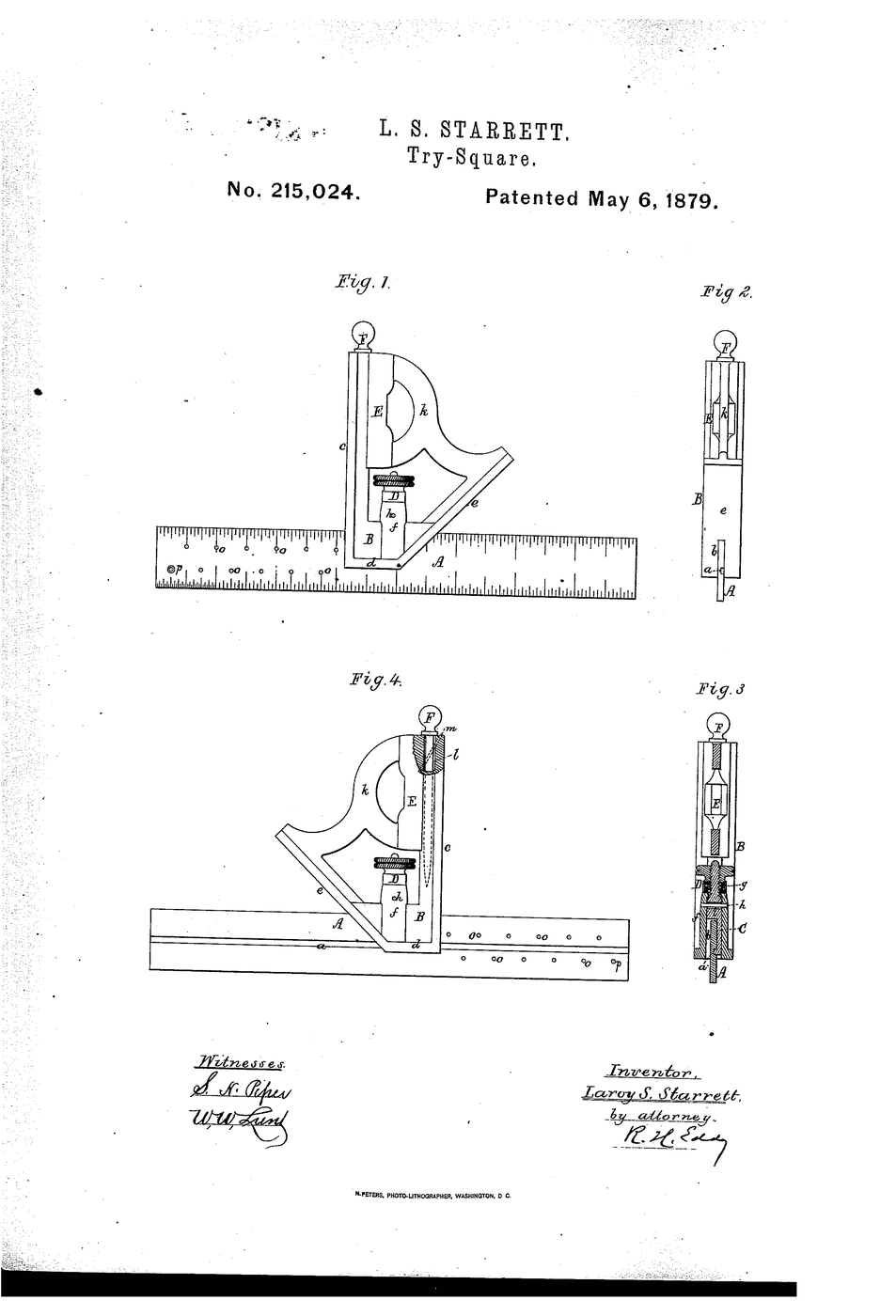
The record is gone and we say so. The Patent Office fire of December 1836 destroyed the original files, and Hawes' claim text and patent number were among the roughly 10,000 documents lost. Fewer than 2,900 were ever restored. So the popular line — “the first American patent for a steel square” — cannot be checked against the document, and this blueprint does not pretend otherwise. What can be checked is the tool: steel holds an angle that wood loses to damp, and a one-piece square has no joint to work loose.
Інструкції
State the problem before you trust the tool
State the problem before you trust the tool
Write down the question this blueprint answers: how do you check a square when the only thing you have to check it against is another square?
Plane one edge of the board straight
Plane one edge of the board straight
Choose the straightest edge of the wooden board. Sand it flat with 220 grit until a steel rule laid along it shows no light underneath.
Матеріали для цього кроку:
 Пласка дерев'яна дошка1 штука
Необхідні інструменти ({count})
 Лінійка
 Наждачний папір
Scribe a line with the square
Scribe a line with the square
Hold the try square against that edge. Scribe a line across the board with the marker.
Матеріали для цього кроку:
Пласка дерев'яна дошка1 штукаНеобхідні інструменти ({count})
 Столярний косинець
 Перманентний маркер
Flip the square and scribe again
Flip the square and scribe again
Turn the square over on the same edge, register it on the same point, and scribe a second line on top of the first.
Матеріали для цього кроку:
Пласка дерев'яна дошка1 штукаНеобхідні інструменти ({count})
Столярний косинецьПерманентний маркерRead the error — it is doubled
Read the error — it is doubled
If the two lines diverge, the square is out. The gap you see is twice the error, because flipping adds the fault to itself. Halve it before you record it.
Матеріали для цього кроку:
 Міліметровий папір1 аркуш
Необхідні інструменти ({count})
ЛінійкаMeasure the divergence in millimetres
Measure the divergence in millimetres
Measure the gap 200 mm from the pivot point. Divide by two, then by 200: that is the error per millimetre of blade.
Матеріали для цього кроку:
Міліметровий папір1 аркушНеобхідні інструменти ({count})
ЛінійкаRepeat the test on a framing square
Repeat the test on a framing square
Run the same flip test on the large framing square. Long blades magnify a small angular fault, so expect a larger gap for the same error.
Матеріали для цього кроку:
Пласка дерев'яна дошка1 штукаНеобхідні інструменти ({count})
 Великий теслярський кутникПерманентний маркер
Compare against a machinist's square
Compare against a machinist's square
Stand the machinist square on the surface plate beside the try square blade. Hold both to the light. The line of light between them is the difference.
Необхідні інструменти ({count})
 Слюсарний кутникСтолярний косинець
 Повірна плита
Measure the gap with a feeler leaf
Measure the gap with a feeler leaf
Slide feeler leaves into that light gap until one just holds. Record the leaf thickness — now the error is a number, not an impression.
Необхідні інструменти ({count})
 Набір щупів
Build a 3-4-5 square from plywood
Build a 3-4-5 square from plywood
Cut three plywood strips at 300, 400 and 500 mm. Any triangle in that ratio is right-angled — Hawes' carpenters knew this centuries before they could buy a steel square.
Матеріали для цього кроку:
 Лист фанери1 аркуш
Необхідні інструменти ({count})
Лінійка Макетний ніж
Glue and check your wooden square
Glue and check your wooden square
Glue the three strips into a triangle. When dry, flip-test it exactly as in steps 3-5.
Матеріали для цього кроку:
Лист фанери1 аркуш Столярний клей20 мл
Необхідні інструменти ({count})
Перманентний маркерLeave the wooden square somewhere damp overnight
Leave the wooden square somewhere damp overnight
Put it in a bathroom or outdoors overnight. Re-run the flip test in the morning and record the change. This is the failure Hawes' steel square removed.
Матеріали для цього кроку:
Лист фанери1 аркушRank your squares by measured error
Rank your squares by measured error
Write the four squares in order of measured error, smallest first. Keep the best one for layout and use the rest for rough work.
Матеріали для цього кроку:
Міліметровий папір1 аркушHistory & Context
History & Context
Silas Hawes (1779-1854), blacksmith, South Shaftsbury, Vermont. United States patent granted 15 December 1819 for a steel carpenter's square.
Why there is no patent number here. On 15 December 1836 — seventeen years to the day after Hawes' grant — fire destroyed the Patent Office building in Washington and with it every original file. About 10,000 patents burned; roughly 2,845 were later reconstructed from inventors' own copies and are now called the X-patents. Hawes' was not among them. His claim text, drawing and number are gone, and honest sources cannot supply what was destroyed. Where batch 35's blueprints could quote a sheet, this one cannot, and it says so rather than inventing a plausible number.
What is documented. Hawes was making squares in quantity in South Shaftsbury in the 1820s; the town became a centre of square-making, and the trade later concentrated in Shaftsbury and then in Connecticut. The saw-blade origin story is traditional and repeated in local histories; treat it as tradition, not as evidence.
The real content of the invention. A one-piece steel square has no joint, so it cannot rack; it does not swell or shrink with humidity as a wooden square does; and because it was rolled and then stamped, every square off the line was the same square. That last property is the one that matters industrially — not accuracy in itself, but repeatable accuracy you can buy. Every layout in the shop starts from it.
The flip test is older than the patent and still the standard. It works because it needs no reference square at all: it compares the tool against its own mirror image. Any error appears doubled, which is also why it can detect faults far below what you could see by eye. Machinists still check squares this way.
Матеріали
4- 1 штукаЗаповнювач
- 1 аркушЗаповнювач
- 1 аркушЗаповнювач
- 20 млЗаповнювач
Матеріали з пов'язаних креслень
За цим кресленням виготовляють

Пов'язані креслення
Ці креслення діляться знаннями — техніки, матеріали або принципи
CC0 Суспільне надбання
Це креслення випущено під ліцензією CC0. Ви можете вільно копіювати, змінювати, поширювати та використовувати цю роботу для будь-яких цілей без запиту дозволу.
Підтримайте мейкера, купуючи продукти через його креслення, де він отримує Комісію мейкера встановлену вендорами, або створіть нову ітерацію цього креслення та включіть його як зв'язок у власне креслення для розподілу доходу.