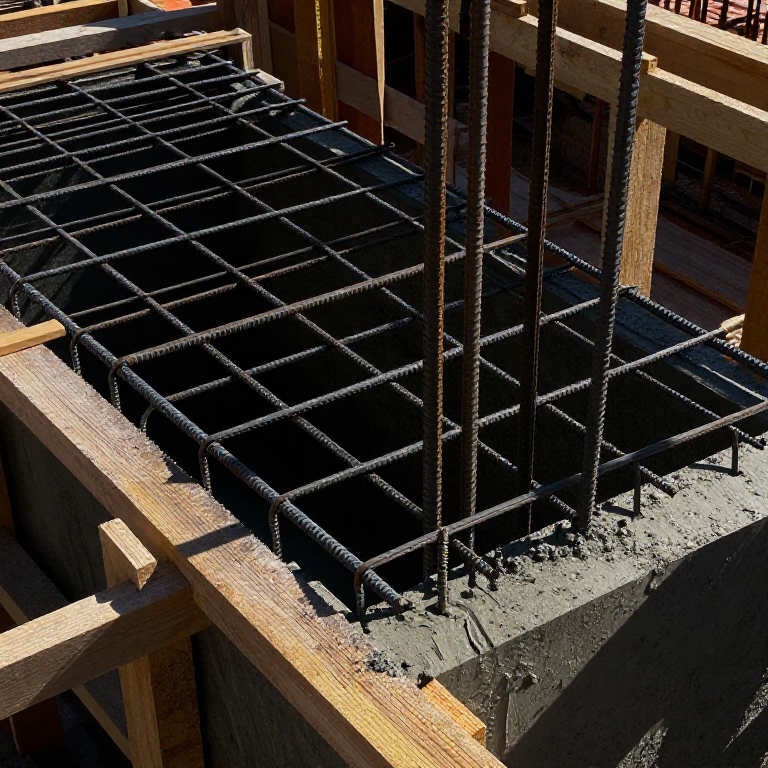


Casting Reinforced Concrete — Marrying Steel and Stone into the Modern Structure
Concrete is wonderful stuff in compression — squeeze it and it holds — but pull on it and it cracks like a biscuit. Steel is the opposite: superb in tension, useless if you try to build a wall of it. In the late 1800s builders like Joseph Monier and François Hennebique realised that embedding steel inside concrete combines the best of both, and reinforced concrete became the material that built the modern world.
The idea works because of three lucky properties. Concrete and steel expand and contract at almost exactly the same rate, so temperature changes do not tear them apart. Wet concrete is strongly alkaline, which coats the steel in a protective film that stops it rusting. And the two grip each other firmly, so a load shared between them is truly shared. Put steel where the structure is stretched and concrete where it is squeezed, and you get a member strong in every direction.
From this came bridges, dams, tunnels, and the skeletons of skyscrapers — shapes impossible in stone or iron alone. The skill is in knowing where the steel must go and in surrounding it completely with sound, well-cured concrete.
Інструкції
Understand the partnership
Understand the partnership
Know where the steel goes
Know where the steel goes
Build the formwork
Build the formwork
Матеріали для цього кроку:
 Дошка пиломатеріалу10 штук
Необхідні інструменти ({count})
 Молоток
Cut and bend the rebar
Cut and bend the rebar
Матеріали для цього кроку:
 Арматурний стрижень № 4 з маловуглецевої сталі15 метрів
Необхідні інструменти ({count})
 Станок для згинання прутка
Place and tie the cage
Place and tie the cage
Матеріали для цього кроку:
 В'язальний дріт1 рулон
Mix the concrete
Mix the concrete
Матеріали для цього кроку:
 Портландцемент50 кг
 Дрібний пісок100 кг
 Гравій200 кг
Необхідні інструменти ({count})
 Бетономішалка
Pour around the steel
Pour around the steel
Матеріали для цього кроку:
 Вода30 літрів
Compact out the air
Compact out the air
Необхідні інструменти ({count})
 Трамбувальний стрижень
Cure it slowly
Cure it slowly
Strip the formwork
Strip the formwork
Необхідні інструменти ({count})
 Цвяходер-лом
Understand why it lasts
Understand why it lasts
See what it built
See what it built
Матеріали
7- 10 штукЗаповнювач
- Заповнювач
- 1 рулонЗаповнювач
- 50 кгЗаповнювач
- 100 кгЗаповнювач
- 200 кгЗаповнювач
- 30 літрівЗаповнювач
Необхідні інструменти
5- Заповнювач
- Заповнювач
- Заповнювач
- Заповнювач
- Заповнювач
Матеріали з пов'язаних креслень



Пов'язані креслення
Ці креслення діляться знаннями — техніки, матеріали або принципи


CC0 Суспільне надбання
Це креслення випущено під ліцензією CC0. Ви можете вільно копіювати, змінювати, поширювати та використовувати цю роботу для будь-яких цілей без запиту дозволу.
Підтримайте мейкера, купуючи продукти через його креслення, де він отримує Комісію мейкера встановлену вендорами, або створіть нову ітерацію цього креслення та включіть його як зв'язок у власне креслення для розподілу доходу.