Collaboration
ART
BEAUTY & WELLNESS
CRAFT
CULTURE & HISTORY
ENTERTAINMENT
ENVIRONMENT
FOOD & DRINKS
REVERSE ENGINEERING
SCIENCES
SPORTS
TECHNOLOGY
WEARABLES
Bellows Rocking-Dasher Churn: A Hand Bellows Blows Air Down a Knee Nozzle Into the Cream and Rocks a Paddle Dasher Beside It
Buttercup

Created by

Buttercup

11. November 2026IE
0
0
0
0
0

Bellows Rocking-Dasher Churn: A Hand Bellows Blows Air Down a Knee Nozzle Into the Cream and Rocks a Paddle Dasher Beside It

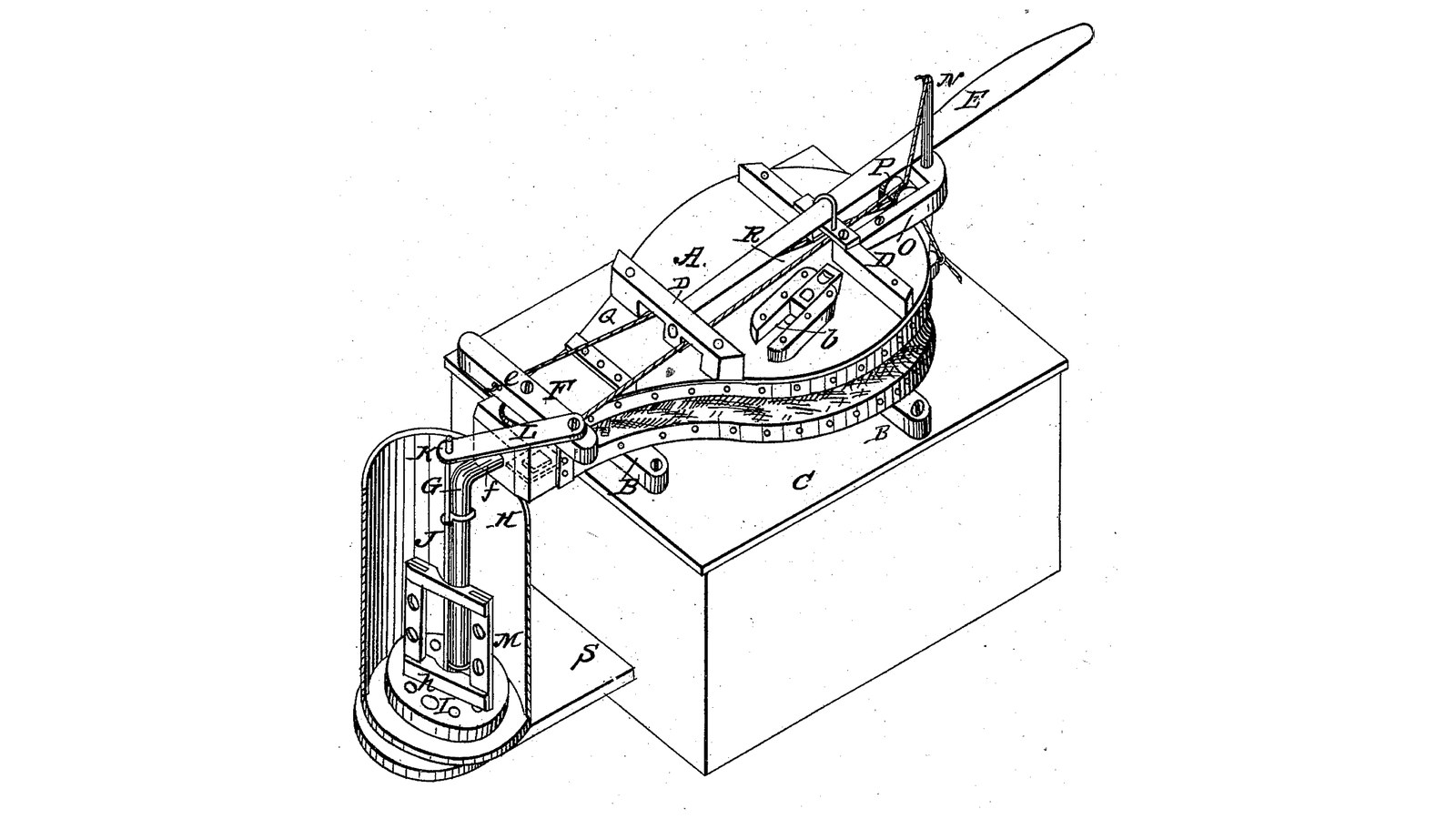
Charles T. Anderson of Hyattstown, Maryland, received US 32,553, dated 18 June 1861, for a churn worked by an ordinary bellows lying on a box beside the cream. Pumping its handle drives air down a knee-shaped nozzle to holes near the bottom of the pail, under a disk on legs; at the same time two cords over a roller on the bellows rock a lever at its nose, which through a link and crank swings a paddle dasher back and forth beside the nozzle. An adjustable hole on the bellows' top sets how much air goes in; closed, the dasher churns alone. The patent gives no sizes; every size here is ours.
Advanced
About 3 days

Instructions

1

Air for the cream

Loading Jupyter Notebook...
2

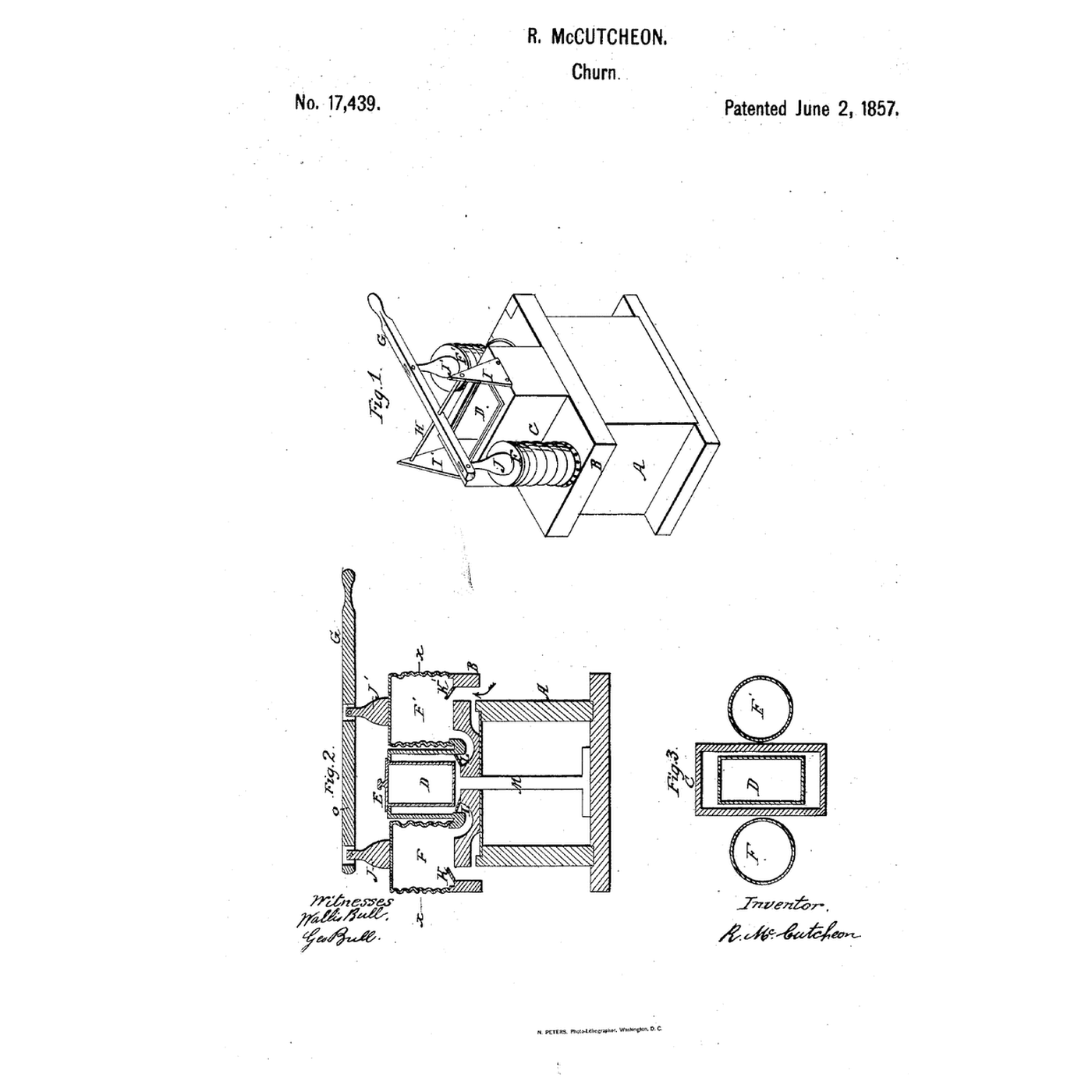
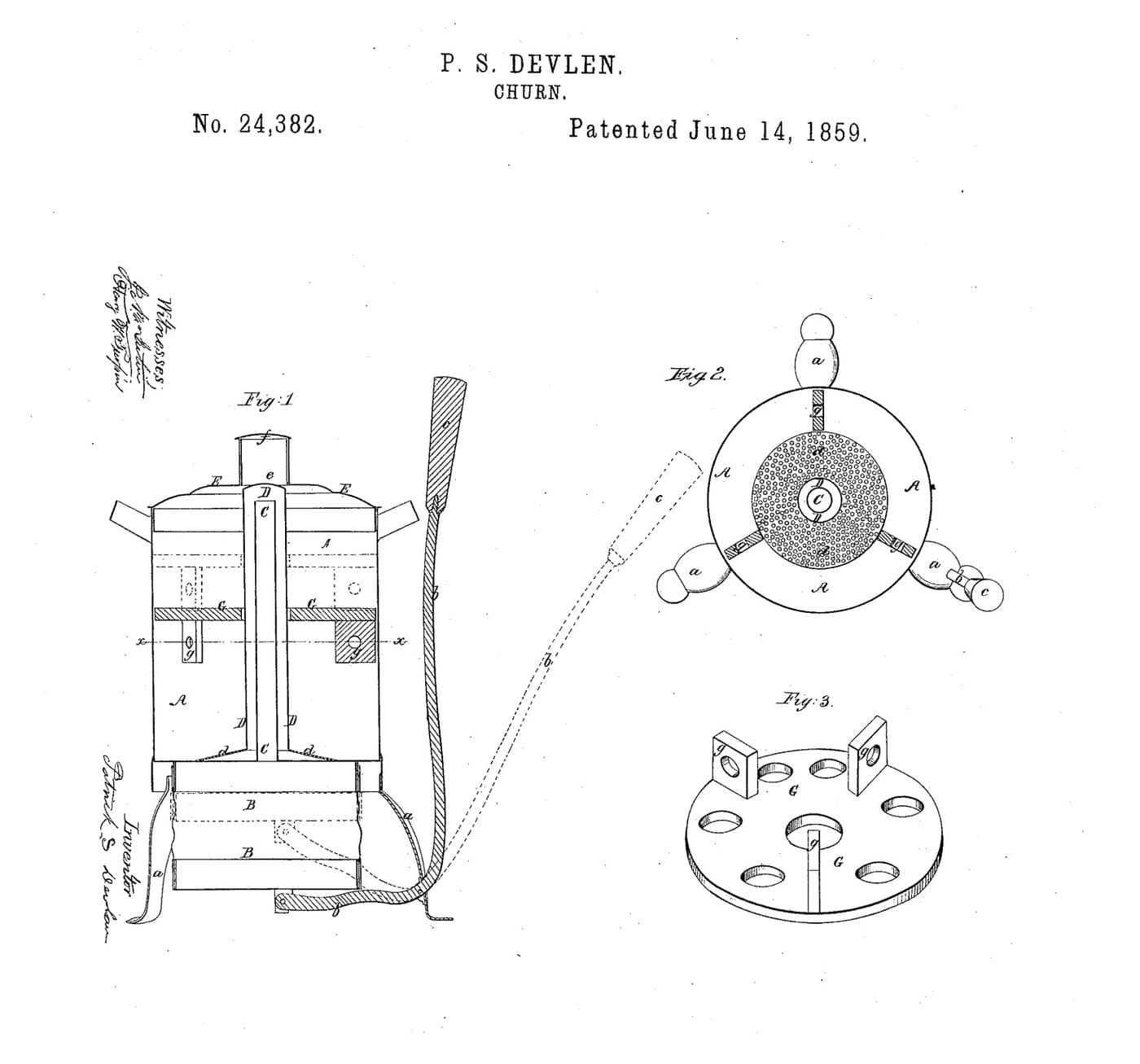
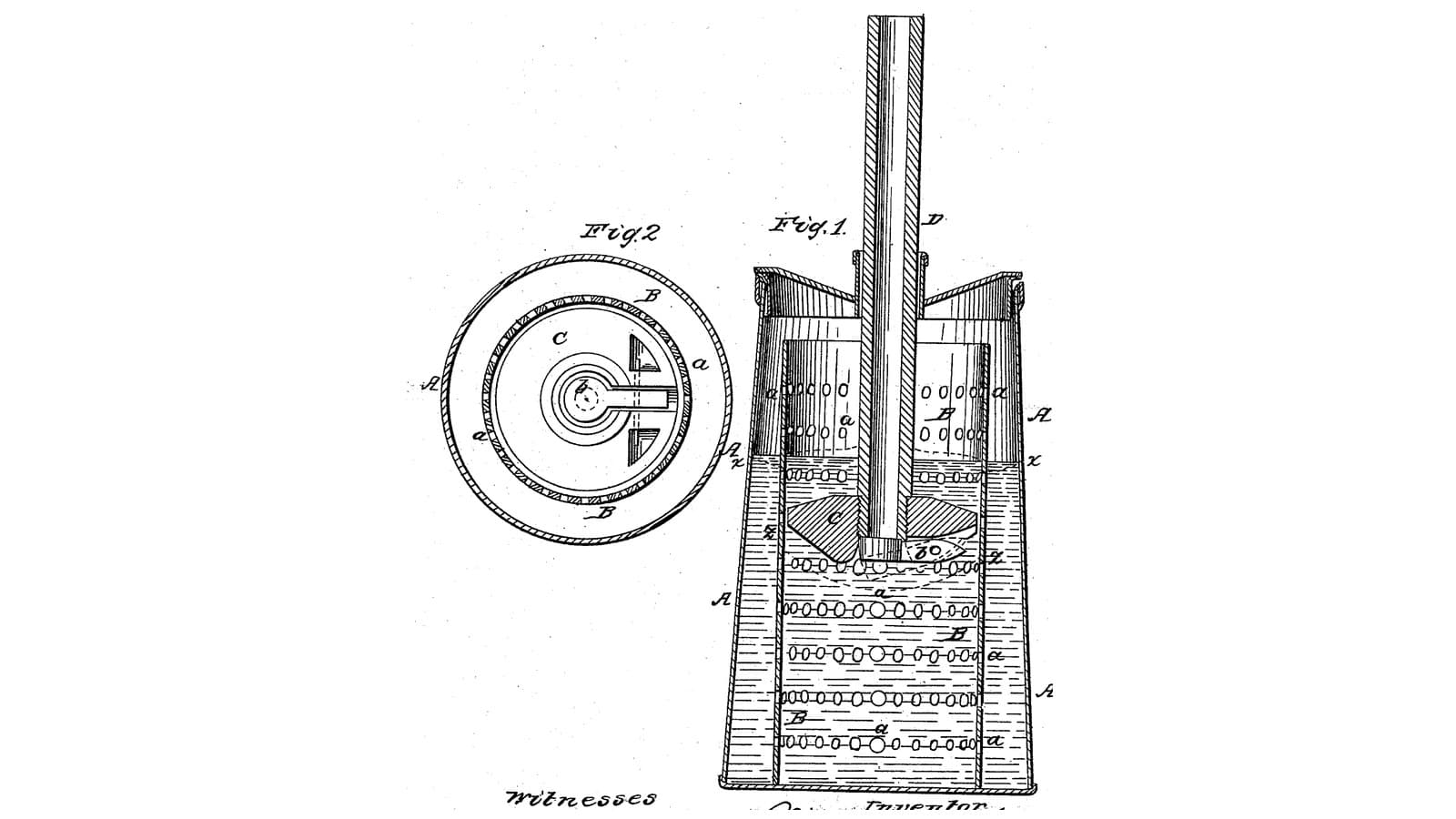
A bellows blowing air through the cream, years before

The tempered-air churn uses the bellows alone. Anderson's bellows also rocks a dasher by cords and a lever.
3

Read US 32,553

"The vessel being filled with cream, an up and down or vibratory movement is given to the upper portion of the bellows by means of the handle and a current of air thereby forced through the nozzle of the bellows into the cream through the apertures of the lower end of the nozzle. At the same time a vibrating motion is imparted to the dasher."
4

Box C, platform S, bars B and bellows A

Make a hardwood box C 520 x 360 mm and 450 high from 20 mm boards, and screw a platform S 380 x 340 x 30 mm to the ground at one end of it. Screw two hardwood bars B 40 x 20 mm across its top, 280 mm apart. Lay a hand bellows about 460 mm long on them, its nozzle toward the platform, and screw its bottom board to the bars. Bore a 30 mm hole in its top board as the aperture b and screw over it a hardwood slide in guides, to open it wide, part way or shut. Bore a 40 mm hole in the bottom board near its nose and glue a leather flap over it inside, hinged at one edge, as the valve that lets air in as the bellows opens. Screw two hardwood cross pieces D 200 x 30 mm on the top board and a hardwood handle E 400 mm long to them, reaching back.

Materials for this step:

Hardwood BoardHardwood Board4 pieces
Wood GlueWood Glue1 piece
Wood ScrewsWood Screws40 pieces
BellowsBellows1 piece
LeatherLeather1 piece

Tools needed:

Table SawTable Saw
JigsawJigsaw
Spade Bit SetSpade Bit Set
Cordless DrillCordless Drill
Drill Bit SetDrill Bit Set
Bar ClampBar Clamp
Screwdriver SetScrewdriver Set
Tape MeasureTape Measure
5

Print the knee elbow

The elbow joining the nozzle's two tubes: two 22.4 mm sockets at right angles round a 17 mm bore. PETG, 0.2 mm layers, 30 % infill, 4 walls.
Design FileSTLCC0 - Free
6

Nozzle G, disk I and the pail H

Cut a 22 mm stainless tube into a short end f 300 mm long and a long end 460 mm long and join them at right angles in the printed elbow with food-safe silicone, as the knee nozzle G; drill six 7 mm holes round the long end 25 mm above its foot. Fit the short end into the bellows' nozzle, sealed with leather. Cut an HDPE disk I 180 mm across, bore it 22.6 mm 80 mm from its centre for the tube, four 24 mm apertures h round its centre, and a socket boss at its centre; screw three hardwood legs g 60 mm long under it. Slide it on the tube so the tube's foot and the legs stand on the floor of a 20-litre food-grade pail H set on the platform. Cover the pail with butter muslin.

Materials for this step:

Stainless Steel TubeStainless Steel Tube1 piece
PETG FilamentPETG Filament1 piece
Silicone SealantSilicone Sealant1 piece
LeatherLeather1 piece
HDPE SheetHDPE Sheet1 piece
Hardwood DowelsHardwood Dowels1 piece
Wood ScrewsWood Screws3 pieces
20-Liter Bucket20-Liter Bucket1 piece
Butter Muslin CheeseclothButter Muslin Cheesecloth1 piece

Tools needed:

FDM 3D PrinterFDM 3D Printer
HacksawHacksaw
Files (Hand File)Files (Hand File)
Cordless DrillCordless Drill
Drill Bit SetDrill Bit Set
Spade Bit SetSpade Bit Set
JigsawJigsaw
CompassCompass
7

Staff J, dasher M, yoke, crank K and link L

Turn a hardwood staff J 20 mm across and 375 mm long, its foot to fit the disk's socket. Screw a hardwood paddle M 120 x 200 x 12 mm across it, its foot 25 mm above the disk. Fix a yoke of mild steel flat bar to the tube 340 mm above the pail's floor, with a ring round the staff's top. Pin a crank K of flat bar, 60 mm throw, on the staff's top, and join it with a flat bar link L to one end of the lever F.

Materials for this step:

Hardwood BoardHardwood Board1 piece
Hardwood DowelsHardwood Dowels1 piece
Wood ScrewsWood Screws4 pieces
Mild Steel Flat BarMild Steel Flat Bar1 piece
Hex Bolt AssortmentHex Bolt Assortment2 pieces
Split PinSplit Pin2 pieces

Tools needed:

Wood LatheWood Lathe
Table SawTable Saw
HacksawHacksaw
Files (Hand File)Files (Hand File)
Bench ViseBench Vise
Cordless DrillCordless Drill
Drill Bit SetDrill Bit Set
Screwdriver SetScrewdriver Set
8

Print the forked bracket O

The forked bracket on the bellows' top board: 160 mm long, a 40 x 34 mm fork to slide on the post and a 30 x 24 slot for the roller P. PETG, 0.2 mm layers, 30 % infill, 4 walls.
Design FileSTLCC0 - Free
9

Lever F, post N, bracket O, roller P and cords Q, R

Cut a hardwood lever F 300 x 30 x 15 mm and pivot it at its middle on an M10 bolt e upright in the bellows' nose block, with a wing nut. Screw a pedestal block to the box's back end and stand a hardwood post N 30 mm square, 380 tall, in it behind the bellows. Screw the bracket O to the top board's back end so its fork slides on the post, and pin a hardwood roller P 18 mm across in its slot. Tie a cord Q from the post's top, under the roller, to one end of the lever, and a cord R from the pedestal, over the roller, to the other end, both just taut with the bellows half open.

Materials for this step:

Hardwood BoardHardwood Board1 piece
Hex Bolt AssortmentHex Bolt Assortment1 piece
Wing NutWing Nut1 piece
Flat WasherFlat Washer2 pieces
PETG FilamentPETG Filament1 piece
Hardwood DowelsHardwood Dowels1 piece
CordCord1 piece
Wood ScrewsWood Screws8 pieces

Tools needed:

FDM 3D PrinterFDM 3D Printer
Table SawTable Saw
Cordless DrillCordless Drill
Drill Bit SetDrill Bit Set
Adjustable SpannerAdjustable Spanner
Screwdriver SetScrewdriver Set
Tape MeasureTape Measure
10

The build in 3D

FreeCAD model of this build, the pail cut open: the box and platform, the bellows with its slide, cross pieces and handle, the knee nozzle down to the holed foot under the disk on its legs, the staff with its paddle and yoke, the lever on its bolt, the link, and the post with the forked bracket, roller and cords.
Design FileBLENDCC0 - Free
11

Churn

Pour about 8 litres of heavy cream at about 15 °C, checked with the thermometer, into the pail and cover it with the muslin. Work the handle up and down steadily, timing it: the bellows blows air out under the cream and the paddle rocks. Open or close the slide on the bellows' top to give more or less air. When the butter comes, unhook the link from the crank, draw the nozzle out of the bellows and lift the pail away; turn the disk on the tube until the staff's foot clears it and lift the dasher out. Take out the butter, pour the buttermilk into a bowl, wash the butter in cold water until it runs clear, salt and weigh it.

Materials for this step:

Heavy CreamHeavy Cream8 l
Coarse Sea SaltCoarse Sea Salt1 piece
WaterWater1 piece

Tools needed:

Leave-In Probe ThermometerLeave-In Probe Thermometer
StopwatchStopwatch
Digital Kitchen ScaleDigital Kitchen Scale
Stainless Steel Mixing Bowl (Large)Stainless Steel Mixing Bowl (Large)
12

Troubleshooting

Bellows churn troubleshooting.

Flow

Loading...
13

History and honest limits

**Charles T. Anderson** of Hyattstown, Montgomery County, Maryland, US 32,553, 18 June 1861, "Churn". He claimed the pivoted reciprocating dasher M with the bellows A and vertical nozzle G, and the nozzle G, detachable dasher M and eccentrically pivoted disk I together. His bellows was "of ordinary construction"; ours is a bought or made hand bellows with the patent's top aperture, valve and nozzle added. His vessel could be a firkin, pail, can or box. The patent gives no sizes; every size here is ours.

Materials

21

Tools Required

19

Design Files

3

CC0 Public Domain

This blueprint is released under CC0. You are free to copy, modify, distribute, and use this work for any purpose, without asking permission.

Support the Maker by purchasing products through their Blueprint where they earn a Maker Commission set by Vendors, or create a new iteration of this Blueprint and include it as a connection in your own Blueprint to share revenue.

Discussion

(0)

Log in to join the discussion

Loading comments...