ART
BEAUTY & WELLNESS
CRAFT
CULTURE & HISTORY
ENTERTAINMENT
ENVIRONMENT
FOOD & DRINKS
REVERSE ENGINEERING
SCIENCES
SPORTS
TECHNOLOGY
WEARABLES
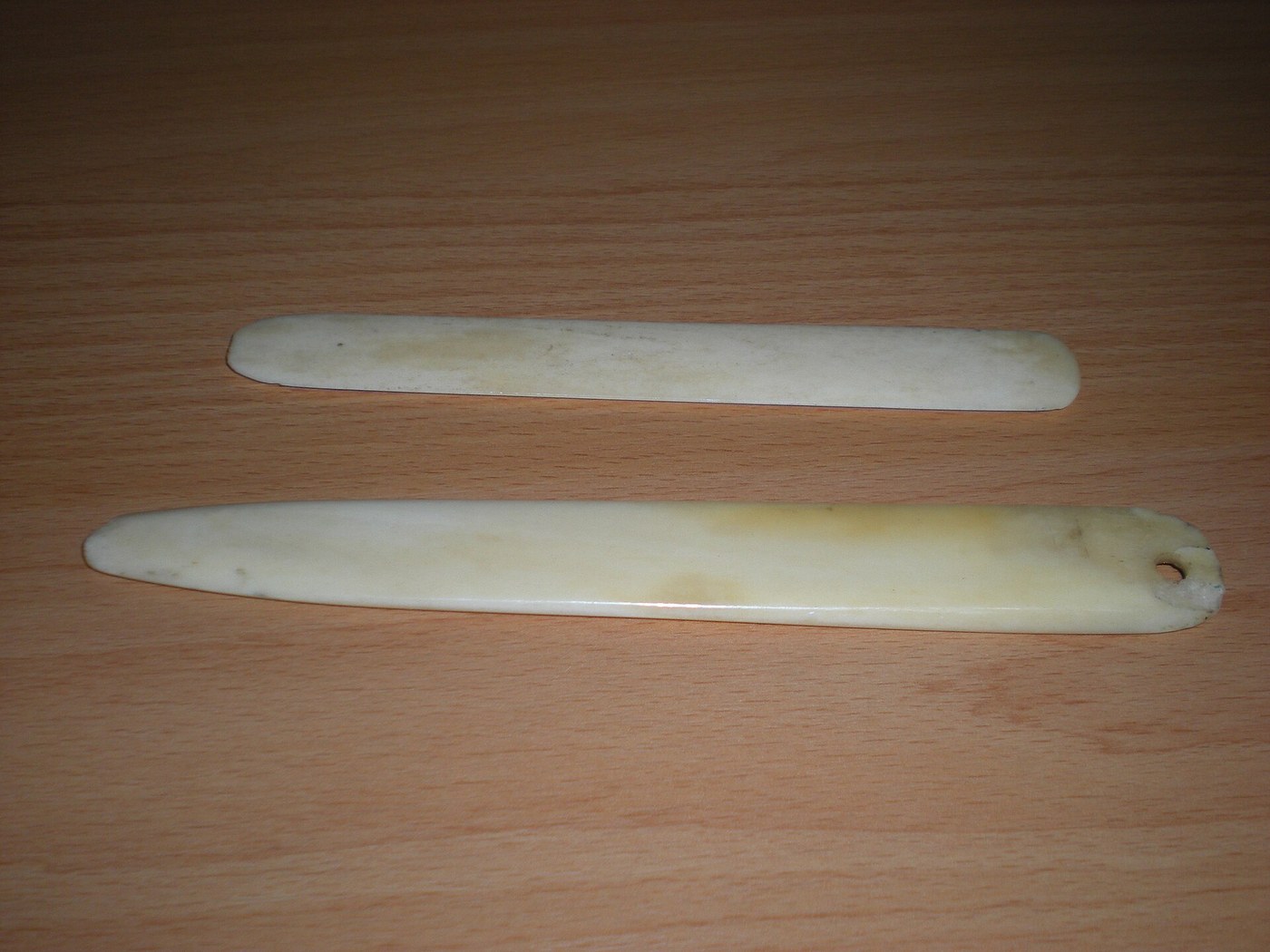


Bone Folder Cut from a Leg Bone
A bone folder is a dull-edged tool for folding and creasing paper in bookbinding; traditionally it is cut from the leg bone of a cow or deer, which leaves little residue on the paper. Clean a leg bone, saw a strip from the thick wall of its shaft, shape one end round and the other to a blunt point, and smooth and polish it.
The picture: two bone folders, one straight and one tapered.
Beginner
An afternoon
Instructions
1
1
Clean the bone
Clean the bone
Simmer the leg bone in water until the meat and fat come away, scrub it, and let it dry for several days.
Materials for this step:
 Bone1 piece
 Water5 liters
Tools needed:
 Iron Kettle
 Fire Pit
2
2
Saw a strip
Saw a strip
Saw off the knobbly ends, then saw a strip about 2.5 cm wide and 15–20 cm long lengthways from the thick wall of the shaft. Wear a mask; bone dust is fine.
Tools needed:
 Coping Saw
 Bench Vise
 Dust Mask
3
3
Shape it
Shape it
File the strip flat on both faces, round one end and taper the other to a blunt point. Keep every edge dull. Drill a small hole for a hanging cord if you like.
Tools needed:
 Metal FileBench Vise
 Hand Drill
4
4
Smooth and polish
Smooth and polish
Sand it smooth with finer and finer paper, then rub it on the strop until it is glossy and slides over paper without catching.
Tools needed:
 Sandpaper
 Leather Strop
5
5
Strips from one bone
Strips from one bone
Loading Jupyter Notebook...
Tools Required
9- Placeholder
- Placeholder
- Placeholder
- Placeholder
- Placeholder
- Placeholder
- Placeholder
- Placeholder
- Placeholder
This blueprint makes

Related Blueprints
These blueprints share knowledge with this one — techniques, materials, or principles that connect them in the learning graph.

CC0 Public Domain
This blueprint is released under CC0. You are free to copy, modify, distribute, and use this work for any purpose, without asking permission.
Support the Maker by purchasing products through their Blueprint where they earn a Maker Commission set by Vendors, or create a new iteration of this Blueprint and include it as a connection in your own Blueprint to share revenue.