ART
BEAUTY & WELLNESS
CRAFT
CULTURE & HISTORY
ENTERTAINMENT
ENVIRONMENT
FOOD & DRINKS
REVERSE ENGINEERING
SCIENCES
SPORTS
TECHNOLOGY
WEARABLES
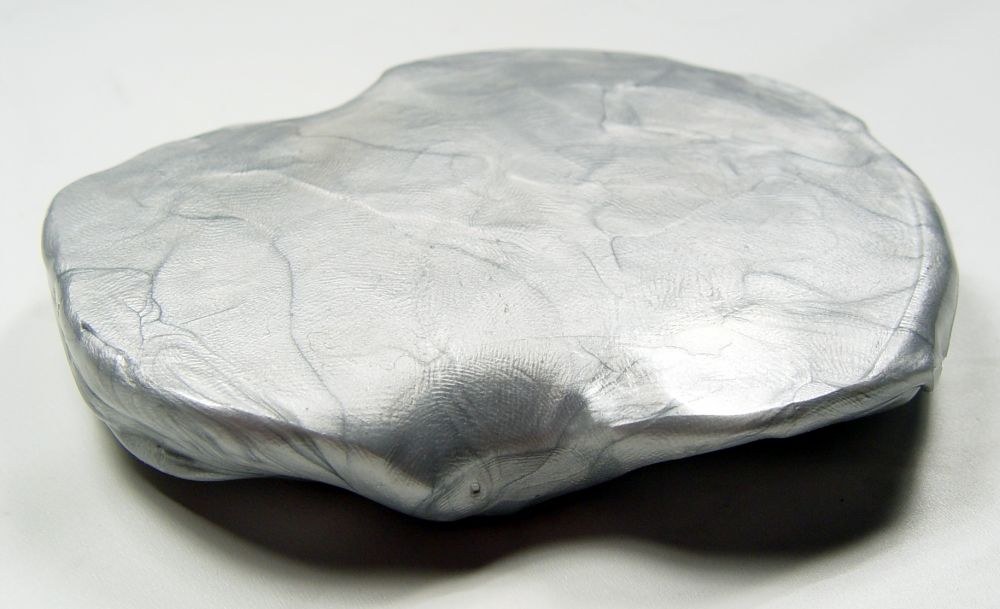


Bouncing Putty
Looking for a synthetic rubber during the Second World War, James Wright at General Electric heated silicone oil with boric acid. The result was no rubber: it bounced, shattered under a hammer, stretched like toffee when pulled slowly and slumped into a puddle overnight. Nobody found an industrial use; in 1950 it was sold as a toy.
**US 2,541,851**, "Process for making puttylike elastic plastic, siloxane derivative composition containing zinc hydroxide", Wright, assigned to General Electric, filed 23. December 1944, granted 13. February 1951: liquid dimethylsiloxane heated with 5 to 25 % by weight of a boron compound such as boric acid or borax.
**You measure both of its lives**: how high it bounces, how fast it flows, and where one turns into the other.
Beginner
1 hour plus a day of slumping
Instructions
1
1
Weigh a ball
Weigh a ball
Weigh out 20 g of bouncing putty and roll it into a smooth ball between your palms.
Materials for this step:
 Bouncing Putty20 g
Tools needed:
 Precision Digital Scale
2
2
Bounce it
Bounce it
Tape a tape measure up a wall. Drop the ball from 1.0 m onto a hard floor five times, filming in slow motion, and read each rebound height.
Materials for this step:
 Masking Tape1 roll
Tools needed:
 Tape Measure
 Smartphone with Slow-Motion Video
3
3
Pull slow, pull fast
Pull slow, pull fast
Roll a 10 mm thick rope. Pull one over 10 seconds: it strings out. Pull another sharply: it snaps with a clean face. Try pull times in between and note the fastest pull that still stretches.
Tools needed:
 Stopwatch
 Metal Ruler
4
4
Strike it
Strike it
Glasses on. Set a ball on a hard surface and hit it once, sharply, with the mallet. It cracks rather than squashing. Squash another slowly with your thumb.
Tools needed:
 Rubber Mallet
 Clear Safety Glasses
5
5
Let it slump
Let it slump
Re-roll the 20 g ball and set it on wax paper on a level surface. Measure its diameter now and after 10, 30, 60 and 180 minutes and 24 hours.
Materials for this step:
 Wax Paper1 sheet
Tools needed:
 Digital Caliper 6-Inch
6
6
Deborah numbers
Deborah numbers
Loading Jupyter Notebook...
7
7
History & Context
History & Context
**What the patent specifies:** liquid dimethylsiloxane heated with 5–25 % of a boron compound until putty-like. **Modern build (derived):** commercial bouncing putty, measured.
It became a famous toy and a staple of physics teaching about materials that are neither simply solid nor simply liquid. Its limits: it picks up dirt, will not hold a shape, and flows out of any container that is not closed.
Materials
3- 20 gPlaceholder
- 1 rollPlaceholder
- 1 sheetPlaceholder
Tools Required
8- Placeholder
- 1 vendor sell this, none ship to you yetPlaceholder
- Placeholder
- Placeholder
- Placeholder
- Placeholder
- Placeholder
- Placeholder
Related Blueprints
These blueprints share knowledge with this one — techniques, materials, or principles that connect them in the learning graph.
CC0 Public Domain
This blueprint is released under CC0. You are free to copy, modify, distribute, and use this work for any purpose, without asking permission.
Support the Maker by purchasing products through their Blueprint where they earn a Maker Commission set by Vendors, or create a new iteration of this Blueprint and include it as a connection in your own Blueprint to share revenue.