ART
BEAUTY & WELLNESS
CRAFT
CULTURE & HISTORY
ENTERTAINMENT
ENVIRONMENT
FOOD & DRINKS
REVERSE ENGINEERING
SCIENCES
SPORTS
TECHNOLOGY
WEARABLES


Butter-Strainer Churn: Cream Thrown Into a Strainer That Keeps the Butter
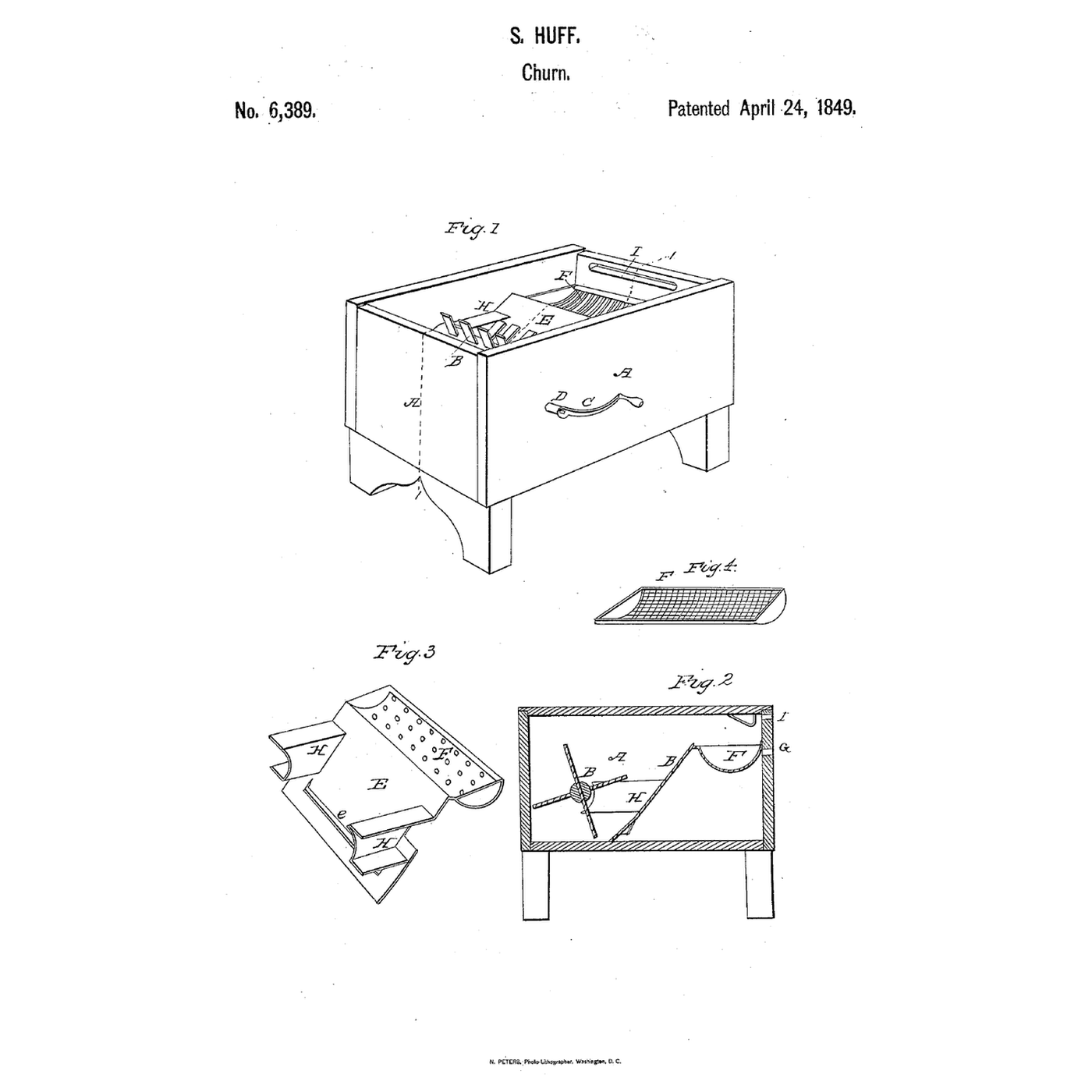
Huff wrote that "the virgin or first formed butter is peculiarly rich," and that beating it on with the rest spoils it; he set out to collect each piece "the instant it is formed."
Samuel Huff of New Vienna, Ohio, received US 6,389, dated 24 April 1849, for a churn with a revolving dasher in a box, an inclined plane in front of it that carries the cream it throws into a removable dish-shaped strainer, and air tubes through which the dasher draws air in below the strainer and drives it out above. The cream runs back through the strainer to be thrown again; "the particles of butter are all separated from the milk by being retained upon the strainer."
This rung works out the throw, then prints the dasher and strainer, builds the box with its incline, and makes butter.
Advanced
About 6 hours, plus printing
Instructions
1
1
The throw
The throw
Loading Jupyter Notebook...
2
2
Cream lifted and let fall through the air before it
Cream lifted and let fall through the air before it
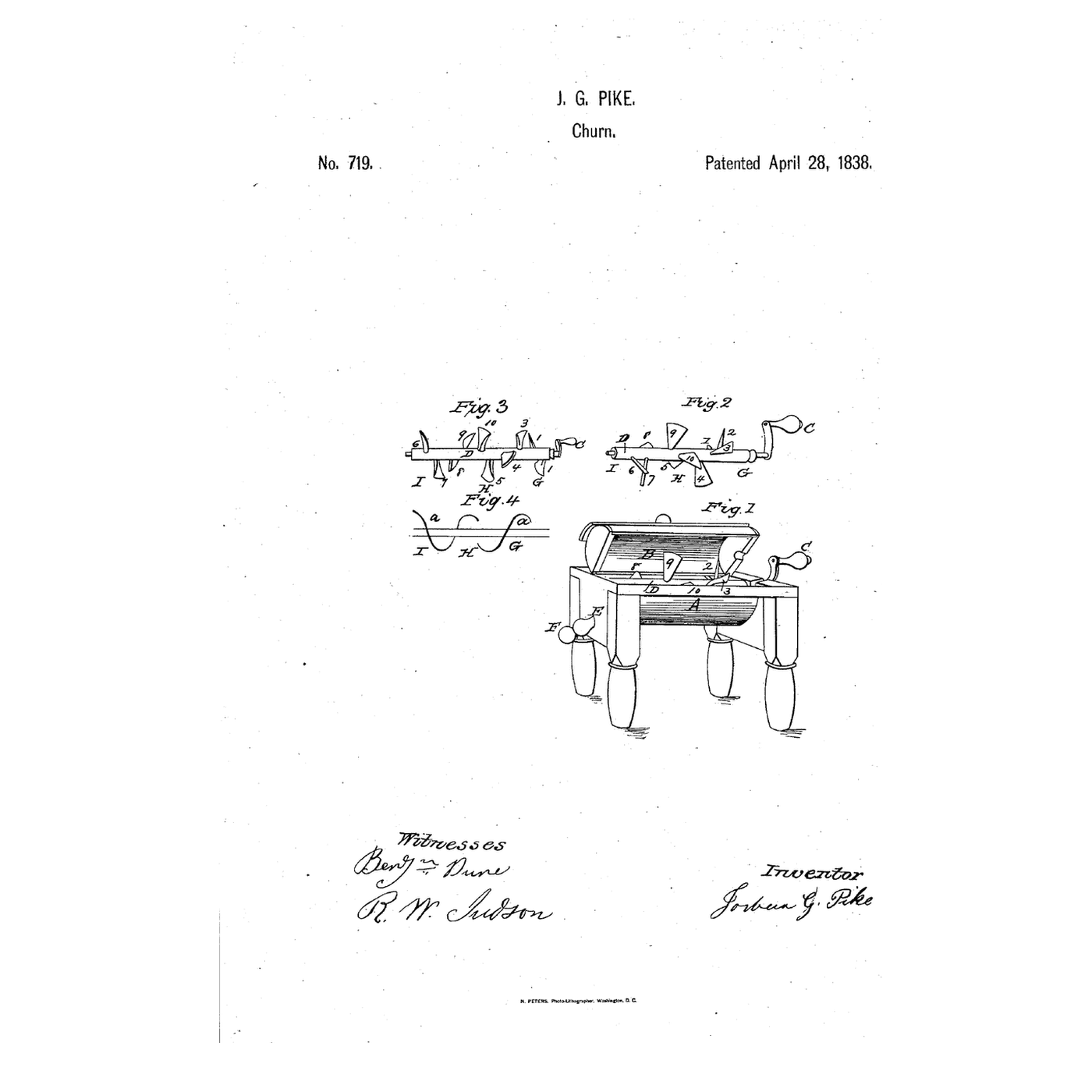
The embedded blueprint lifts cream in buckets and pours it through the air. Huff throws it into a strainer that keeps the butter.
3
3
Read US 6,389
Read US 6,389
"In front of the dasher an inclined plane (E) is arranged in such a manner, that it will convey the cream which is projected upon it, at a tangent from the dashers, into the strainer (F) through which it will run down to the bottom of the box and through the aperture (e) into the same compartment with the dasher, to be again elevated."
4
4
Print the parts
Print the parts
Print the dasher on end (/uploads/blueprints/butter-strainer-churn-dasher.stl), with supports, the dish strainer (/uploads/blueprints/butter-strainer-churn-strainer.stl) and the crank arm (/uploads/blueprints/butter-strainer-churn-crank-arm.stl). Print in PLA at 0.2 mm layers, 30 % infill, 4 walls; wash before first use.
Materials for this step:
 PLA Filament1 piece
Tools needed:
 FDM 3D Printer
5
5
The box and incline
The box and incline
Take a food-grade box about 260 × 150 × 170 mm. Drill both long sides 70 mm up, 75 mm from one end, for the axle. Bend a stainless sheet into a short incline rising from beside the dasher to the strainer, with a slot at its foot for the cream to return, and set it in with silicone. Fit ledges for the strainer's lugs so its rim stands only about 30 mm above the cream's level: the notebook shows a hand-cranked dasher throws the cream only a few centimetres up. Drill a hole low in the far end and one above the strainer for the air.
Materials for this step:
 Food-Grade Storage Container1 piece
 Stainless Steel Sheet - 3041 piece
 Silicone Sealant1 piece
 Plywood Sheet1 piece
Tools needed:
 Cordless Drill
 Drill Bit Set
 Tin Snips
 Deburring Tool
 Rubber Mallet
 Clamps
6
6
Dasher and crank
Dasher and crank
Pass a 10 mm square hardwood axle, rounded where it runs in the sides, through one side, the dasher and the other side. Glue the crank arm and a dowel handle on its outer end. Set the strainer on its ledges.
Materials for this step:
 Hardwood Dowels1 piece
 Wood Glue1 piece
Tools needed:
 Hand Saw
 Sandpaper
7
7
The build in 3D
The build in 3D
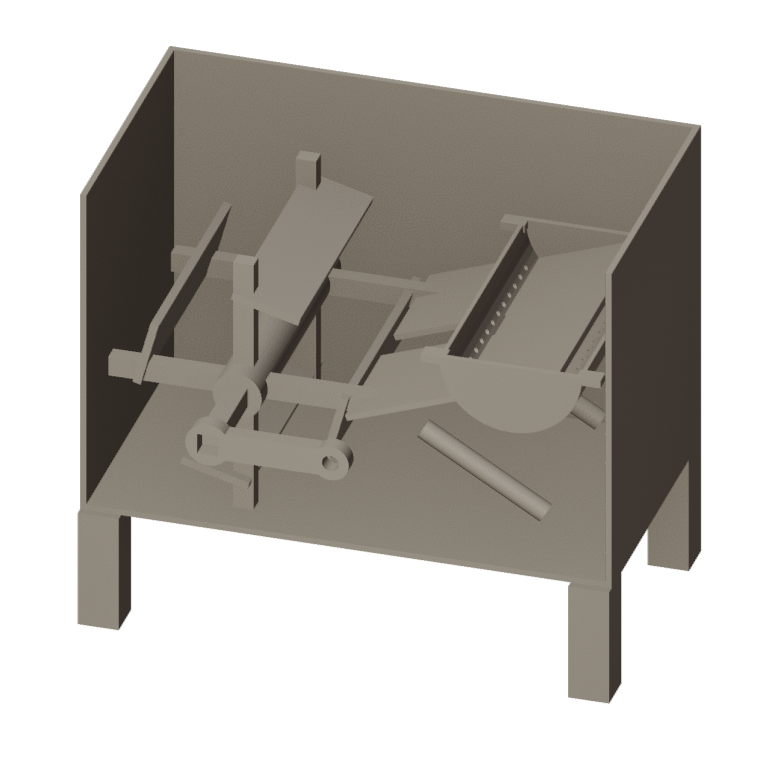
FreeCAD model of this build, not of the patent: one side of the box off to show the four-bladed dasher on its axle, the incline rising to the dish strainer, the strainer on its ledges, the air tubes, and the crank.
8
8
Crank and make butter
Crank and make butter
Let the heavy cream stand until it reaches about 15 °C, checked with the thermometer. Fill the box about half way up the dasher's arms, as he said. Crank steadily, throwing the cream up the incline into the strainer; lift the strainer out from time to time and take off the butter gathered on it. Time until no more forms. Pour off the buttermilk, add cold water, churn a little and pour off again until it runs clear; work in a pinch of salt and weigh the butter.
Materials for this step:
 Heavy Cream1500 ml
 Coarse Sea Salt1 piece
 Water1 piece
Tools needed:
 Leave-In Probe Thermometer
 Stopwatch
 Digital Kitchen Scale
 Stainless Steel Mixing Bowl (Large)
9
9
Cream that falls short, a strainer that clogs
Cream that falls short, a strainer that clogs
Butter-strainer churn troubleshooting.
Flow
Loading...
10
10
History and honest limits
History and honest limits
**Samuel Huff** of New Vienna, Clinton County, Ohio, received US 6,389, dated 24 April 1849. The strainer "may be either perforated, reticulated, or grated, made of metal, wood, or other material, and should be of a dish form, and removable." His view that the first-formed butter has a "nutty sweetness of flavor and waxiness of texture" is his claim, not a measured fact. He claimed the method of exposing the cream to the atmosphere and separating the butter as soon as formed, by the air tubes and strainer in combination with the dasher.
**Honest limits.** A food-grade box, stainless sheet and printed parts stand in for his wooden box. At tabletop scale and hand speed the dasher throws the cream only a few centimetres, so our strainer sits low, just above the cream, where his stood higher in a larger box. FDM prints hold food in their layer lines, so wash well and replace when worn. Your times and weights are the result.
Materials
10- 1 piecePlaceholder
- 1 piecePlaceholder
- 1 piecePlaceholder
- 1 piecePlaceholder
- 1 piecePlaceholder
- 1 piecePlaceholder
- 1 piecePlaceholder
- 1500 mlPlaceholder
- 1 piecePlaceholder
- 1 piecePlaceholder
Tools Required
13- Placeholder
- 1 vendor sell this, none ship to you yetPlaceholder
- Placeholder
- Placeholder
- Placeholder
- Placeholder
- Placeholder
- Placeholder
- Placeholder
- Placeholder
- Placeholder
- Placeholder
- Placeholder
Design Files
1Related Blueprints
These blueprints share knowledge with this one — techniques, materials, or principles that connect them in the learning graph.

CC0 Public Domain
This blueprint is released under CC0. You are free to copy, modify, distribute, and use this work for any purpose, without asking permission.
Support the Maker by purchasing products through their Blueprint where they earn a Maker Commission set by Vendors, or create a new iteration of this Blueprint and include it as a connection in your own Blueprint to share revenue.