ART
BEAUTY & WELLNESS
CRAFT
CULTURE & HISTORY
ENTERTAINMENT
ENVIRONMENT
FOOD & DRINKS
REVERSE ENGINEERING
SCIENCES
SPORTS
TECHNOLOGY
WEARABLES
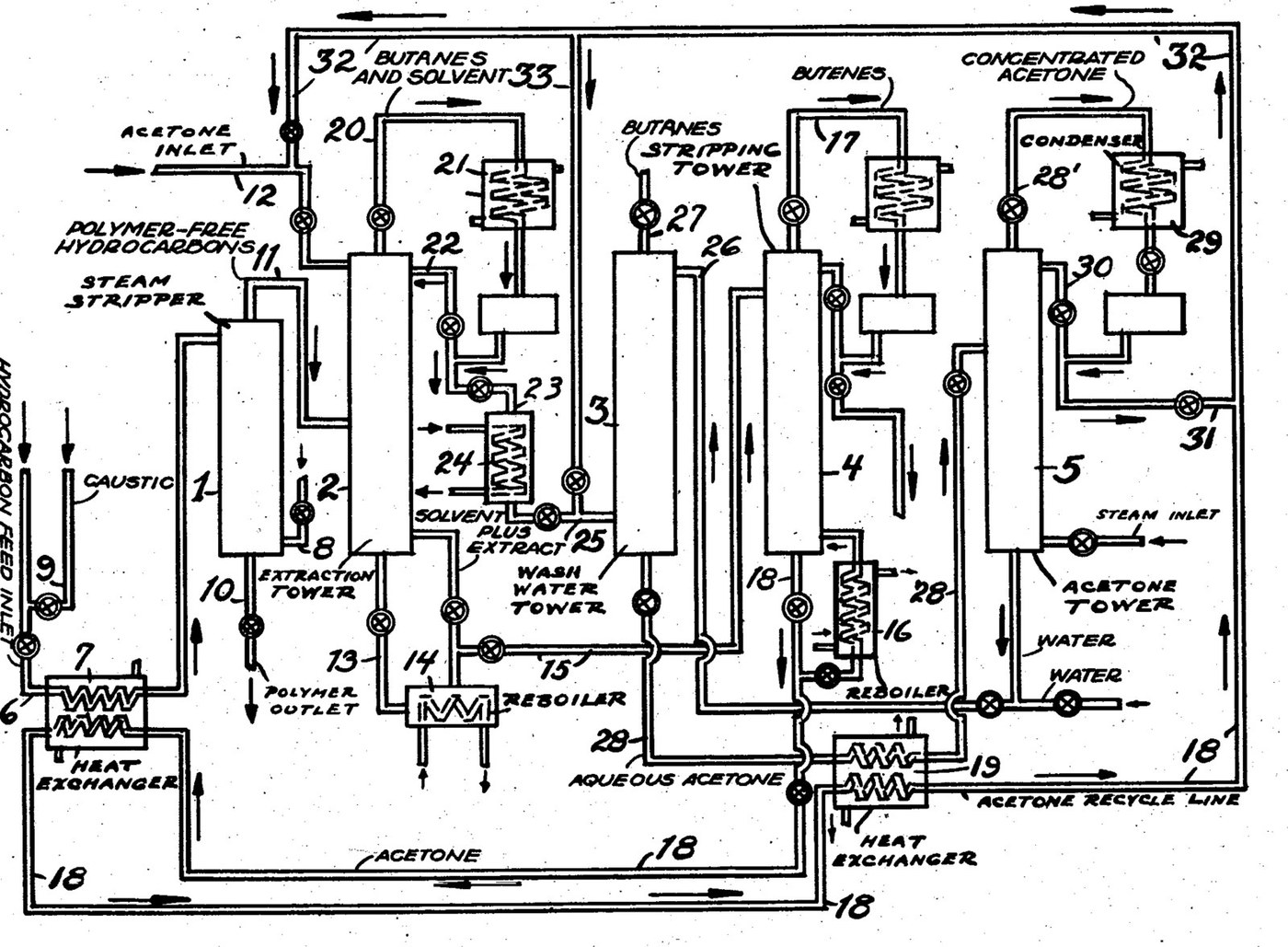


Normal Butylene Fraction: Cracked-Gas C4 Cut Extractively Distilled with Aqueous Acetone (Long, Standard Oil Development, US 2,449,610)
Butanes and butylenes boil too close together to part by plain distillation. Distil them through a stream of watery acetone, which holds back the butylenes, and the butanes go overhead while the butylenes come out at the bottom.
Result: a butylene fraction of 26.7 % butene-1 and 63.5 % butenes-2 (90.2 % normal butylenes), with 3.6 % isobutylene, 4.4 % normal butane and 1.8 % isobutane.
Source: Long, US 2,449,610 (1948). Not given: tower sizes and plates, water amounts, caustic strength. Long does not say how the acid-treated C4 cut is made; it is matched by kind to the Packie & Rupp blueprint. Extremely flammable gases under pressure. Picture: the patent drawing.
Expert
1 day
Instructions
1
1
Start from the acid-treated C4 cut of cracked gas oil
Start from the acid-treated C4 cut of cracked gas oil
Use the four-carbon fraction from cracking a gas oil, with the bulk of its isobutylene removed by sulphuric acid. Long's, by volume: isobutane 42.4 %, normal butane 9.4, isobutylene 2.0, butene-1 15.0, butenes-2 30.2, high-boiling material 1.0.
Materials for this step:
 Butane-Butylene Fraction, Isobutylene Removed1 as required
Tools needed:
 Pressure Gas Cylinder
2
2
Steam-strip out the heavy material
Steam-strip out the heavy material
Strip the feed with steam in the first tower, adding caustic to neutralise any sulphuric acid esters left from the acid treatment. The heavy material leaves at the bottom; the hydrocarbons go overhead as vapour.
Tools needed:
 Fractionating Still
 Steam Boiler
 Water
 Sodium Hydroxide Solution
3
3
Distil through aqueous acetone
Distil through aqueous acetone
Feed the vapour into the second tower and pass it up through aqueous acetone (14-17 % water) flowing down, at 120-200 °F and 50-150 lbs pressure. With 85 % solvent on the top plate and a cold reflux ratio of 6.5 to 1, the butanes go overhead and the butylenes leave in the acetone at the bottom.
Tools needed:
Fractionating Still Acetone
 Pressure Gauge
 Condenser Coil
4
4
Strip the butylenes from the acetone
Strip the butylenes from the acetone
In a third tower, reboiled at the bottom and refluxed at the top with product butylenes, distil the butylenes off the acetone. They come over as 26.7 % butene-1 and 63.5 % butenes-2, with 3.6 % isobutylene and 6.2 % butanes.
Tools needed:
Fractionating StillCondenser CoilPressure Gas Cylinder5
5
Recover the acetone and keep it clean
Recover the acetone and keep it clean
Wash the acetone out of the overhead butanes with water, keeping it below 15 % in the water or the layers emulsify badly. Reconcentrate the dilute acetone to about 83 % acetone, 17 % water, and recycle it. Bleed part of the recycled acetone into the butanes before washing, so the heavy material building up in it leaves with them.
Tools needed:
Fractionating StillWaterAcetoneMaterials
1- 1 as requiredPlaceholder
This blueprint makes
Related Blueprints
These blueprints share knowledge with this one — techniques, materials, or principles that connect them in the learning graph.
CC0 Public Domain
This blueprint is released under CC0. You are free to copy, modify, distribute, and use this work for any purpose, without asking permission.
Support the Maker by purchasing products through their Blueprint where they earn a Maker Commission set by Vendors, or create a new iteration of this Blueprint and include it as a connection in your own Blueprint to share revenue.