Collaboration
ART
BEAUTY & WELLNESS
CRAFT
CULTURE & HISTORY
ENTERTAINMENT
ENVIRONMENT
FOOD & DRINKS
REVERSE ENGINEERING
SCIENCES
SPORTS
TECHNOLOGY
WEARABLES
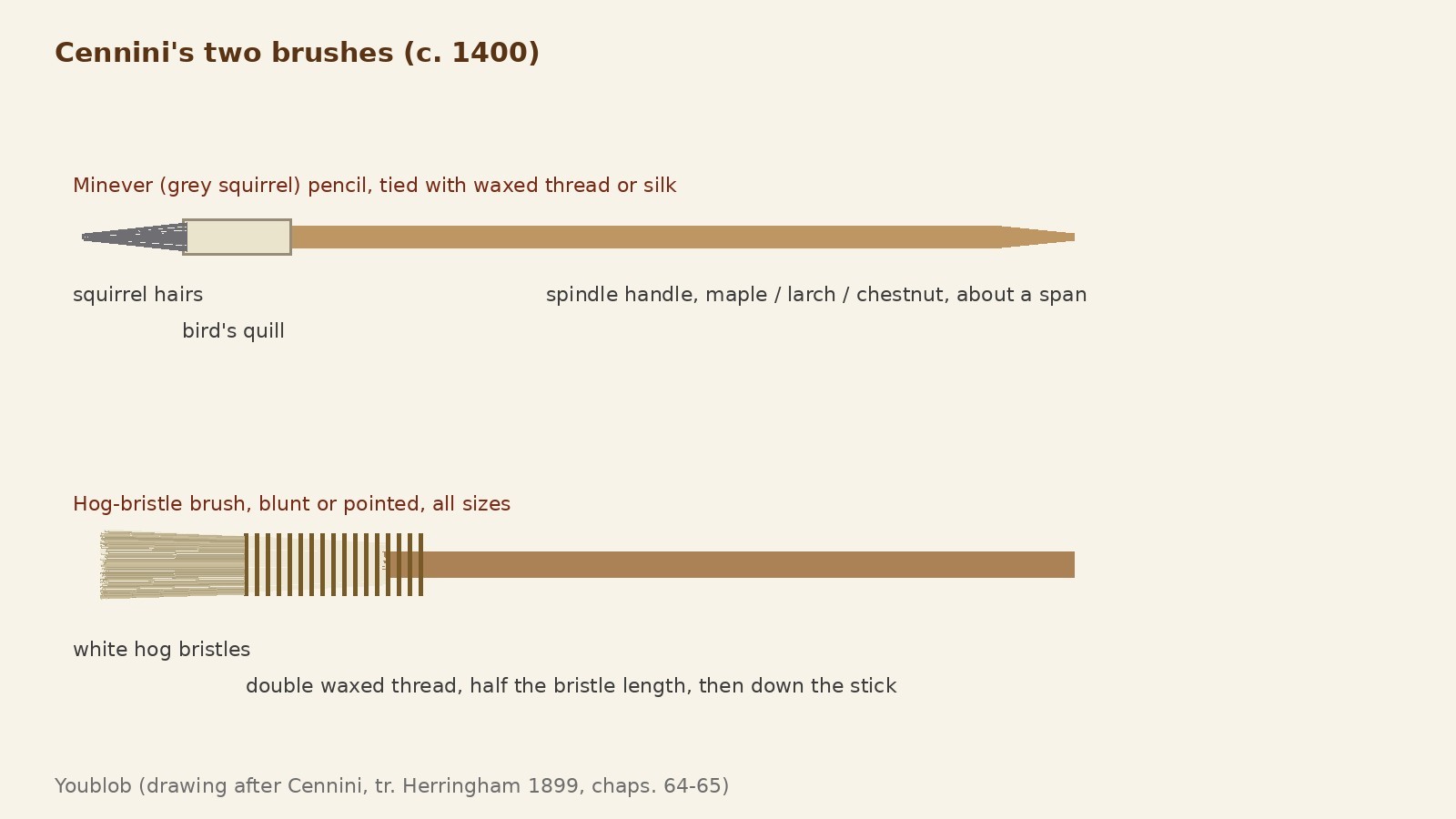


Squirrel-Hair Quill Pencils and Hog-Bristle Brushes (Cennini, c. 1400)
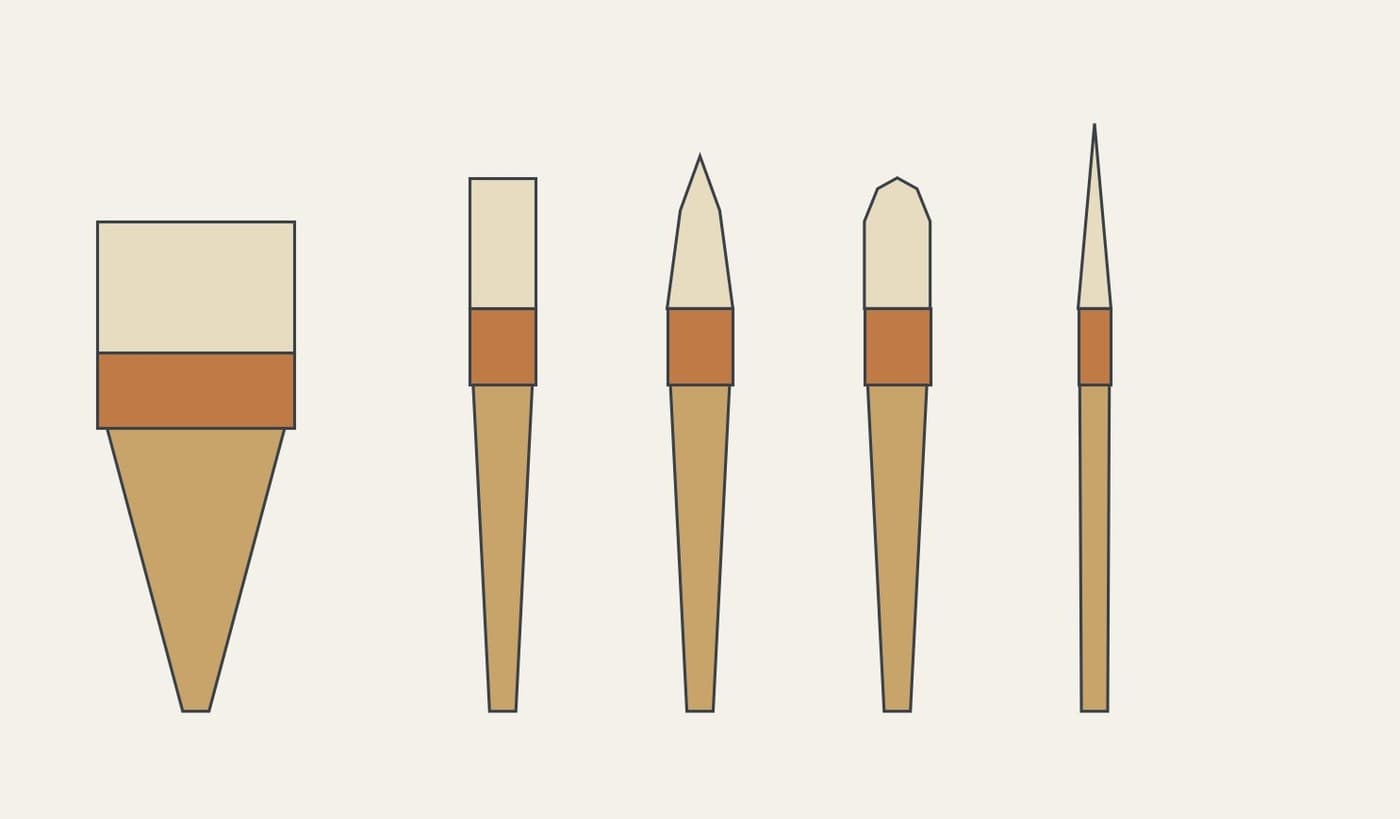
The painter's own brushes from Cennino Cennini's handbook: soft squirrel-tail hairs tied and squeezed into a bird's quill on a spindle-shaped wooden handle, and white hog bristles first broken in on a wall brush, then bound with waxed thread into blunt and pointed brushes of every size.
Beginner
An afternoon (plus breaking in the bristles)
Instructions
1
1
His sizes
His sizes
Loading Jupyter Notebook...
2
2
Read the Book of the Art
Read the Book of the Art
"In painting, two kinds of brushes are necessary, namely, minever and hog's bristles."
3
3
Keep the tails
Keep the tails
Use dressed (cured) grey-squirrel tails, never raw ones. To keep moths off and the hairs from falling out, stick them tight into kneaded clay or chalk and hang them up; wash them in clean water before use.
Materials for this step:
 Squirrel Tails1 piece
 Clay1 piece
4
4
Bundle the hairs
Bundle the hairs
For a soft gilding pencil, draw the longest hairs from the tips of six or eight tails. For other brushes take the straightest, stiffest hairs from the middle of the tail. Make small bundles, soak them in a glass of clear water, squeeze each with the fingers, and trim them with scissors. Lay the points even and tie each with waxed thread or silk, two knots.
Materials for this step:
Squirrel Tails1 piece Waxed Linen Thread1 piece
Tools needed:
 Glass Jar
 Scissors
5
5
Set them in quills
Set them in quills
Take a quill (vulture, goose, hen or dove) to suit the bundle, cut off its end, and push the hairs in, squeezing in as many as you can: the firmer and shorter the brush, the finer work it does. Scrape a small stick of maple, larch, chestnut or other good wood into a smooth spindle that fits tightly into the quill, about a span long. For flat washes blunt the brush a little with scissors and rub it on a smooth stone; keep others to a perfect point for outlines, and some very small for fine work.
Materials for this step:
 Feathers1 piece
 Hardwood Dowels1 piece
Tools needed:
Scissors Sloyd Carving Knife
6
6
Break in the bristles
Break in the bristles
Take bristles of a white domestic pig (better than black). Bind a pound of them on a large stick and use it to whitewash and wash walls until the bristles soften.
Materials for this step:
 Boar Bristles1 pieceHardwood Dowels1 pieceWaxed Linen Thread1 piece
Tools needed:
Sloyd Carving Knife7
7
Make the bristle brushes
Make the bristle brushes
Unbind the wall brush and make the bristles up into brushes of all sizes, some blunt (all hairs one length), some pointed. Bind each bundle with a double waxed thread, push the pointed end of a stick into it, bind it evenly for half the length of the bristles and then on down the stick.
Materials for this step:
Boar Bristles1 pieceHardwood Dowels1 pieceWaxed Linen Thread1 pieceTools needed:
ScissorsSloyd Carving Knife8
8
Troubleshooting
Troubleshooting
Brush troubleshooting.
Flow
Loading...
9
9
History and honest limits
History and honest limits
From Cennino Cennini, **Il Libro dell'Arte** (c. 1400), translated by Christiana J. Herringham as **The Book of the Art of Cennino Cennini** (1899), chaps. 64-66 (checked on the archive.org scan bookartcenninoc01herrgoog, pp. 52-54). One word in the manuscript, what the wall brush is tied with, is defaced. Herringham explains minever as the grey squirrel. The metric figures and the smooth stone in place of his porphyry are ours.
Materials
6- 1 piecePlaceholder
- 1 piecePlaceholder
- 3 piecesPlaceholder
- 1 piecePlaceholder
- 1 piecePlaceholder
- 1 piecePlaceholder
This blueprint makes

Related Blueprints
These blueprints share knowledge with this one — techniques, materials, or principles that connect them in the learning graph.
CC0 Public Domain
This blueprint is released under CC0. You are free to copy, modify, distribute, and use this work for any purpose, without asking permission.
Support the Maker by purchasing products through their Blueprint where they earn a Maker Commission set by Vendors, or create a new iteration of this Blueprint and include it as a connection in your own Blueprint to share revenue.