ART
BEAUTY & WELLNESS
CRAFT
CULTURE & HISTORY
ENTERTAINMENT
ENVIRONMENT
FOOD & DRINKS
REVERSE ENGINEERING
SCIENCES
SPORTS
TECHNOLOGY
WEARABLES
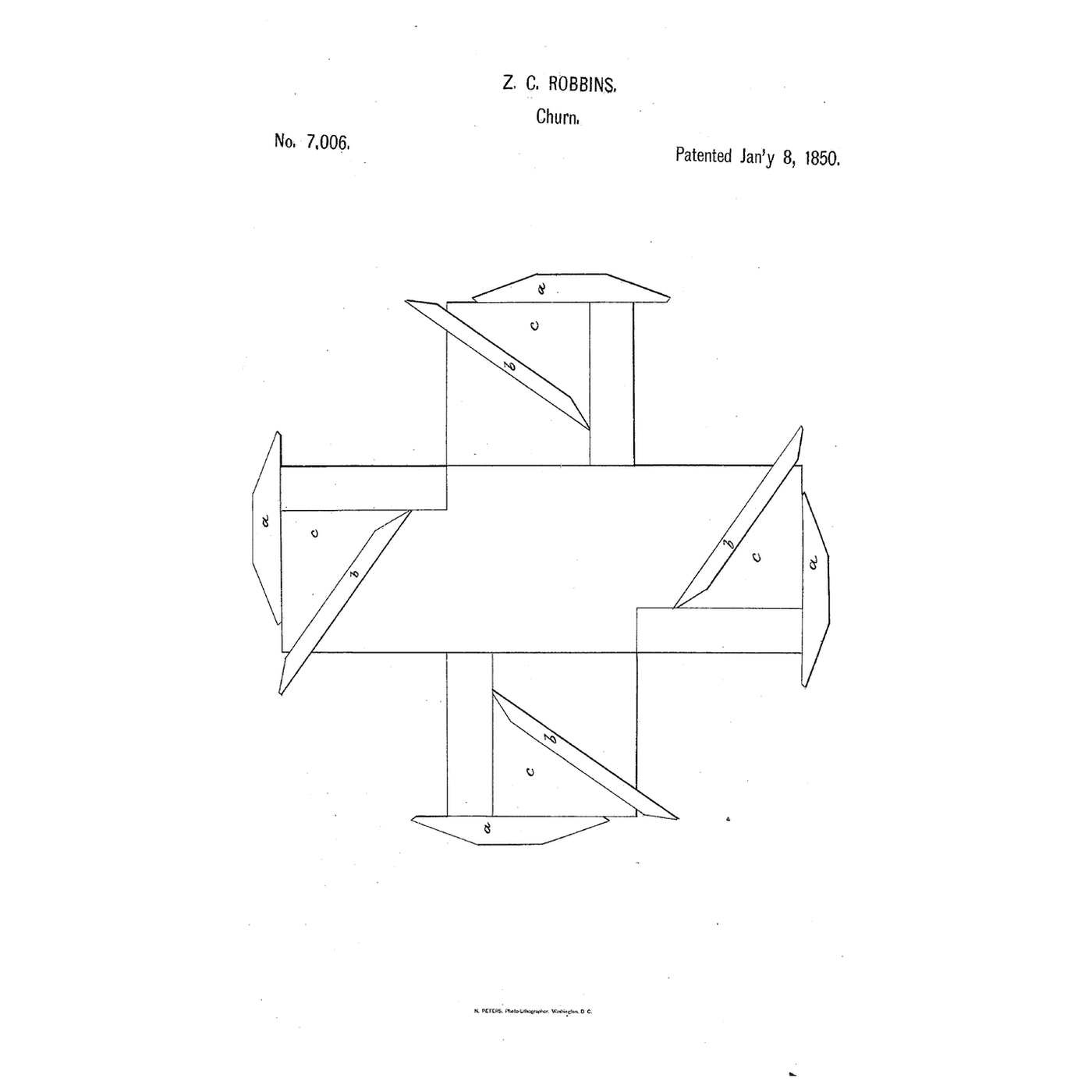


Centrifugal and Centripetal Churn Dasher: Paired Blades That Squeeze the Cream Through
Robbins wrote that in all other churns butter gathers round the dasher and clogs it, so churning stops "before the cream has parted with all the butter it contains."
Z. C. Robbins of St. Louis, Missouri, received US 7,006, dated 8 January 1850, for what he called the "Centrifugal and Centripetal Churn-Dasher": broad outer blades on the ends of the arms with their inner faces at right angles to the radii, and inner blades whose outer edges lie on the circle of motion a short distance behind the outer blades' after edges, passing obliquely forward under them. Turned, the cream is forced between each pair; reversed, the inner blades gather the butter "into a roll in the center of the dasher." It followed his telegraph churn of June 1849.
This rung works out the squeeze, then prints the dasher in one piece, fits it in a box, and makes butter.
Intermediate
About 3 hours, plus printing
Instructions
1
1
The squeeze
The squeeze
Loading Jupyter Notebook...
2
2
His first dasher
His first dasher
The embedded blueprint is Robbins's 1849 telegraph churn. Six months later he paired its blades so they squeeze the cream between them.
3
3
Read US 7,006
Read US 7,006
"When the dasher is rotated in cream, the cream will be gathered between the diverging surfaces of each pair of blades, and by the joint action of pressure and suction, be forced therefrom through the narrow space between their after edges."
4
4
Print the dasher
Print the dasher
Print the dasher on end in one piece with supports (/uploads/blueprints/centrifugal-centripetal-dasher-churn-dasher.stl): four tangential outer blades and four oblique inner blades between two crosses. Print the crank arm (/uploads/blueprints/centrifugal-centripetal-dasher-churn-crank-arm.stl). Print in PLA at 0.2 mm layers, 30 % infill, 4 walls; wash before first use.
Materials for this step:
 PLA Filament1 piece
Tools needed:
 FDM 3D Printer
5
5
Shaft
Shaft
Push a 10 mm square hardwood shaft through the dasher's hubs and glue it centred.
Materials for this step:
 Hardwood Dowels1 piece
 Wood Glue1 piece
Tools needed:
 Hand Saw
 Sandpaper
6
6
The box
The box
Take a food-safe box about 190 mm each way. Drill both ends on the axis 90 mm up, round the shaft where it runs, pass it through, and glue the crank arm and a dowel handle on. He held it could run uncovered.
Materials for this step:
 Food-Grade Storage Container1 pieceWood Glue1 piece
Tools needed:
 Cordless Drill
 Drill Bit Set
7
7
The build in 3D
The build in 3D
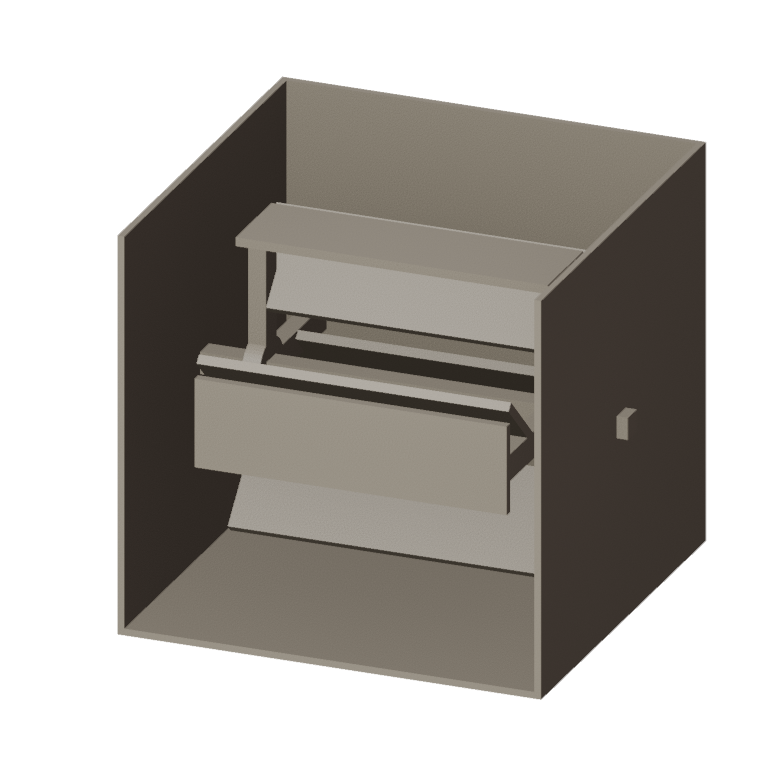
FreeCAD model of this build, not of the patent: the box with one side off to show the dasher of paired outer and inner blades between two crosses, and the crank.
8
8
Crank, then reverse into a roll
Crank, then reverse into a roll
Let the heavy cream stand until it reaches about 15 °C, checked with the thermometer. Pour in 1.5 litres. Crank steadily, outer blades leading; as soon as the butter begins to separate, reverse the crank, as he said, so the inner blades gather it into a roll in the centre. Pour off the buttermilk, add cold water, churn a little and pour off again until it runs clear; work in a pinch of salt and weigh the butter.
Materials for this step:
 Heavy Cream1500 ml
 Coarse Sea Salt1 piece
 Water1 piece
Tools needed:
 Leave-In Probe Thermometer
 Stopwatch
 Digital Kitchen Scale
 Stainless Steel Mixing Bowl (Large)
9
9
Butter that clogs, or will not roll
Butter that clogs, or will not roll
Centrifugal-centripetal dasher troubleshooting.
Flow
Loading...
10
10
History and honest limits
History and honest limits
**Z. C. Robbins** of St. Louis, Missouri, received US 7,006, dated 8 January 1850. He wrote that dairy-women would favour no churn whose surfaces could not all be reached for cleansing, and that his would make more butter, faster and with less power, than any churn ever patented; that is his claim, not our measurement. He claimed the outer blades tangential to their circle combined with the inclined inner blades.
**Honest limits.** A food-safe box and a printed dasher stand in for his. FDM prints hold food in their layer lines, so wash well and replace when worn. Your times and weights are the result.
Materials
7- 1 piecePlaceholder
- 1 piecePlaceholder
- 2 piecesPlaceholder
- 1 piecePlaceholder
- 1500 mlPlaceholder
- 1 piecePlaceholder
- 1 piecePlaceholder
Tools Required
9- Placeholder
- Placeholder
- Placeholder
- 1 vendor sell this, none ship to you yetPlaceholder
- Placeholder
- Placeholder
- Placeholder
- Placeholder
- Placeholder
Design Files
1Related Blueprints
These blueprints share knowledge with this one — techniques, materials, or principles that connect them in the learning graph.
Telegraph Beater Churn: Nested Knife-Edged Beaters That Whip the Cream
by Martin
FOOD & DRINKS
0
0
0
0
0
0
Shaftless Dasher-Wheel Churn: Bevelled Buckets Drive the Cream to the Centre
by Martin
FOOD & DRINKS
0
0
0
0
0
0
Adjustable Concave Beater Churn: Beaters You Turn to Meet the Cream at Any Level
by Woody
FOOD & DRINKS
0
0
0
0
0
0
CC0 Public Domain
This blueprint is released under CC0. You are free to copy, modify, distribute, and use this work for any purpose, without asking permission.
Support the Maker by purchasing products through their Blueprint where they earn a Maker Commission set by Vendors, or create a new iteration of this Blueprint and include it as a connection in your own Blueprint to share revenue.