ART
BEAUTY & WELLNESS
CRAFT
CULTURE & HISTORY
ENTERTAINMENT
ENVIRONMENT
FOOD & DRINKS
REVERSE ENGINEERING
SCIENCES
SPORTS
TECHNOLOGY
WEARABLES
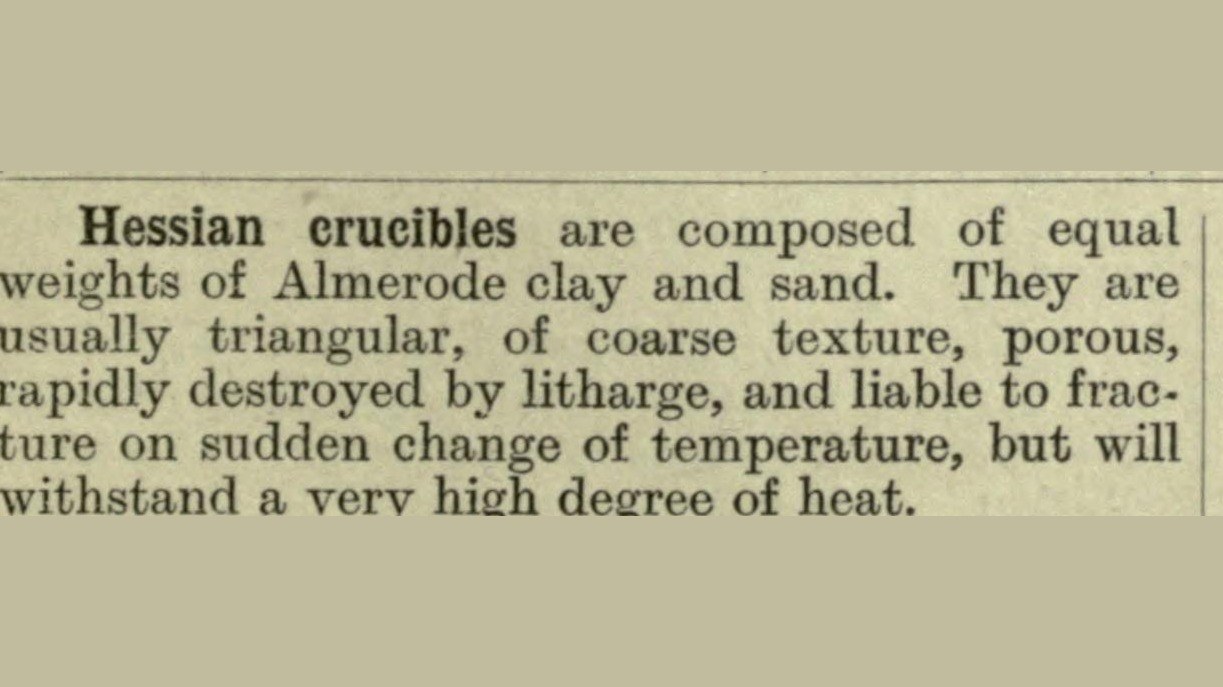


Ceramic Crucible: a Hessian Crucible of Equal Weights of Clay and Sand (Thorpe 1912)
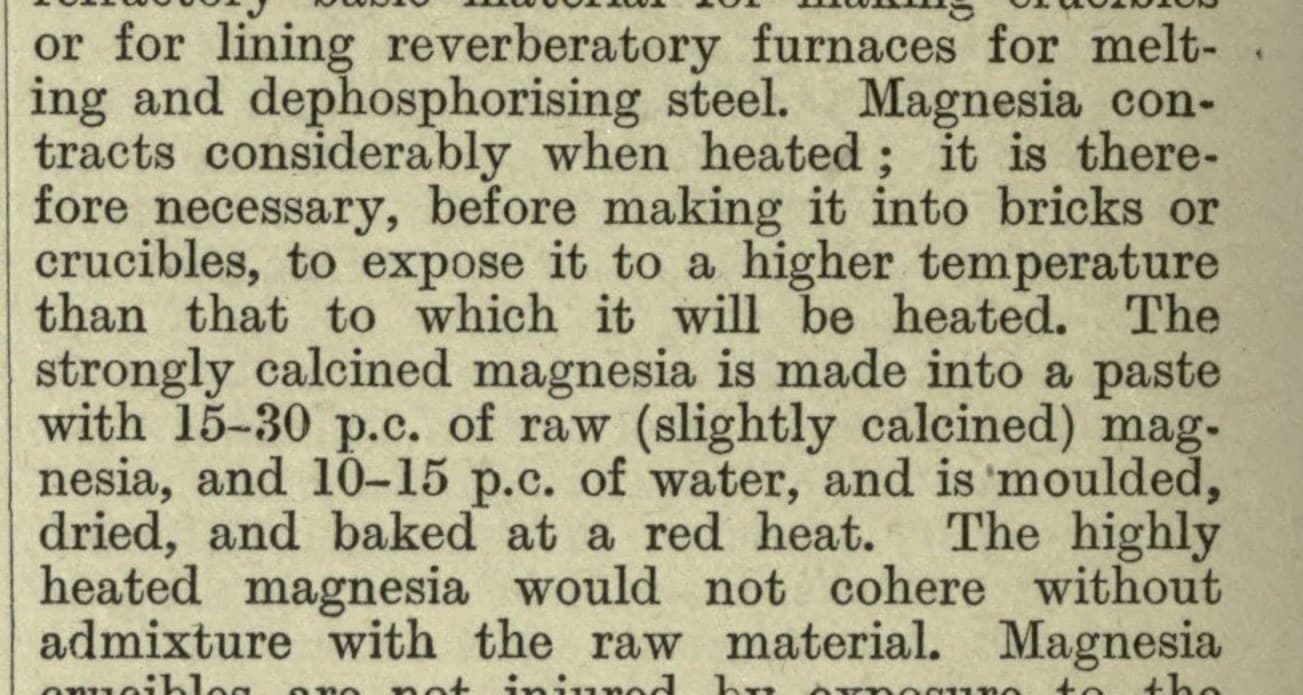
A ceramic crucible is a fired clay pot for melting metal. Thorpe's Dictionary of Applied Chemistry (1912) describes the Hessian crucible: equal weights of clay and sand, usually triangular, coarse and porous; it withstands a very high heat but cracks on sudden changes of temperature and is quickly eaten by litharge.
His general rules for clay crucibles fill in the work: weather the clay, beat it fine to drive out air, mix in the sand, form the crucibles and bake small ones in a kiln. Sizes, forming and baking heat are not given.
Source: Thorpe, Dictionary of Applied Chemistry vol. II (1912), CRUCIBLES, pp. 168-169. Picture: the Hessian paragraph.
Beginner
Weeks of weathering, then two days
Instructions
1
1
Read Thorpe
Read Thorpe
"Hessian crucibles are composed of equal weights of Almerode clay and sand."
2
2
Weather and clean the clay
Weather and clean the clay
Leave the clay exposed to the air in a moist state for some months; it breaks down, grows more plastic and is easier to clean. Pick out foreign matter, above all iron pyrites, which turns into a flux and leaves cavities, and lime.
Materials for this step:
 Clay1 half by weight
Tools needed:
 Water
3
3
Beat and mix
Beat and mix
Beat the clay well, as fine as you can get it, to drive out air bubbles. Weigh it, and mix in an equal weight of sand; Berthier warns that the sand should not be too fine, or it combines with the clay and lowers the melting point.
Materials for this step:
 Quartz Sand1 half by weight
Tools needed:
 Wooden Mallet
 Precision Digital Scale
4
4
Form the crucibles
Form the crucibles
Form the crucibles; Hessian crucibles are usually triangular. Thorpe gives no sizes and no forming method (unknown).
Tools needed:
 Clay Tool Set
 Unknown Dimensions
5
5
Bake
Bake
Bake small crucibles in a kiln. Thorpe notes that the higher the baking heat, the more liable the crucible is to crack when heated again; the temperature is not given.
Tools needed:
 Kiln
 Heat-Resistant Gloves
6
6
History and honest limits
History and honest limits
Thorpe sets the Hessian crucible beside others of his day: French crucibles of raw and burnt clay, Cornish crucibles for copper assaying, Stourbridge crucibles with old glass-pot grog, and graphite crucibles for melting metals. The sand forms a skeleton that keeps the pot from slumping at heats where the clay alone would soften.
He gives the proportions only; the size, the forming and the baking heat are not given, and plain clay and quartz sand stand for Almerode clay and its sand.
Tools Required
7- Placeholder
- Placeholder
- Placeholder
- Placeholder
- Placeholder
- Placeholder
- Placeholder
This blueprint makes

Related Blueprints
These blueprints share knowledge with this one — techniques, materials, or principles that connect them in the learning graph.
CC0 Public Domain
This blueprint is released under CC0. You are free to copy, modify, distribute, and use this work for any purpose, without asking permission.
Support the Maker by purchasing products through their Blueprint where they earn a Maker Commission set by Vendors, or create a new iteration of this Blueprint and include it as a connection in your own Blueprint to share revenue.