Collaboration
ART
BEAUTY & WELLNESS
CRAFT
CULTURE & HISTORY
ENTERTAINMENT
ENVIRONMENT
FOOD & DRINKS
REVERSE ENGINEERING
SCIENCES
SPORTS
TECHNOLOGY
WEARABLES
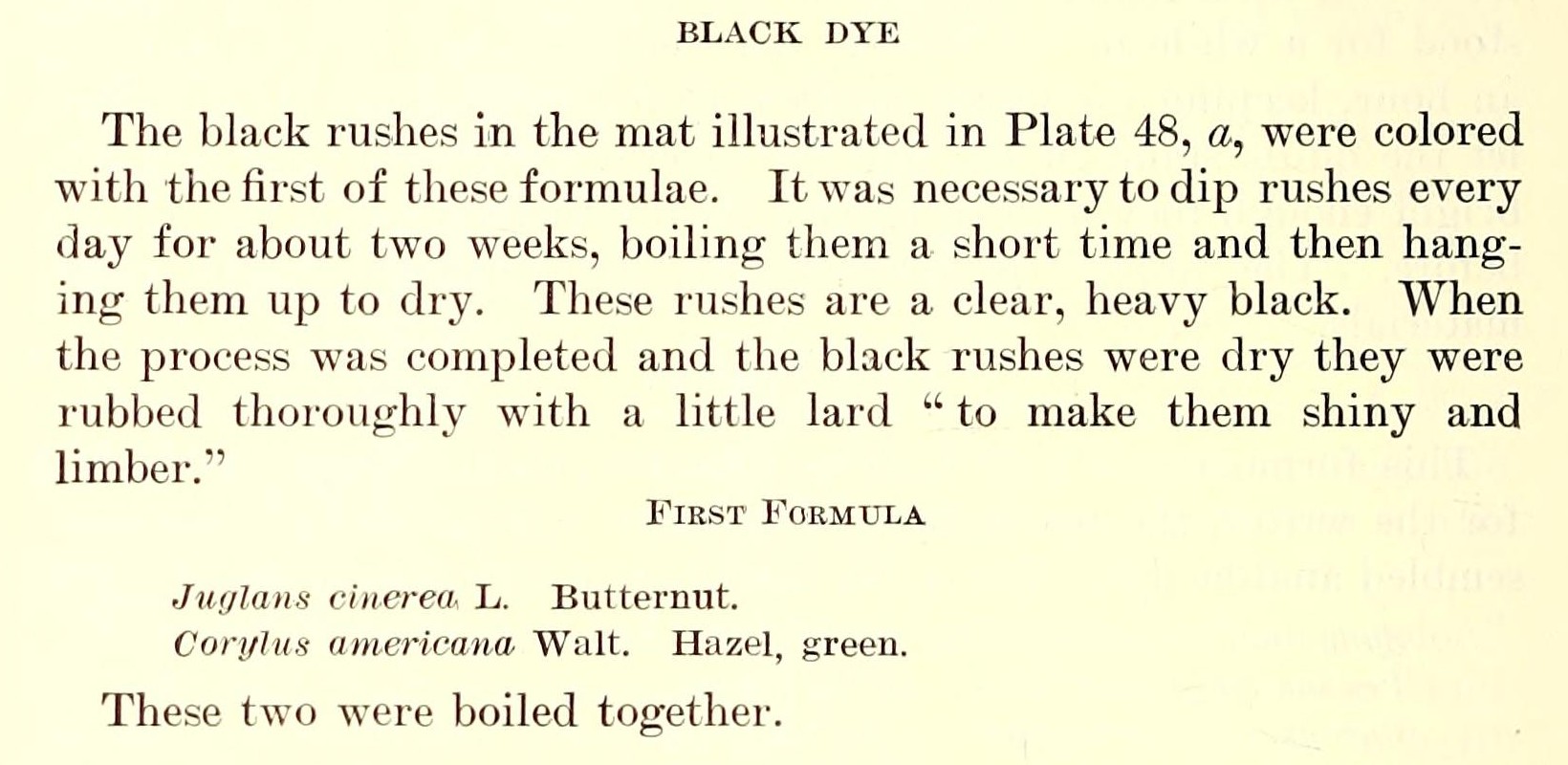


Chippewa Black Dyes: Butternut, Green Hazel Burs and Oak Bark with Black Spring Earth or Grindstone Dust (Densmore, 1928)
The seven Chippewa (Ojibwe) black dyes Frances Densmore recorded: tannin-rich butternut, oak, alder and dogwood bark and green hazel burs, boiled and darkened with iron, from black earth out of springs or the dust of a grindstone. The chemist she consulted put it simply: iron on tannin makes an ink.
Beginner
A day, or two weeks for rushes
Instructions
1
1
Read Densmore
Read Densmore
Black earth from springs "is full of compounds of iron with organic acids": the iron acts on the tannin and makes an ink. Grindstone dust, silt with iron in it, does the same work.
2
2
Formula 1: butternut and green hazel
Formula 1: butternut and green hazel
Boil butternut bark and green hazel burs together (amounts not given). This made the clear, heavy black rushes of a mat she illustrates.
Materials for this step:
 Butternut Bark1 piece
 Green Hazel Burs1 piece
 Water1 piece
Tools needed:
 Hammerstone
 Fire Pit
 Large Dye Pot
3
3
Formula 2: boiled down with black earth
Formula 2: boiled down with black earth
Boil bur oak bark with butternut inner bark and a little butternut root. After a while put in the black earth, later the ochre. The more it is boiled down, the blacker. Keep it in the kettle and heat it to use.
Materials for this step:
 Dried Oak Bark1 pieceButternut Bark1 piece
 Dye Mud1 piece
 Raw Ochre1 pieceWater1 piece
Tools needed:
Fire PitLarge Dye Pot4
4
Formulae 3 to 6
Formulae 3 to 6
(3) Alder, red-osier dogwood and oak bark with either grindstone dust or black earth. (4) Boil bur oak inner bark and green hazel burs, add butternut and black earth later, and let it stand a long time before use. (5) Butternut with grindstone dust. (6) Black earth with grindstone dust.
Materials for this step:
 Alder Bark (Dried)1 piece
 Red-osier Dogwood Bark1 pieceDried Oak Bark1 pieceGreen Hazel Burs1 pieceButternut Bark1 pieceDye Mud1 piece
 Grindstone Dust1 pieceWater1 piece
Tools needed:
HammerstoneFire PitLarge Dye Pot5
5
Formula 7 on wool
Formula 7 on wool
Inner bark of oak, green hazel burs, grindstone dust and a little ochre dust in hot water: this one was used on white blanket for her. Boil the wool in it. Hers came out not a heavy black, said to be from too little dye, so make plenty (ours: dye again as for the rushes). Rinse and dry (ours).
Materials for this step:
Dried Oak Bark1 pieceGreen Hazel Burs1 pieceGrindstone Dust1 pieceRaw Ochre1 pieceWater1 piece Undyed Wool Yarn1 piece
Tools needed:
HammerstoneFire PitLarge Dye Pot6
6
Rushes, her way
Rushes, her way
For mat rushes she gives this: dip them every day for about two weeks, boil them a short time and hang them up to dry each time. When dry, rub them well with a little lard "to make them shiny and limber". At a spring in Ontario women simply buried their rushes in the black earth for a few days.
Materials for this step:
 Dried Rush Stems1 piece
 Lard1 piece
Tools needed:
Large Dye PotFire Pit7
7
Troubleshooting
Troubleshooting
Black dye troubleshooting.
Flow
Loading...
8
8
History and honest limits
History and honest limits
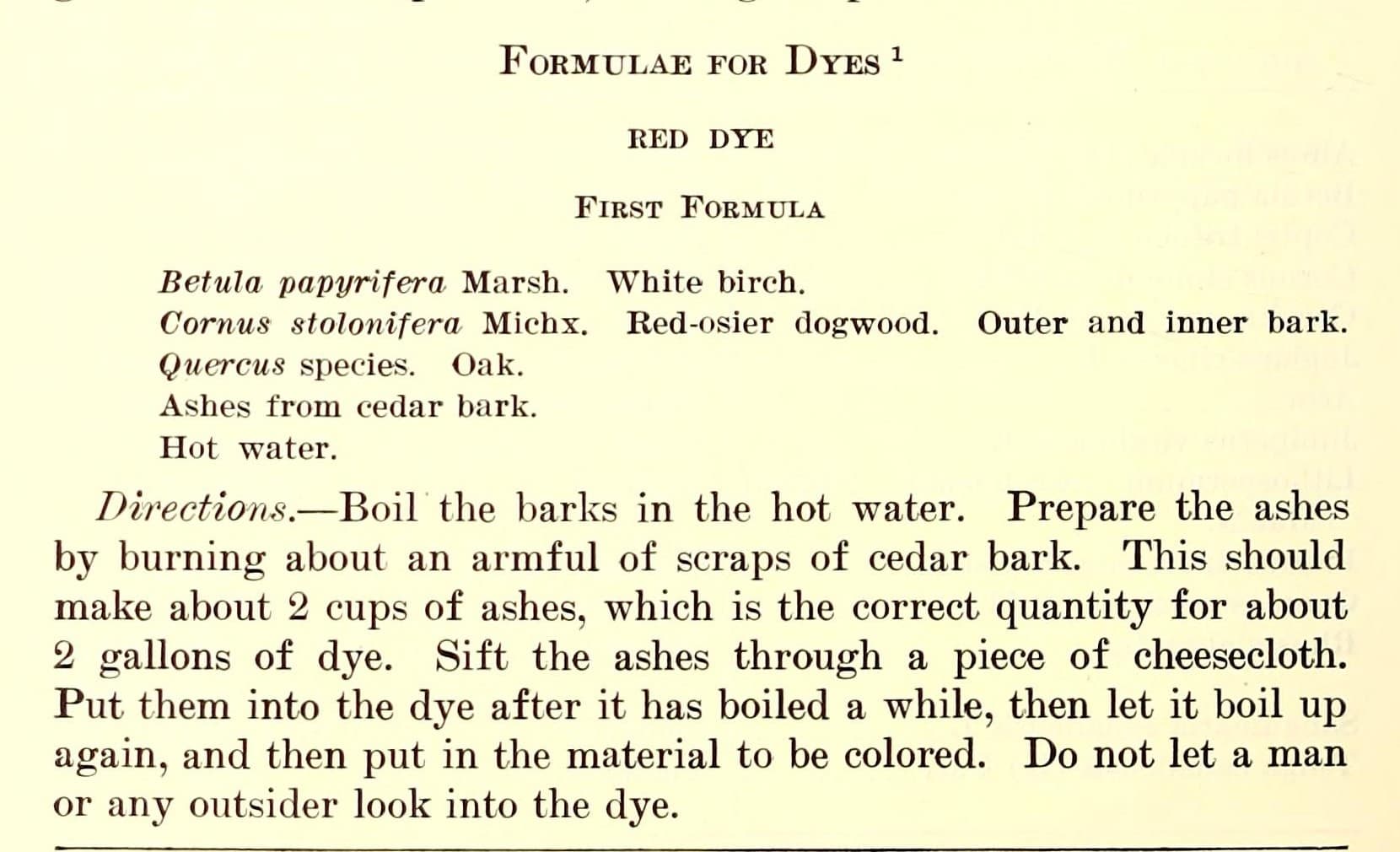
From Frances Densmore, *Uses of Plants by the Chippewa Indians*, **44th Annual Report of the Bureau of American Ethnology** (1928), pp. 370, 372-373 (checked on the archive.org scan usesofplantsbych00dens). She gives no amounts for any black formula; using yarn throughout, metric figures and rinsing are ours.
Materials
12- 3 piecesPlaceholder
- 1 piecePlaceholder
- 4 piecesPlaceholder
- 1 piecePlaceholder
- 2 piecesPlaceholder
- 1 piecePlaceholder
- 1 piecePlaceholder
- 1 piecePlaceholder
- 1 piecePlaceholder
- 1 piecePlaceholder
- 1 piecePlaceholder
- 1 piecePlaceholder
This blueprint makes

Related Blueprints
These blueprints share knowledge with this one — techniques, materials, or principles that connect them in the learning graph.
CC0 Public Domain
This blueprint is released under CC0. You are free to copy, modify, distribute, and use this work for any purpose, without asking permission.
Support the Maker by purchasing products through their Blueprint where they earn a Maker Commission set by Vendors, or create a new iteration of this Blueprint and include it as a connection in your own Blueprint to share revenue.