Collaboration
ART
BEAUTY & WELLNESS
CRAFT
CULTURE & HISTORY
ENTERTAINMENT
ENVIRONMENT
FOOD & DRINKS
REVERSE ENGINEERING
SCIENCES
SPORTS
TECHNOLOGY
WEARABLES
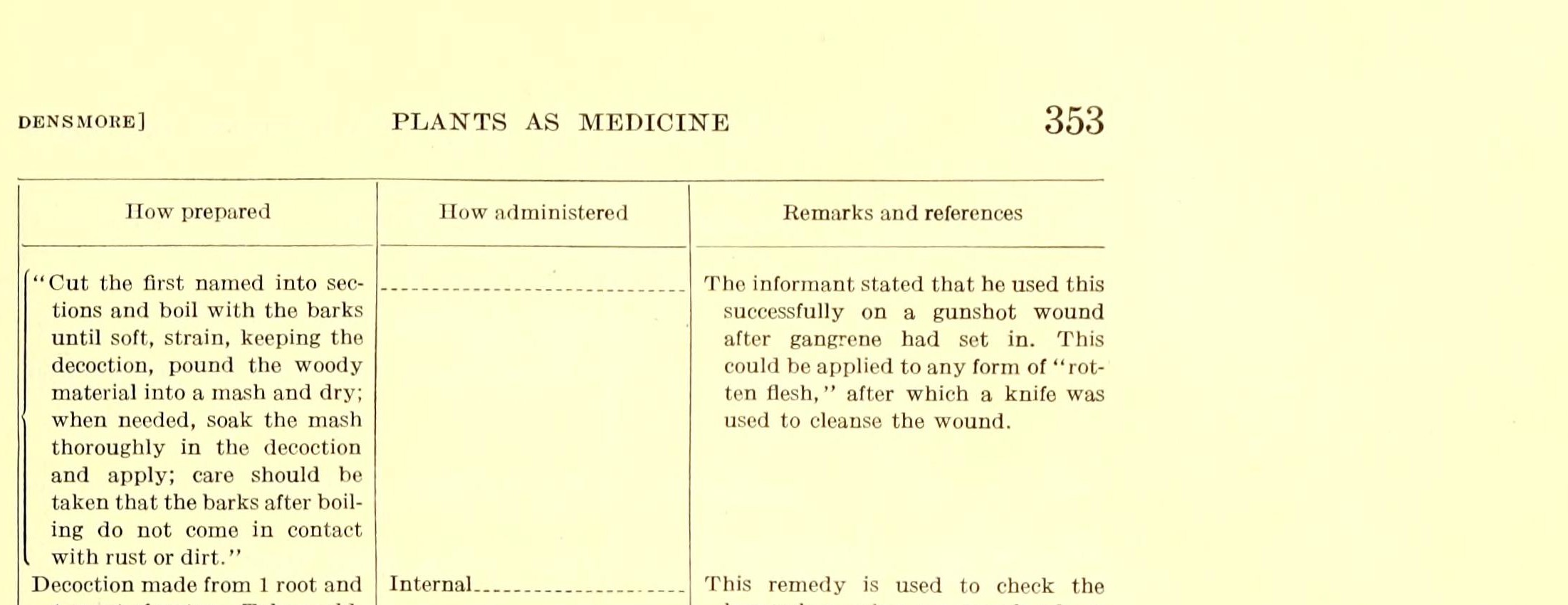


Chippewa Poultices for Cuts and Bruises: White Pine with Cherry and Plum Bark, and Fireweed Leaves (Densmore, 1928)
Two Chippewa (Ojibwe) poultices recorded by Frances Densmore. For cuts: a young white pine trunk boiled with wild cherry and wild plum inner bark, strained, the wood pounded to a mash and dried, then soaked in the kept decoction when needed. For bruises: moistened fireweed leaves. Recorded use, not medical advice.
Beginner
Half a day, plus drying
Instructions
1
1
Read Densmore
Read Densmore
"Care should be taken that the barks after boiling do not come in contact with rust or dirt." Recorded use, not medical advice: deep or dirty wounds need a doctor (ours).
2
2
Boil pine with the barks
Boil pine with the barks
Cut the trunk of a young white pine into sections and boil them with wild cherry inner bark and the inner bark of a young wild plum until soft. Ours: a clay pot, since nothing boiled may touch rust; amounts are not given.
Materials for this step:
 White Pine Sapling1 piece
 Wild Cherry Inner Bark1 piece
 Wild Plum Bark1 piece
 Water1 piece
Tools needed:
 Hatchet
 Clay Pot
 Fire Pit
3
3
Strain, mash and dry
Strain, mash and dry
Strain and keep the decoction. Pound the woody material into a mash and dry it. Ours: keep both clean and covered.
Tools needed:
 Cheesecloth
 Hammerstone
 Drying Rack
 Birch Bark Container
4
4
Apply to a cut
Apply to a cut
When needed, soak the mash thoroughly in the decoction and apply. The informant said he used it on a gunshot wound after gangrene had set in, and that it could go on any "rotten flesh", after which a knife was used to clean the wound.
Tools needed:
Clay Pot5
5
Fireweed poultice for a bruise
Fireweed poultice for a bruise
Moisten fresh or dried fireweed leaves and make them into a poultice. The same poultice might be used to draw out a sliver.
Materials for this step:
 Fireweed Leaves1 pieceWater1 piece
Tools needed:
Hammerstone6
6
Troubleshooting
Troubleshooting
Poultice troubleshooting.
Flow
Loading...
7
7
History and honest limits
History and honest limits
From Frances Densmore, *Uses of Plants by the Chippewa Indians*, **44th Annual Report of the Bureau of American Ethnology** (1928), pp. 352-353 (checked on the archive.org scan usesofplantsbych00dens). Chippewa remedies were mostly knowledge of the Midewiwin, shared with her so a record would survive. Amounts, the clay pot and safety advice are ours. Recorded use, not medical advice.
Materials
5- 1 piecePlaceholder
- 1 piecePlaceholder
- 1 piecePlaceholder
- 2 piecesPlaceholder
- 1 piecePlaceholder
This blueprint makes

Related Blueprints
These blueprints share knowledge with this one — techniques, materials, or principles that connect them in the learning graph.
CC0 Public Domain
This blueprint is released under CC0. You are free to copy, modify, distribute, and use this work for any purpose, without asking permission.
Support the Maker by purchasing products through their Blueprint where they earn a Maker Commission set by Vendors, or create a new iteration of this Blueprint and include it as a connection in your own Blueprint to share revenue.