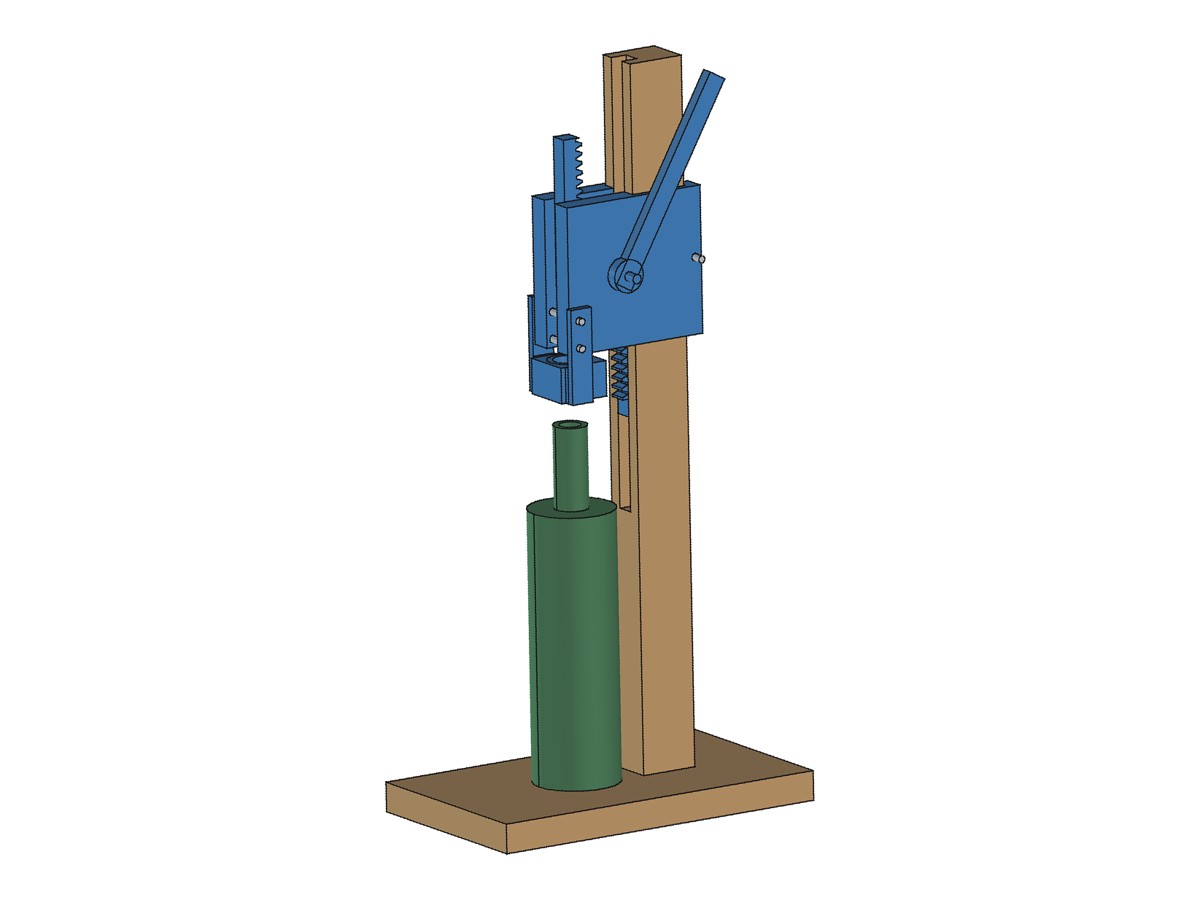
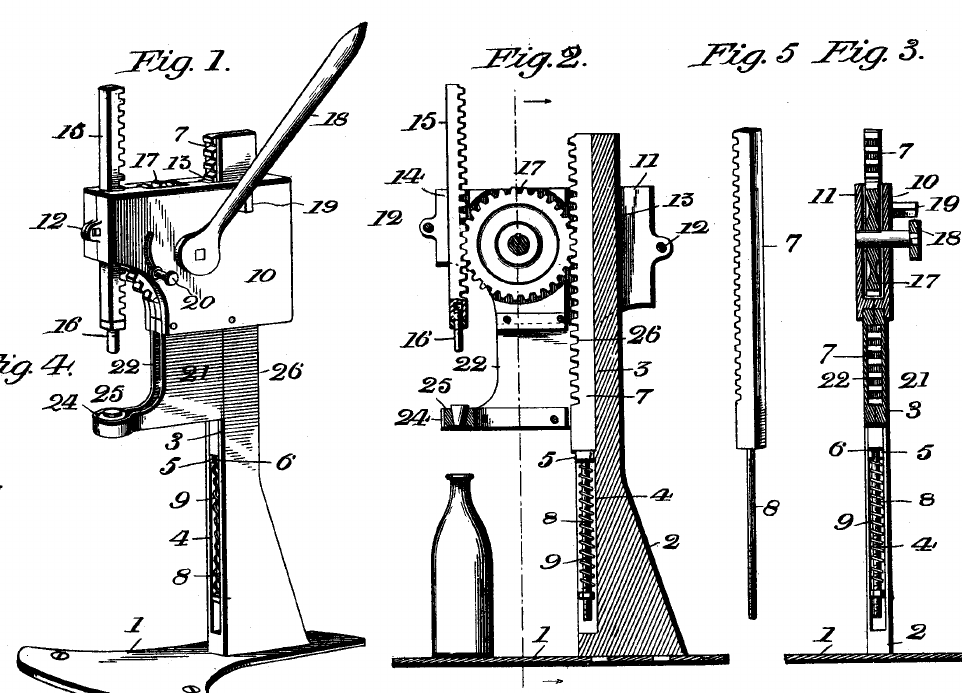
"""Corker after Raiche US 675,906 (1901): kinematics and layout. EVERY number OURS (mm, ground z = base top).
x: from the standard's front face towards the bottle; y: across; z: up."""
import math
M, Z = 2.5, 16                    # module, wheel teeth
R = M * Z / 2                     # wheel pitch radius 20
FACE = 15.0                       # tooth face width (y)
BOTTLE_TOP = 300.0                # 75 cl wine bottle (measure yours; the head is set by where the standard's rack sits)
COLLAR_H = 30.0                   # collar 25 height = cork length it holds
CLEAR = 25.0                      # collar bottom above the bottle top, head fully up
CORK_TOP_GAP = 0.0                # cork top flush with collar top
TIP_GAP = CLEAR                   # plunger tip this far above the cork: it just reaches the cork as the collar seats
PUSH_PAST = 2.0                   # tip ends 2 mm below the bottle top: cork set just under flush
X_RACK7_PITCH = 1.25 * M          # rack 7 root on the standard face (x = 0), pitch line here
X_AXLE = X_RACK7_PITCH + R
X_PLUNGER_PITCH = X_AXLE + R
X_PLUNGER_ROOT = X_PLUNGER_PITCH + 1.25 * M
PLUNGER_T = 12.0                  # plunger body behind its teeth (x)
X_BOTTLE = X_PLUNGER_ROOT + PLUNGER_T / 2   # cork / bottle axis
# strokes
phase1 = CLEAR                    # head travel until the collar seats; plunger moves 2x (head + relative)
rel1 = phase1                     # plunger travel relative to the head in phase 1
phase2_rel = COLLAR_H + PUSH_PAST # plunger travel relative to the (stopped) head in phase 2 = rack 7 rise
theta1, theta2 = phase1 / R, phase2_rel / R
COLLAR_BOT_UP = BOTTLE_TOP + CLEAR
CORK_TOP_UP = COLLAR_BOT_UP + COLLAR_H
TIP_UP = CORK_TOP_UP + TIP_GAP
TIP_END = BOTTLE_TOP - PUSH_PAST
# head (plates 10/11) and axle at the up position
TIP_OUT = 37.0                    # M8 tip bolt sticks out this far below the plunger body (keeps the body out of the collar)
AXLE_UP = TIP_UP + 50.0
HEAD_H = 110.0
HEAD_BOT_UP = AXLE_UP - 50.0
if __name__ == "__main__":
    print(f"axle x {X_AXLE:.2f}, plunger pitch x {X_PLUNGER_PITCH:.2f}, bottle axis x {X_BOTTLE:.2f}")
    print(f"phase 1: head down {phase1}, plunger down {2*phase1} (2x); turn {math.degrees(theta1):.0f} deg")
    print(f"phase 2: head still, plunger down {phase2_rel}, rack 7 up {phase2_rel} against the spring; turn {math.degrees(theta2):.0f} deg")
    print(f"handle total {math.degrees(theta1+theta2):.0f} deg; tip {TIP_UP} -> {TIP_UP - 2*phase1 - phase2_rel} (target {TIP_END})")
    print(f"collar bottom up {COLLAR_BOT_UP}, axle up {AXLE_UP}, axle down {AXLE_UP-phase1}")

# ---- build_all.py ----
"""Raiche corker (US 675,906) with our sizes: parts, clash check at three handle positions, STL export, hero render.
freecadcmd with NOSAVE=1 -> solids + clash only."""
import os, sys, math
sys.path.insert(0, "/home/admiraloom/Desktop/youblob/JIRA-tasks/batch-2535")
sys.path.insert(0, "/home/admiraloom/Desktop/youblob/JIRA-tasks/freecad/batch-2525")
import importlib, _geo as G; importlib.reload(G)
import FreeCAD as App, Part
V = App.Vector
OUT = "/home/admiraloom/Desktop/youblob/JIRA-tasks/freecad/batch-2535/out/"
LOG = open(OUT + "build.log", "w")
def L(*a): LOG.write(" ".join(map(str, a)) + "\n"); LOG.flush()
def box(x0, x1, y0, y1, z0, z1): return Part.makeBox(x1-x0, y1-y0, z1-z0, V(x0, y0, z0))
def ycyl(x, z, r, y0, y1): return Part.makeCylinder(r, y1-y0, V(x, y0, z), V(0, 1, 0))
def zcyl(x, y, r, z0, z1): return Part.makeCylinder(r, z1-z0, V(x, y, z0), V(0, 0, 1))
def xcyl(y, z, r, x0, x1): return Part.makeCylinder(r, x1-x0, V(x0, y, z), V(1, 0, 0))
m = G.M; p = math.pi * m; PA = math.radians(20); BL = 0.25
def rack(x_root, sgn, z0, z1, zref, y0, y1, body):
    """Rack along z; teeth point to +x (sgn=+1) or -x from the root line x_root; a tooth SPACE is centred at zref."""
    xp = x_root + sgn * 1.25 * m; xt = xp + sgn * m
    tw = p / 2 - BL                      # tooth thickness at the pitch line
    half_p = tw / 2; dt = math.tan(PA)
    solid = box(*(sorted([x_root, x_root - sgn * body])), y0, y1, z0, z1)
    k0 = int((z0 - zref) / p) - 2; k1 = int((z1 - zref) / p) + 2
    for k in range(k0, k1 + 1):
        zc = zref + (k + 0.5) * p        # tooth centre half a pitch from a space centre
        pts = [(x_root, zc - half_p - 1.25 * m * dt), (xt, zc - half_p + m * dt), (xt, zc + half_p - m * dt), (x_root, zc + half_p + 1.25 * m * dt)]
        w = Part.makePolygon([V(x, y0, z) for x, z in pts] + [V(pts[0][0], y0, pts[0][1])])
        t = Part.Face(w).extrude(V(0, y1 - y0, 0))
        solid = solid.fuse(t)
    return solid.common(box(-500, 500, y0 - 1, y1 + 1, z0, z1)).removeSplitter()
try:
    import gears as GR
    GR.PA = PA; GR.BACKLASH = BL
    prof = GR.involute_profile(G.Z, m, pts=10)
    def wheel_at(x, z, ang):
        w = Part.makePolygon([V(px, 0, pz) for px, pz in prof] + [V(prof[0][0], 0, prof[0][1])])
        sh = Part.Face(w).extrude(V(0, G.FACE, 0)).translate(V(0, -G.FACE / 2, 0))
        sh = sh.cut(ycyl(0, 0, 4.2, -20, 20))
        sh.rotate(V(0, 0, 0), V(0, 1, 0), ang)
        return sh.translate(V(x, 0, z))
    # ---- fixed: base, standard, shoulder, rack 7 rest position ------------------------
    base = box(-120, 180, -90, 90, -25, 0)
    std = box(-50, 0, -20, 20, 0, 600).cut(box(-14.5, 0.1, -8, 8, 300, 601)).cut(box(-16.5, 0.1, -8, 8, 220, 300.1))   # groove 3 (rack) and groove 4 (spring)
    shoulder = box(-14.4, -0.1, -7.9, 7.9, 300, 315).cut(zcyl(-7, 0, 4.3, 299, 316))
    RACK7_Z0, RACK7_Z1 = 315.0, 470.0
    def rack7(rise): return rack(0.0, 1, RACK7_Z0 + rise, RACK7_Z1 + rise, G.AXLE_UP + rise, -7.5, 7.5, 14.0).cut(zcyl(-7, 0, 3.4, RACK7_Z0 + rise - 1, RACK7_Z0 + rise + 30)).cut(Part.makePolygon([V(-7 + 7.6*math.cos(math.radians(60*i+30)), 7.6*math.sin(math.radians(60*i+30)), 0) for i in range(7)]).extend if False else Part.Face(Part.makePolygon([V(-7 + 7.6*math.cos(math.radians(60*i+30)), 7.6*math.sin(math.radians(60*i+30)), RACK7_Z0 + rise + 8) for i in range(7)])).extrude(V(0, 0, 7)))
    # ---- head (moves down by h) ----------------------------------------------------------
    XB = G.X_BOTTLE
    def plates(h):
        out = None
        for s in (1, -1):
            pl = box(-62, 68, 8 if s > 0 else -26, 26 if s > 0 else -8, G.HEAD_BOT_UP - 15, G.HEAD_BOT_UP + G.HEAD_H)
            pl = pl.cut(box(-51, 0.2, -20.3 if s < 0 else 7, 20.3 if s > 0 else -7, 0, 700))   # room for the standard
            pl = pl.cut(box(-51, 0.2, -20.3, 20.3, 0, 700))
            out = pl if out is None else out.fuse(pl)
        for (x, z, r) in ((G.X_AXLE, G.AXLE_UP, 4.3), (-56, G.AXLE_UP, 3.2), (62, G.HEAD_BOT_UP - 8, 3.2), (62, G.AXLE_UP - 35, 3.2)):
            out = out.cut(ycyl(x, z, r, -40, 40))
        return out.translate(V(0, 0, -h))
    def bracket(h):
        zb = G.COLLAR_BOT_UP
        blk = box(XB - 22, XB + 22, -22, 22, zb, zb + G.COLLAR_H)
        for s in (1, -1):
            blk = blk.fuse(box(50, 70, 26 if s > 0 else -32, 32 if s > 0 else -26, zb, G.AXLE_UP - 25))
            blk = blk.fuse(box(50, 70, 22 if s > 0 else -26, 26 if s > 0 else -22, zb, zb + G.COLLAR_H))
        blk = blk.cut(zcyl(XB, 0, 18.2, zb - 1, zb + G.COLLAR_H + 1))
        for z in (G.HEAD_BOT_UP - 8, G.AXLE_UP - 35): blk = blk.cut(ycyl(62, z, 3.2, -40, 40))
        return blk.translate(V(0, 0, -h))
    def collar(h):
        zb = G.COLLAR_BOT_UP; H = G.COLLAR_H
        outer = zcyl(XB, 0, 18.0, zb, zb + H)
        bore = Part.makeCone(18.5 / 2, 27 / 2, H - 6.3, V(XB, 0, zb + 6.3), V(0, 0, 1))
        seat = Part.makeCone(31 / 2, 18.5 / 2, 6.3, V(XB, 0, zb - 0.01), V(0, 0, 1))
        return outer.cut(bore.fuse(seat).fuse(zcyl(XB, 0, 18.5/2, zb, zb + 7))).translate(V(0, 0, -h))
    def bolts(h):
        b = None
        for (x, z) in ((-56, G.AXLE_UP), (62, G.HEAD_BOT_UP - 8), (62, G.AXLE_UP - 35)):
            c = ycyl(x, z, 3.0, -36, 36); b = c if b is None else b.fuse(c)
        return b.translate(V(0, 0, -h))
    def plunger(h, rel):
        zb = G.TIP_UP + G.TIP_OUT; body = rack(G.X_PLUNGER_ROOT, -1, zb, zb + 125, G.AXLE_UP, -7.5, 7.5, G.PLUNGER_T)
        tip = zcyl(XB, 0, 4.0, G.TIP_UP, zb + 20)
        return body.fuse(tip).translate(V(0, 0, -h - rel))
    def axle_handle(h, ang):
        ax = ycyl(G.X_AXLE, G.AXLE_UP, 4.0, -40, 60)
        lever = box(-10, 180, 38, 48, -8, 8); lever = lever.fuse(ycyl(0, 0, 14, 38, 48))
        lever.rotate(V(0, 0, 0), V(0, 1, 0), 240 + ang)        # starts pointing up and back, pushed down and forward
        lever.translate(V(G.X_AXLE, 0, G.AXLE_UP))
        return ax.fuse(lever).translate(V(0, 0, -h))
    bottle = zcyl(XB, 0, 14.5, 230, G.BOTTLE_TOP).fuse(zcyl(XB, 0, 37, 0, 230)).cut(zcyl(XB, 0, 9.25, 200, G.BOTTLE_TOP + 1))
    # three positions: rest, collar seated, full stroke
    th1, th2 = math.degrees(G.theta1), math.degrees(G.theta2)
    STATES = {"rest": (0.0, 0.0, 0.0, 0.0), "seated": (G.phase1, G.rel1, 0.0, th1), "full": (G.phase1, G.rel1 + G.phase2_rel, G.phase2_rel, th1 + th2)}
    for SIGN in (1,):
        L("== wheel sign", SIGN)
        for st, (h, rel, rise, ang) in STATES.items():
            parts = {"base": base, "standard": std, "shoulder": shoulder, "rack7": rack7(rise), "plates": plates(h), "bracket": bracket(h),
                     "collar": collar(h), "bolts": bolts(h), "plunger": plunger(h, rel), "wheel": wheel_at(G.X_AXLE, G.AXLE_UP - h, SIGN * ang),
                     "axle+handle": axle_handle(h, -SIGN * ang if False else SIGN * ang), "bottle": bottle}
            ks = list(parts); hits = []
            for i in range(len(ks)):
                for j in range(i + 1, len(ks)):
                    a, b = ks[i], ks[j]
                    if {a, b} in ({"axle+handle", "wheel"}, {"axle+handle", "plates"}, {"bolts", "plates"}, {"bolts", "bracket"}, {"collar", "bracket"}):
                        continue                                   # intended fits (axle in its holes, bolts, collar in its holder)
                    v = parts[a].common(parts[b]).Volume
                    if v > 0.01: hits.append(f"{a}x{b}:{v:.2f}")
            L(st, hits)
        tot = th1 + th2
        for a in range(0, int(tot) + 1, 8):
            h = min(a, th1) / th1 * G.phase1
            hp = axle_handle(h, a)
            hh = [k for k, sh in (("standard", std), ("base", base), ("bottle", bottle), ("bracket", bracket(h)), ("plates", plates(h))) if (hp.common(sh).Volume > 0.01 and k != "plates") or (k == "plates" and hp.common(sh).Volume > 60)]
            if hh: L("handle sweep", a, hh)
        L("handle start 240, end", 240 + round(tot))
    if os.environ.get("NOSAVE") != "1":
        import MeshPart
        h, rel, rise, ang = STATES["rest"]
        prints = {"corker-wheel": wheel_at(0, 0, 0).cut(Part.Face(Part.makePolygon([V(7.6*math.cos(math.radians(60*i)), -7.5, 7.6*math.sin(math.radians(60*i))) for i in range(7)])).extrude(V(0, 6.5, 0))), "corker-rack": rack7(0), "corker-plunger": rack(G.X_PLUNGER_ROOT, -1, G.TIP_UP + G.TIP_OUT, G.TIP_UP + G.TIP_OUT + 125, G.AXLE_UP, -7.5, 7.5, G.PLUNGER_T).cut(zcyl(G.X_BOTTLE, 0, 4.3, G.TIP_UP, G.TIP_UP + G.TIP_OUT + 30)).cut(Part.Face(Part.makePolygon([V(G.X_BOTTLE + 7.6*math.cos(math.radians(60*i)), 7.6*math.sin(math.radians(60*i)), G.TIP_UP + G.TIP_OUT + 12) for i in range(7)])).extrude(V(0, 0, 7))), "corker-plates": plates(0),
                  "corker-collar-holder": bracket(0), "corker-collar": collar(0), "corker-shoulder": shoulder}
        prints["corker-handle"] = axle_handle(0, 0).cut(ycyl(G.X_AXLE, G.AXLE_UP, 4.0, -40, 60)).translate(V(-G.X_AXLE, -38, -G.AXLE_UP)).cut(ycyl(0, 0, 4.3, -5, 15))
        for k, v in prints.items():
            L(k, "valid", v.isValid(), "solids", len(v.Solids), "vol cm3", round(v.Volume / 1000, 1))
            MeshPart.meshFromShape(Shape=v, LinearDeflection=0.05, AngularDeflection=0.2).write(OUT + k + ".stl")
        import FreeCADGui as Gui
        d = App.newDocument("h")
        wood, petg, steel, glass = (0.72, 0.55, 0.36), (0.20, 0.45, 0.70), (0.70, 0.71, 0.74), (0.25, 0.45, 0.30)
        cols = {"base": wood, "standard": wood, "shoulder": petg, "rack7": petg, "plates": petg, "bracket": petg, "collar": petg,
                "bolts": steel, "plunger": petg, "wheel": petg, "axle+handle": petg, "bottle": glass}
        st = {"rest": (0, 0, 0, 0)}["rest"]
        parts = {"base": base, "standard": std, "shoulder": shoulder, "rack7": rack7(0), "plates": plates(0), "bracket": bracket(0), "collar": collar(0),
                 "bolts": bolts(0), "plunger": plunger(0, 0), "wheel": wheel_at(G.X_AXLE, G.AXLE_UP, 0), "axle+handle": axle_handle(0, 0), "bottle": bottle}
        for n, sh in parts.items():
            o = d.addObject("Part::Feature", n.replace("+", "_")); o.Shape = sh; d.recompute()
            Gui.ActiveDocument.getObject(n.replace("+", "_")).ShapeColor = cols[n]
        v = Gui.ActiveDocument.ActiveView
        v.setCameraType("Orthographic"); v.setViewDirection((-0.55, -0.85, -0.25)); v.fitAll(); Gui.updateGui()
        v.saveImage(OUT + "hero.png", 1200, 1600, "White"); L("hero saved")
except Exception:
    import traceback; L(traceback.format_exc())
LOG.close(); os._exit(0)

 Digital Caliper 6-Inch
 PETG Filament22 g
 FDM 3D Printer
 Hardwood Board1 piece (25 x 180 x 300 mm and 50 x 40 x 600 mm)
 Wood Glue20 ml
 Wood Screws4 pieces
 Hand Saw
 Chisel Set
 Wooden Mallet
 Combination Square
 Cordless Drill
 Drill Bit Set
 Bar Clamp
 Sandpaper
 Threaded Rod1 piece (M8, 90 mm)
 Compression Spring Set1 piece (about 14 x 60 mm)
 Hex Nut3 piece (M8)
 Flat Washer1 piece (M8)
 Hacksaw
 Adjustable Wrench
 Screwdriver Set
 Socket Head Cap Screw1 piece (M8 x 50)
 Hex Key Set
 Corks1 piece