Collaboration
ART
BEAUTY & WELLNESS
CRAFT
CULTURE & HISTORY
ENTERTAINMENT
ENVIRONMENT
FOOD & DRINKS
REVERSE ENGINEERING
SCIENCES
SPORTS
TECHNOLOGY
WEARABLES
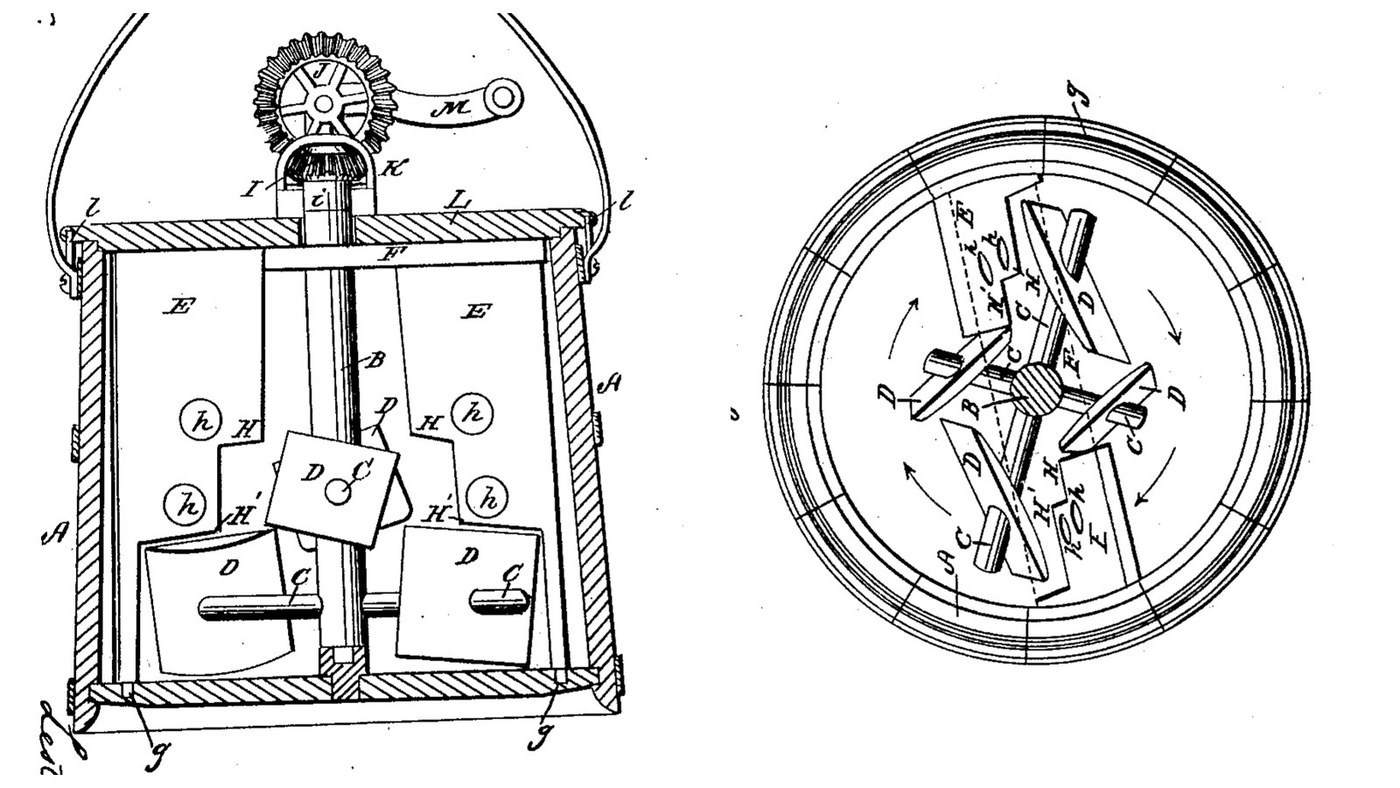

Diagonal-Blade Shouldered-Breaker Churn: Pitched Blades on Uneven Arms Turn Under the Shoulders of Two Breakers
Lester Day of Buffalo, New York, received US 26,970, dated 31 January 1860, for a churn. An upright shaft carries short upper arms and long lower arms, each with a rectangular blade set diagonally and adjustable along it, the two of a pair at different distances so neither follows the other's track. Two breakers, joined at the top and lifting out together, stand opposite each other with stepped shoulders under which the blades turn, and holes the cream is thrown through.
The patent gives no sizes; every size here is ours.
Intermediate
About 2 days, plus printing
Instructions
1
1
Blades that never follow each other's track
Blades that never follow each other's track
Loading Jupyter Notebook...
2
2
Short blades within, a long one under, two months before
Short blades within, a long one under, two months before
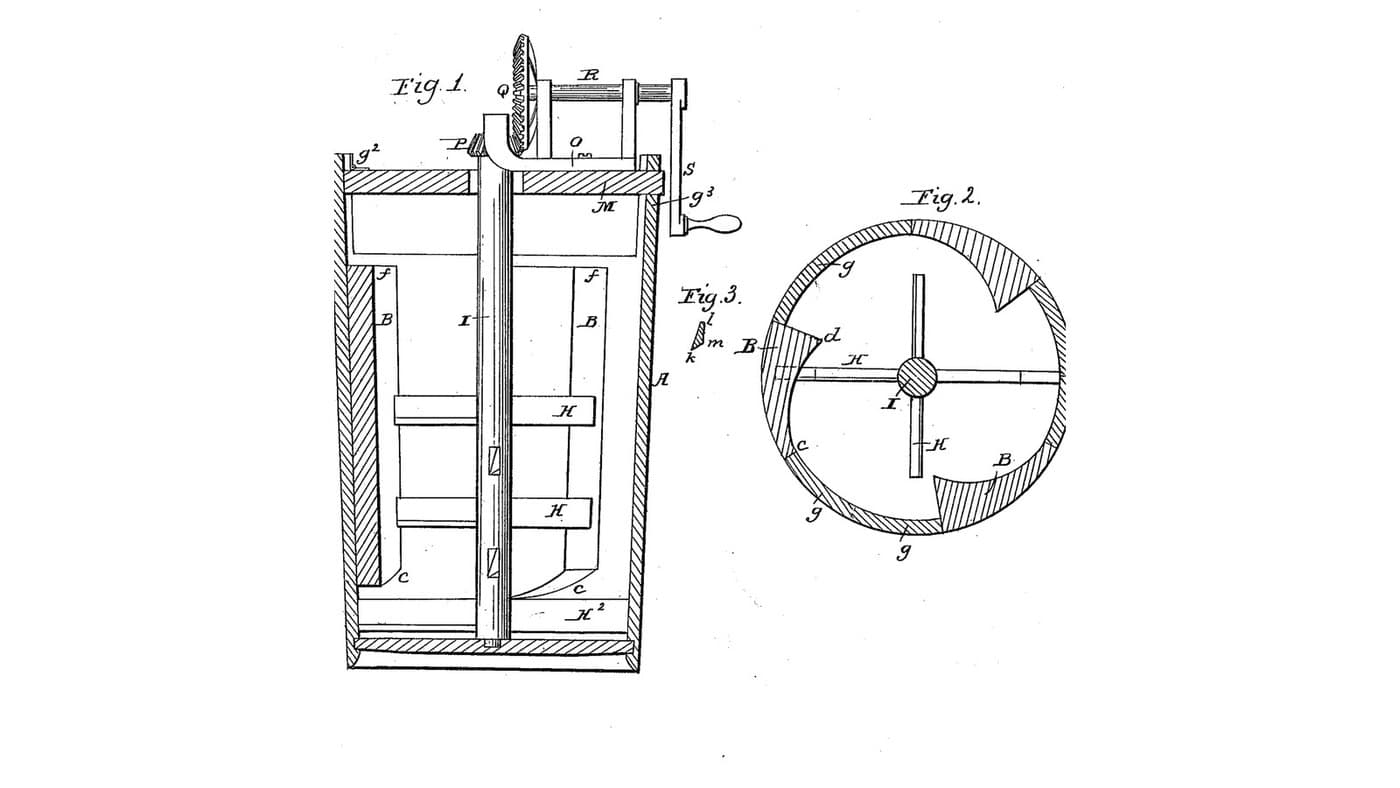
Jebb's thick staves are part of the tub. Day's breakers stand free, step back in two shoulders, and lift out.
3
3
Read US 26,970
Read US 26,970
"Motion being given to the dash blades by means of the crank and gearing, in the direction of the arrows, they will by their diagonal position on the arms throw the cream or milk outward against the side of the barrel and against the breakers, part passing through the space between the breakers and the side of the barrel, and part being thrown through the holes (h) in the breakers and part being thrown back by the breakers meeting these currents causing a concussion between them"
4
4
Print the wheel J
Print the wheel J
Crown wheel, 36 teeth on its face, module 2, with a hub bored 12.4 mm and a cross hole for a pin. PETG, 0.2 mm layers, 40 % infill, 4 walls.
5
5
Print the pinion I
Print the pinion I
Spur pinion, 12 teeth, module 2, with a 12.4 mm square socket for the shaft's top. PETG, 0.2 mm layers, 40 % infill, 4 walls.
6
6
Print the foot step b
Print the foot step b
A cup 60 mm across and 25 mm tall with a 21 mm socket for the shaft's foot. PETG, 0.2 mm layers, 40 % infill, 4 walls.
7
7
Tub A, breakers E and cross piece F
Tub A, breakers E and cross piece F
Use a wooden tub 360 mm across inside and 450 mm deep; glue the foot step in the middle of its floor and two hardwood sockets g opposite each other against the wall. Cut two breakers from 15 mm hardwood, 420 mm tall, their outer edges 10 mm off the wall: from the top down to 350 mm up their inner edges reach 40 mm from the middle, then step out at H to 118 mm, and at H' (165 mm up) to 150 mm. Bore two 30 mm holes h through each at 220 and 290 mm up. Screw a cross piece 336 x 40 x 20 mm across their tops, bored 32 mm in the middle, and stand them in the sockets leaning slightly. Fill the tub with water overnight so it swells tight, then empty it.
Materials for this step:
 Wooden Tub1 piece
 Hardwood Board2 pieces
 Wood Glue1 piece
 Wood Screws12 pieces
 PETG Filament1 piece
Tools needed:
 FDM 3D Printer
 Jigsaw
 Table Saw
 Spade Bit Set
 Cordless Drill
 Drill Bit Set
 Bar Clamp
 Tape Measure
 Water
8
8
Shaft B, arms C and blades D
Shaft B, arms C and blades D
Turn a hardwood shaft 30 mm across and 500 mm long, its foot turned to 19 mm and its top 40 mm cut to a 12 mm square. Bore it across for two 16 mm hardwood arms at 300 mm up, 204 mm long, and two at 110 mm up at right angles, 272 mm long. Cut eight blades 90 x 70 x 10 mm, bore each through its middle at 45 degrees to its face for the arm, and slide them on: the upper pair at 50 and 62 mm from the shaft, the lower at 84 and 96 mm, the nearer and farther blade on opposite sides. Pin each where it sits.
Materials for this step:
Hardwood Board1 piece Hardwood Dowels2 piecesWood Glue1 piece
Tools needed:
 Wood LatheTable SawCordless DrillDrill Bit Set
 SandpaperTape Measure
9
9
Cover L, gear frame K and crank M
Cover L, gear frame K and crank M
Cut a cover to sit on the rim, bored 32 mm in its middle, held by two hooks and eyes. Screw two chairs on it in a line from the middle, carrying a 12 mm stainless shaft with the crown wheel and a crank, and drop the pinion over the shaft's square top so they mesh. Lift the cover off to free the shaft; lift the breakers out by the cross piece to clean them.
Materials for this step:
Hardwood Board1 piece Stainless Steel Rod1 piece
 Hook and Eye2 piecesWood Screws8 piecesHardwood Dowels1 pieceWood Glue1 piece
Tools needed:
Jigsaw CompassCordless DrillDrill Bit Set
 Hacksaw
 Files (Hand File)
 Screwdriver Set
10
10
The build in 3D
The build in 3D
FreeCAD model of this build, the tub and cover cut through the middle: the two shouldered breakers with their holes and cross piece, the shaft with its short upper and long lower arms and diagonal blades, the foot step, and the crown wheel, pinion and crank on the cover. The dash was turned through 24 positions.
11
11
Churn
Churn
Pour about 15 litres of heavy cream at about 15 °C into the tub, checked with the thermometer, put the cover on and hook it. Turn the crank steadily in the blades' direction, timing it. When the butter comes, lift the cover, dash and breakers out, take out the butter, drain the buttermilk, wash the butter in cold water until it runs clear, salt and weigh it.
Materials for this step:
 Heavy Cream15 l
 Coarse Sea Salt1 pieceWater1 piece
Tools needed:
 Leave-In Probe Thermometer
 Stopwatch
 Digital Kitchen Scale
 Stainless Steel Mixing Bowl (Large)
12
12
Troubleshooting
Troubleshooting
Shouldered-breaker churn troubleshooting.
Flow
Loading...
13
13
History and honest limits
History and honest limits
**Lester Day** of Buffalo, Erie County, New York, US 26,970, 31 January 1860, "Churn". He claimed the breakers E with shoulders H, H', fixed to the cross piece F and removable with it, and the adjustable diagonal dash blades D working with them. His blades may also be turned on their arms to throw the cream upward, or inward and downward when reversed. His bevel wheel and pinion are here a printed crown wheel and pinion. The patent gives no sizes; every size here is ours.
Materials
11- 1 piecePlaceholder
- 2 piecesPlaceholder
- 3 piecesPlaceholder
- 20 piecesPlaceholder
- 1 piecePlaceholder
- 2 piecesPlaceholder
- 1 piecePlaceholder
- 2 piecesPlaceholder
- 15 lPlaceholder
- 1 piecePlaceholder
- 1 piecePlaceholder
Tools Required
19- Placeholder
- 1 vendor sell this, none ship to you yetPlaceholder
- 1 vendor sell this, none ship to you yetPlaceholder
- Placeholder
- 1 vendor sell this, none ship to you yetPlaceholder
- Placeholder
- Placeholder
- 1 vendor sell this, none ship to you yetPlaceholder
- Placeholder
- Placeholder
- Placeholder
- Placeholder
- Placeholder
- Placeholder
- Placeholder
- Placeholder
- Placeholder
- Placeholder
- Placeholder
Design Files
4This blueprint makes

Related Blueprints
These blueprints share knowledge with this one — techniques, materials, or principles that connect them in the learning graph.
Segmental-Stave Churn: Thick Curved Staves Split the Cream's Current, a Long Blade Sweeps Beneath Them
by Buttercup
Woodworking
0
0
0
0
0
0
Ring-Disk Spiral-Pin Churn: Cream Forced Out Between Corrugated Rings, Then Drawn to the Middle by Spiral Pins
by Buttercup
Woodworking
0
0
0
0
0
0

Churning Butter from Cream — The 5,000-Year-Old Fat Separation
by TheChef
CRAFT
60
0
0
0
0
0
CC0 Public Domain
This blueprint is released under CC0. You are free to copy, modify, distribute, and use this work for any purpose, without asking permission.
Support the Maker by purchasing products through their Blueprint where they earn a Maker Commission set by Vendors, or create a new iteration of this Blueprint and include it as a connection in your own Blueprint to share revenue.