Collaboration
ART
BEAUTY & WELLNESS
CRAFT
CULTURE & HISTORY
ENTERTAINMENT
ENVIRONMENT
FOOD & DRINKS
REVERSE ENGINEERING
SCIENCES
SPORTS
TECHNOLOGY
WEARABLES
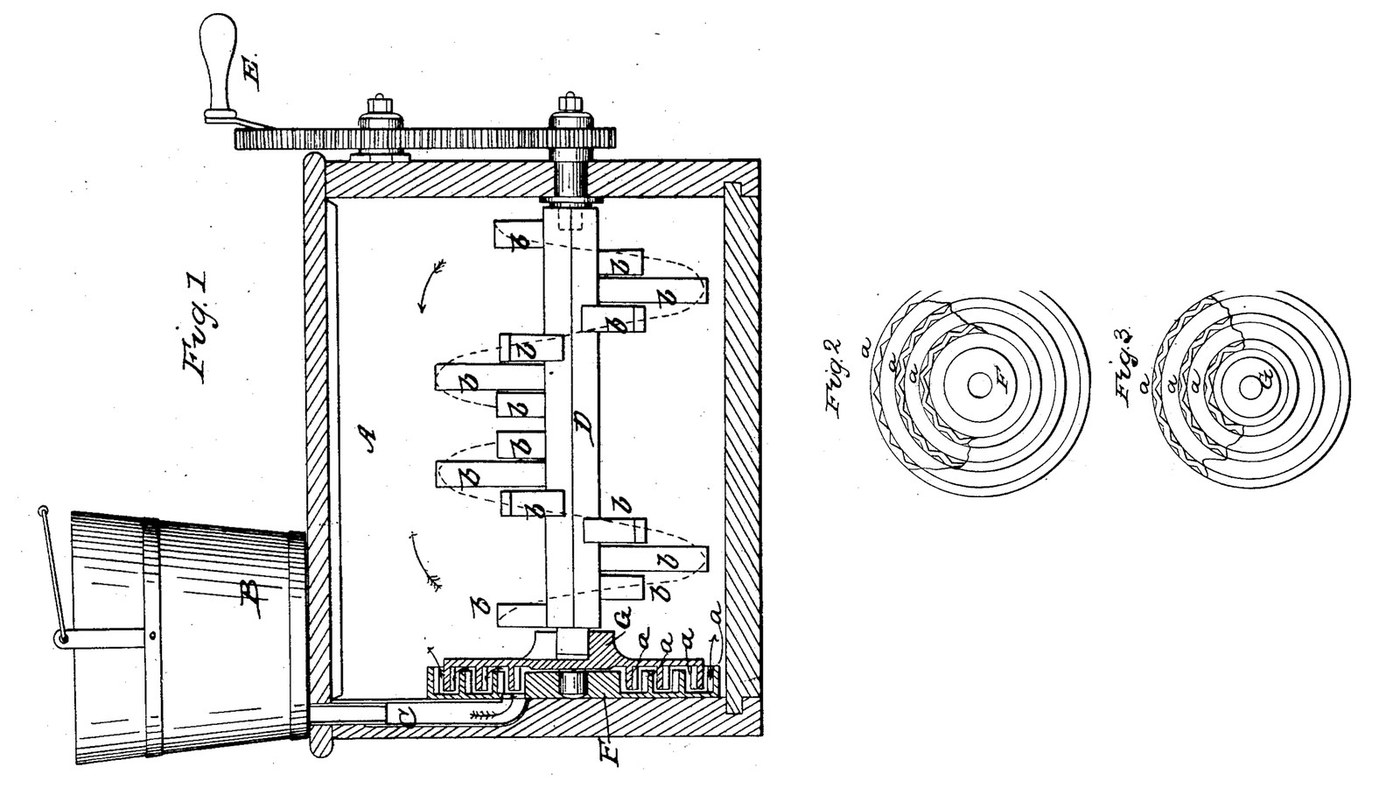

Ring-Disk Spiral-Pin Churn: Cream Forced Out Between Corrugated Rings, Then Drawn to the Middle by Spiral Pins
Daniel C. Brown of New York received US 26,880, dated 24 January 1860, for a churn. Cream poured into a hopper runs into the middle of a still disk at the bottom of a box, under a turning disk; their corrugated rings run between each other without touching, so the cream is flung outward and must climb over ring after ring. Above, the turning shaft carries pins set in two spirals that meet in the middle, drawing the butter there to be gathered.
The patent gives no sizes; every size here is ours.
Intermediate
About 2 days, plus printing
Instructions
1
1
Rings that never touch
Rings that never touch
Loading Jupyter Notebook...
2
2
Agitators passing between each other, two months before
Agitators passing between each other, two months before
Cornell's arms pass between those of a second shaft. Brown's rings run between the rings of a still disk.
3
3
Read US 26,880
Read US 26,880
"The milk or cream thus entering while the disk G is in rapid motion, it will be seen that (by the centrifugal force developed) the fluid will be forced outward, but, meeting the obstruction of the rings, will be checked—accumulate to some extent until forced to climb over and around them, successively advancing thus and being checked and being thereby subjected to the action of the corrugated surfaces upon each side of the rings"
4
4
Print the still disk F
Print the still disk F
A disk 236 mm across with three corrugated rings 8 mm thick and 12 tall at 40, 74 and 108 mm, a 21 mm bearing for G's journal, a 13 mm inlet beside it for the spout, and three feet. PETG, 0.2 mm layers, 40 % infill, 4 walls.
5
5
Print the turning disk G
Print the turning disk G
A disk 236 mm across with two corrugated rings at 57 and 91 mm, a 20 mm journal below and a hub above with a cross hole for the shaft's pin. PETG, 0.2 mm layers, 40 % infill, 4 walls.
6
6
Print the gear wheel
Print the gear wheel
Spur wheel, 48 teeth, module 3, 15 mm face, with a hub bored 20.6 mm. PETG, 0.2 mm layers, 40 % infill, 4 walls.
7
7
Print the geared stud's pinion
Print the geared stud's pinion
Spur pinion, 16 teeth, module 3, 15 mm face, with a hub bored 20.6 mm. PETG, 0.2 mm layers, 40 % infill, 4 walls.
8
8
Box A, hopper B and spout C
Box A, hopper B and spout C
From 20 mm hardwood make a box 300 x 300 mm and 450 mm deep inside with a lid bored 21 mm in its middle. Bore one side 13 mm, 10 mm above the floor in its middle. Bend a 12 mm stainless tube to run from outside, through that hole along the floor and up into F's inlet, seal it through the side, and fit a stainless funnel on its outer end as the hopper. Fill the box with water overnight so it swells tight, then empty it.
Materials for this step:
 Hardwood Board3 pieces
 Wood Glue1 piece
 Wood Screws30 pieces
 Stainless Steel Tube1 piece
 Stainless Steel Funnel1 piece
 Silicone Sealant1 piece
Tools needed:
 Table Saw
 Hand Saw
 Cordless Drill
 Drill Bit Set
 Spade Bit Set
 Hacksaw
 Bar Clamp
 Tape Measure
 Water
9
9
Disks, shaft D and pins b
Disks, shaft D and pins b
Stand F on its feet in the middle of the floor over the spout. Plane a hardwood shaft to a hexagon 40 mm across the flats and 393 mm long, with a 19 mm square socket 30 mm deep in its top, and pin its foot in G's hub. Bore twelve 16 mm holes through it from 35 to 332 mm above its foot, 27 mm apart, and glue in hardwood pins reaching 135 mm from the middle: the lower six turning 60 degrees each from the foot upward, the upper six the same from the top downward, so the two spirals meet at the middle. Set G's journal in F's bearing.
Materials for this step:
Hardwood Board1 piece Hardwood Dowels1 pieceWood Glue1 piece
 Split Pin1 piece
 PETG Filament1 piece
Tools needed:
 FDM 3D Printer
 Wood LatheTable Saw
 Mortise Chisel
 Wooden MalletCordless DrillDrill Bit Set
 Sandpaper
10
10
Geared stud and crank E
Geared stud and crank E
Pass a 20 mm stainless stud through the lid, square at its foot to drop into the shaft's socket, with the pinion pinned on top. Fix a second stud in the lid 96 mm away carrying the gear wheel, meshing, with a crank and handle on it. Lift the lid to free the shaft and disks for cleaning.
Materials for this step:
 Stainless Steel Rod2 piecesHardwood Board1 pieceHardwood Dowels1 piece
 Flat Washer4 piecesSplit Pin2 pieces
Tools needed:
Hacksaw Files (Hand File)Cordless DrillDrill Bit Set
11
11
The build in 3D
The build in 3D
FreeCAD model of this build, cut through the middle: the box, the spout running into the still disk, the turning disk with its rings between the still disk's, the hexagonal shaft with its two spirals of pins, and the geared stud, wheel and crank on the lid. The rotor was turned through 16 positions.
12
12
Churn
Churn
Turn the crank and pour heavy cream at about 15 °C, checked with the thermometer, into the hopper, about 15 litres in all, keeping the disk turning fast. Keep turning, timing it. When the butter comes the pins gather it in the middle: lift the lid, take out the shaft and the butter, drain the buttermilk, wash the butter in cold water until it runs clear, salt and weigh it.
Materials for this step:
 Heavy Cream15 l
 Coarse Sea Salt1 pieceWater1 piece
Tools needed:
 Leave-In Probe Thermometer
 Stopwatch
 Digital Kitchen Scale
 Stainless Steel Mixing Bowl (Large)
13
13
Troubleshooting
Troubleshooting
Ring-disk churn troubleshooting.
Flow
Loading...
14
14
History and honest limits
History and honest limits
**Daniel C. Brown** of New York, US 26,880, 24 January 1860, "Churn". He claimed the disks F and G with the rings on their inner sides. His disks were wood or metal; ours are printed. His hopper is a jointed bucket; ours is a funnel on a tube. The patent gives no sizes; every size here is ours.
Materials
14- 3 piecesPlaceholder
- 2 piecesPlaceholder
- 30 piecesPlaceholder
- 1 piecePlaceholder
- 1 piecePlaceholder
- 1 piecePlaceholder
- 1 piecePlaceholder
- 3 piecesPlaceholder
- 1 piecePlaceholder
- 2 piecesPlaceholder
- 4 piecesPlaceholder
- 15 lPlaceholder
- 1 piecePlaceholder
- 1 piecePlaceholder
Tools Required
19- 1 vendor sell this, none ship to you yetPlaceholder
- Placeholder
- 1 vendor sell this, none ship to you yetPlaceholder
- Placeholder
- Placeholder
- Placeholder
- Placeholder
- 1 vendor sell this, none ship to you yetPlaceholder
- Placeholder
- Placeholder
- Placeholder
- Placeholder
- Placeholder
- Placeholder
- Placeholder
- Placeholder
- Placeholder
- Placeholder
- Placeholder
Design Files
5This blueprint makes

Related Blueprints
These blueprints share knowledge with this one — techniques, materials, or principles that connect them in the learning graph.
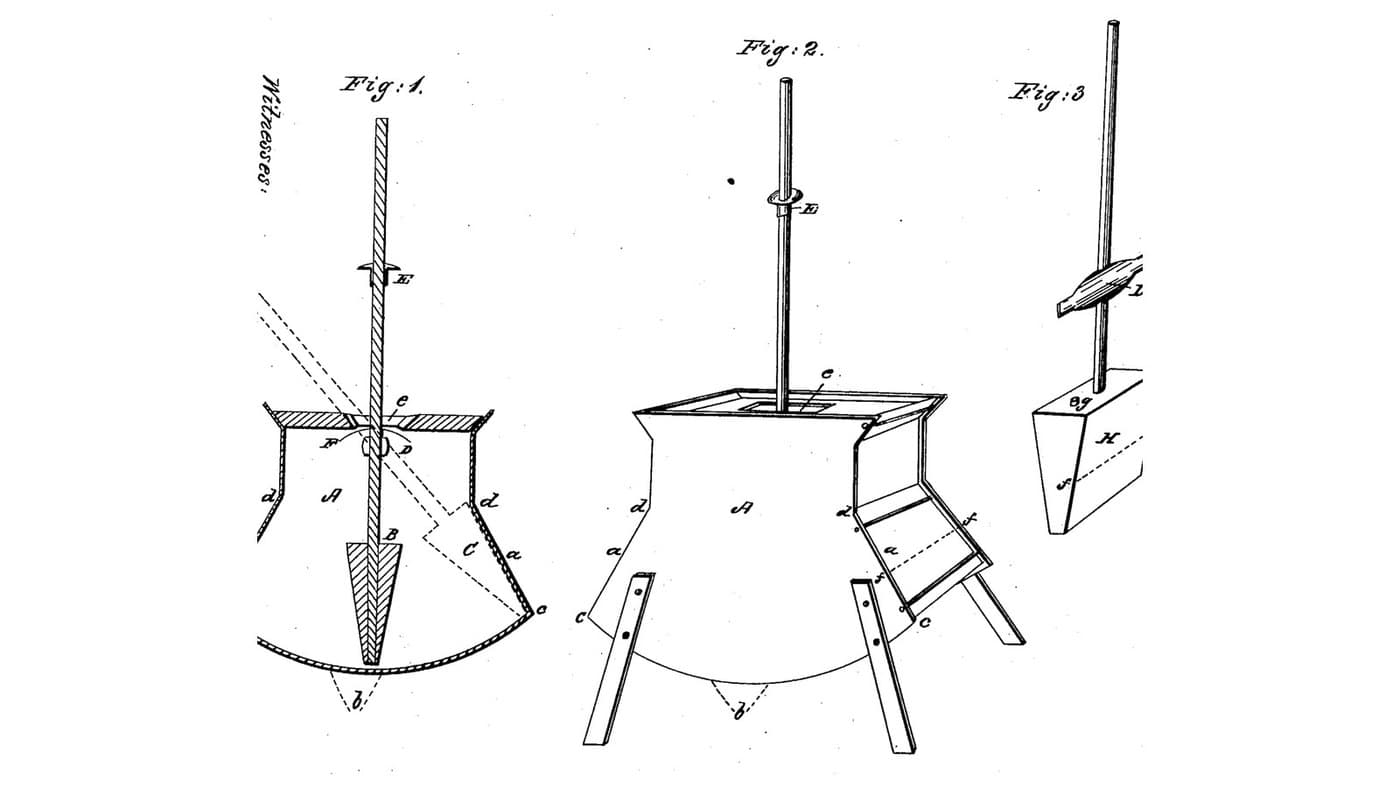
Swinging-Wedge Churn: A Wedge Dasher Sweeps a Curved Bottom and Strikes the Sloping Ends Squarely
by Buttercup
Woodworking
0
0
0
0
0
0
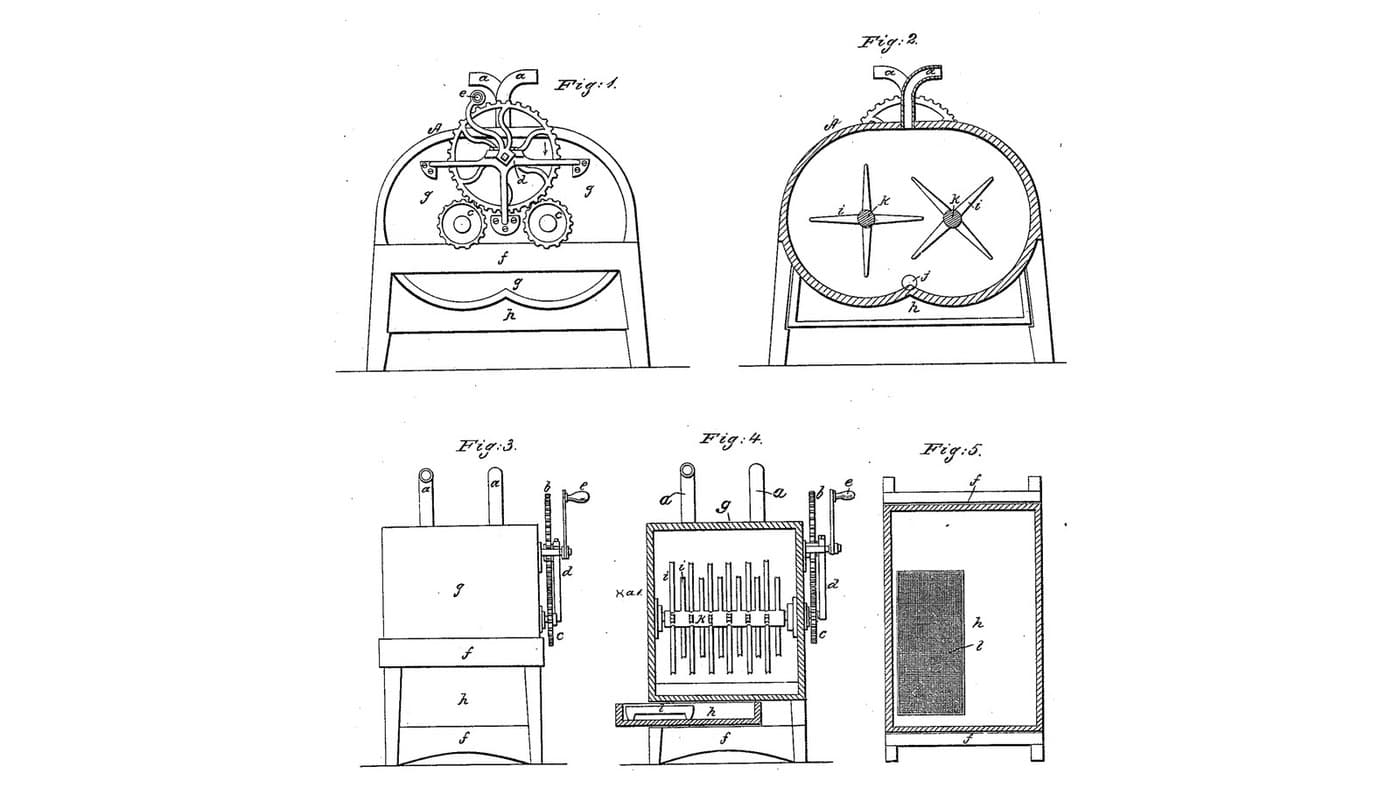
Double Rotary Crag Churn: Two Shafts of Four-Edged Arms Turn Through Each Other in Twin Half-Cylinders
by Buttercup
Woodworking
0
0
0
0
0
0

Churning Butter from Cream — The 5,000-Year-Old Fat Separation
by TheChef
CRAFT
60
0
0
0
0
0
CC0 Public Domain
This blueprint is released under CC0. You are free to copy, modify, distribute, and use this work for any purpose, without asking permission.
Support the Maker by purchasing products through their Blueprint where they earn a Maker Commission set by Vendors, or create a new iteration of this Blueprint and include it as a connection in your own Blueprint to share revenue.