ART
BEAUTY & WELLNESS
CRAFT
CULTURE & HISTORY
ENTERTAINMENT
ENVIRONMENT
FOOD & DRINKS
REVERSE ENGINEERING
SCIENCES
SPORTS
TECHNOLOGY
WEARABLES
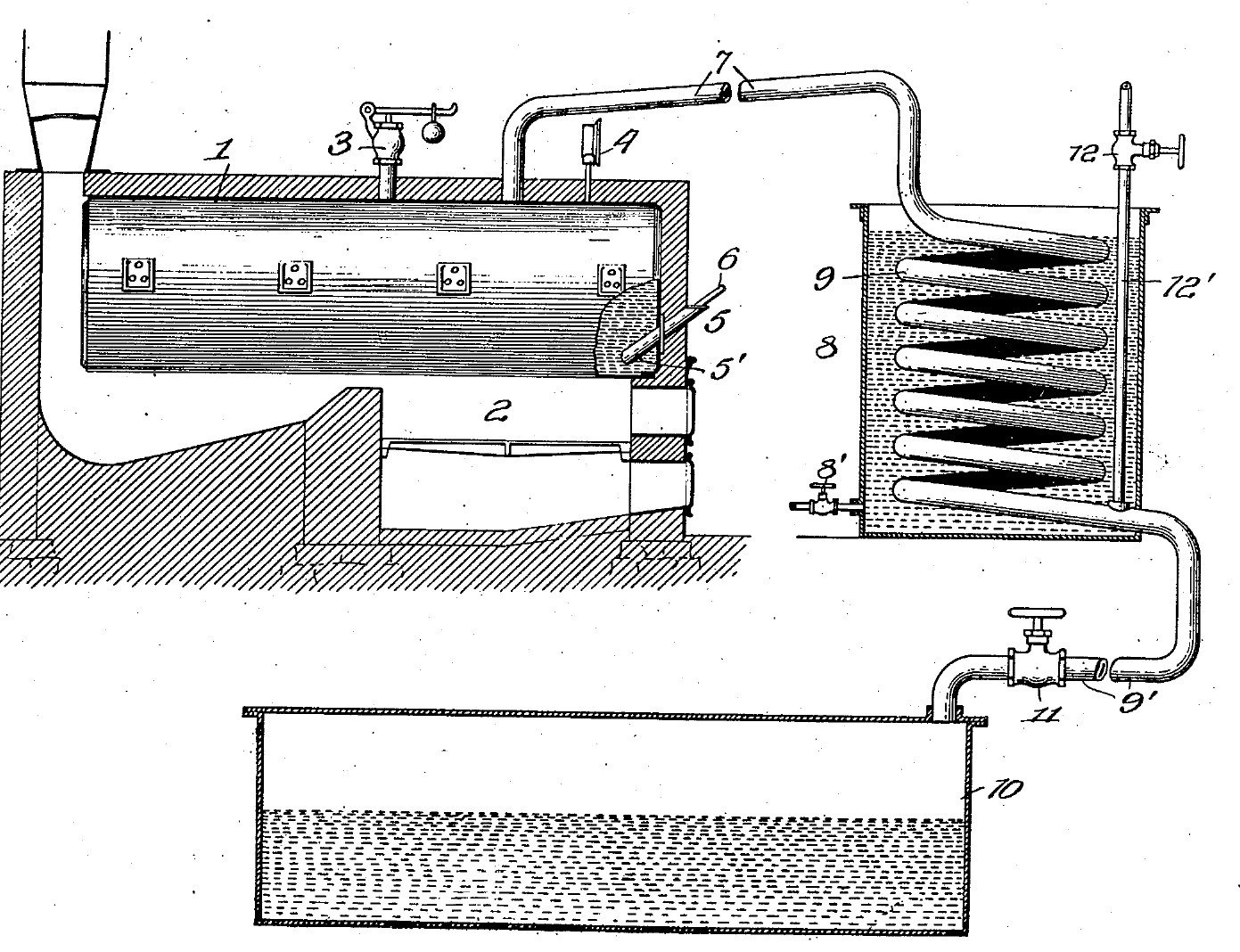


Gasoline by Pressure Cracking: Heavy Residue Distilled at 650-850 °F under 4-5 Atmospheres (Burton, US 1,049,667)
Straight distillation leaves most of a barrel of crude as heavy oil. Burton's 1913 patent turns that residue into gasoline: distil it hot while its own vapour is held at 4 to 5 atmospheres, all the way through the condenser. The heat and pressure break the heavy oil into light oil. Cracked gasoline is the first rung toward high-octane fuel.
Feed: the fuel-oil and gas-oil residue left after the light cuts, boiling at about 600 to 700 °F (claim: above 500 °F).
Source: W. M. Burton, US 1,049,667 (1913), assigned to Standard Oil (Indiana). Not given: charge size, run time, yield. Burton claims the gasoline stays in the paraffin series; that is his claim. A fired still under pressure needs a working safety valve. Picture: the patent drawing.
Expert
2 days
Instructions
1
1
Fill the pressure still with residue
Fill the pressure still with residue
The still is a closed, boiler-like holder over a fire chamber, with a safety valve, a pressure gauge, and a thermometer in an oil-filled tube slanting into it. Fill it with the heavy residue left after the gasoline and illuminating oils have been distilled off.
Materials for this step:
 Petroleum Residuum1 still charge
Tools needed:
 Pressure Still
 Pressure Gauge
 Thermometer
2
2
Close the outlet and fire it
Close the outlet and fire it
A pipe rises from the top of the still to a water-cooled condenser coil, then runs to a receiver tank. Keep the shut-off valve after the coil closed and fire the still. The vapours build up 4 to 5 atmospheres on the liquid, and its boiling point rises from 500-600 °F to 750-800 °F.
Tools needed:
Pressure Still Condenser Coil
 WaterPressure Gauge
3
3
Distil at 650 to 850 °F under pressure
Distil at 650 to 850 °F under pressure
Distil at about 650 to 850 °F. Keep the pressure on the vapours the whole way, in the still and while they condense in the coil. The heat and pressure turn the heavy oil into low-boiling oil.
Tools needed:
Pressure StillThermometerPressure Gauge4
4
Draw off the gasoline from time to time
Draw off the gasoline from time to time
Open the shut-off valve now and then to run the condensed gasoline into the receiver. Do it often enough that the coil never fills with liquid.
Tools needed:
Condenser Coil Oil Storage Tank
5
5
Let off the gas
Let off the gas
Gas that will not condense collects in the coil and blocks it. Release it from time to time through the relief valve on the pipe rising from the lower end of the coil.
Tools needed:
Condenser CoilMaterials
1- 1 still chargePlaceholder
This blueprint makes
Related Blueprints
These blueprints share knowledge with this one — techniques, materials, or principles that connect them in the learning graph.
CC0 Public Domain
This blueprint is released under CC0. You are free to copy, modify, distribute, and use this work for any purpose, without asking permission.
Support the Maker by purchasing products through their Blueprint where they earn a Maker Commission set by Vendors, or create a new iteration of this Blueprint and include it as a connection in your own Blueprint to share revenue.