Collaboration
ART
BEAUTY & WELLNESS
CRAFT
CULTURE & HISTORY
ENTERTAINMENT
ENVIRONMENT
FOOD & DRINKS
REVERSE ENGINEERING
SCIENCES
SPORTS
TECHNOLOGY
WEARABLES
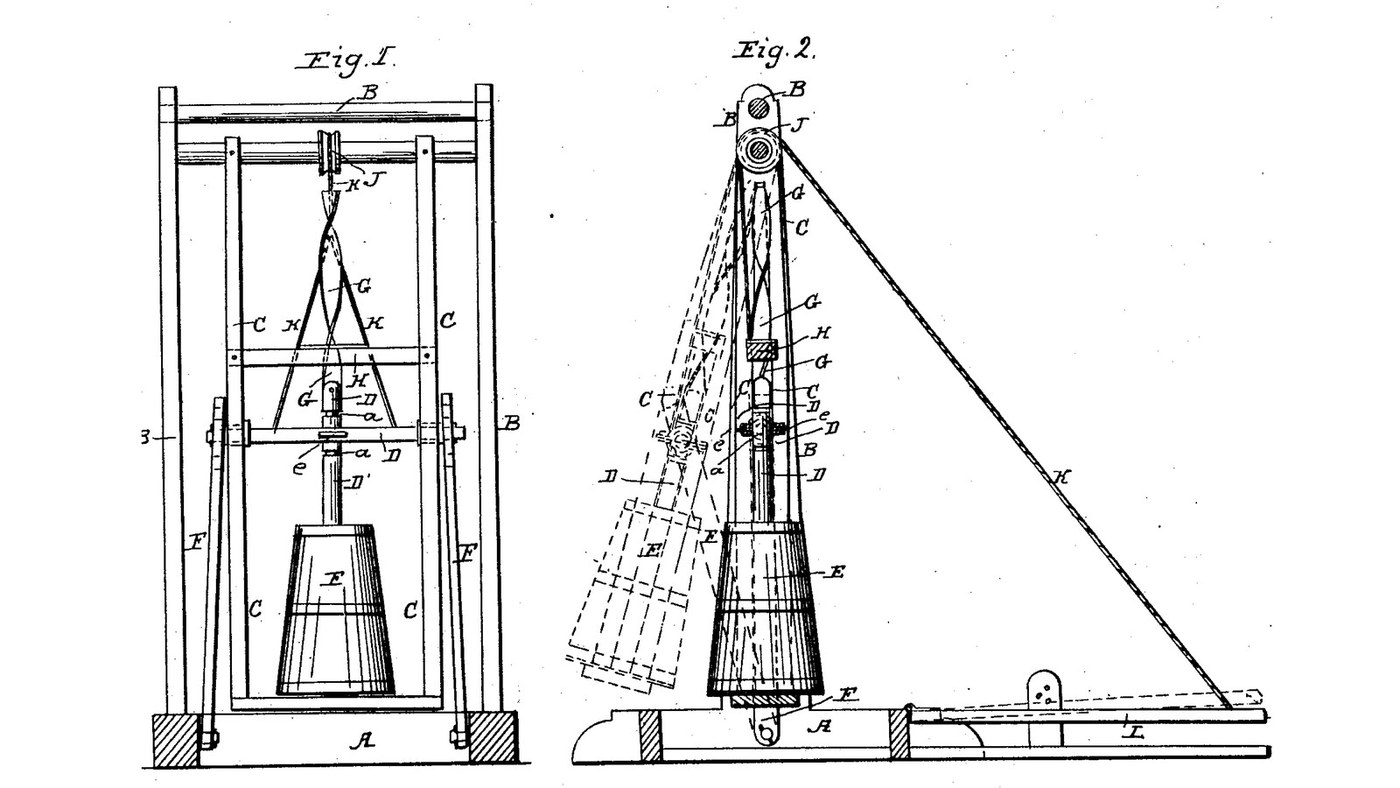

Pendulum Churn: A Treadle Swings the Hung Churn, Arms From the Base Plunge the Dasher and a Twisted Strip Turns It
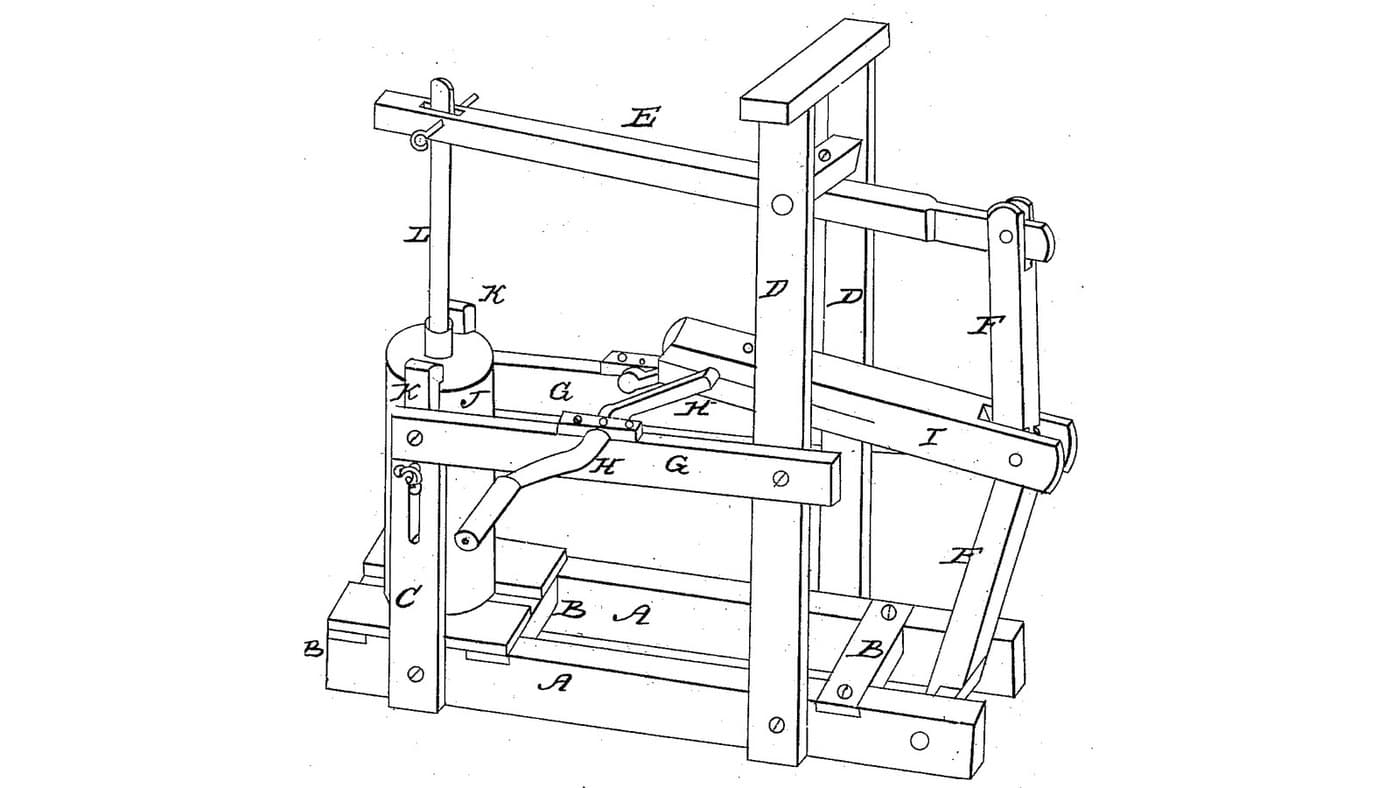
W. B. Gordinier of Coudersport, Pennsylvania, received US 28,170, dated 8 May 1860, for a pendulum churn. The churn stands in a frame that hangs like a swing and is set swinging with a treadle and a cord over a pulley. Arms from the base hold the dash rod's cross head, so as the swing moves the dasher plunges up and down, while a twisted strip on the rod, working through a slotted bar, turns it back and forth.
The patent gives no sizes; every size here is ours.
Advanced
About 3 days
Instructions
1
1
Why the dasher plunges as the churn swings
Why the dasher plunges as the churn swings
Loading Jupyter Notebook...
2
2
A spiral that turns a push into a spin, one week before
A spiral that turns a push into a spin, one week before
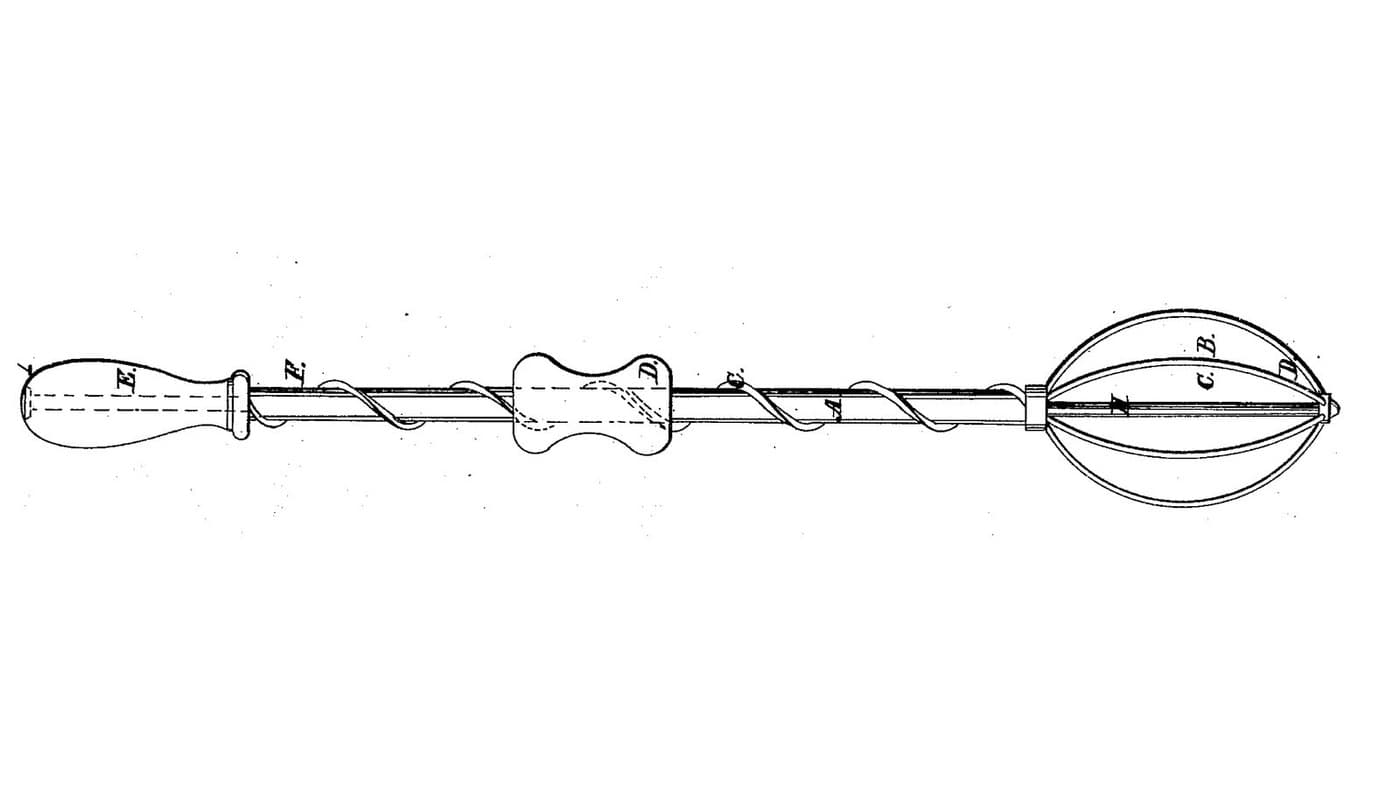
Ashley slides a nut on a spiral to spin his beater. Gordinier slides his twisted strip through a slot.
3
3
Read US 28,170
Read US 28,170
"From this description it will be seen that the mechanism for operating the churn gives to the parts a combined vibrating, reciprocating, and alternate rotary motion, which are obtained by simply moving the treadle L."
4
4
Base A, standards B and cross bar B'
Base A, standards B and cross bar B'
From pine lumber 60 x 50 mm make a base 1600 x 660 mm with four cross pieces, one under the pivot. Stand two standards 60 x 60 mm at the middle of the long sides, 1350 mm tall, joined at the top by a cross bar B'. Bore them 25 mm across 1300 mm above the floor for a 24 mm stainless pivot shaft, with the pulley J loose on its middle.
Materials for this step:
 Pine Lumber4 pieces
 Wood Screws40 pieces
 Wood Glue1 piece
 Stainless Steel Rod1 piece
 Pulley1 piece
 Shaft Collar2 pieces
Tools needed:
 Table Saw
 Cordless Drill
 Drill Bit Set
 Spade Bit Set
 Bar Clamp
 Screwdriver Set
 Tape Measure
5
5
Swing frame C, cross bar H and churn box E
Swing frame C, cross bar H and churn box E
Hang two hardwood hangers 90 x 30 x 60 mm on the pivot shaft, 400 mm apart, and fix two 20 mm hardwood dowels upright under each, 60 mm apart centre to centre, reaching 1150 mm down to a hardwood bottom board 440 x 440 x 25 mm. Across the arms 400 mm below the pivot fix a hardwood bar H with a slot 28 x 7 mm in its middle. Screw a 20-litre bucket to the board and cut a 28 mm hole in its lid's centre.
Materials for this step:
 Hardwood Board2 pieces
 Hardwood Dowels4 piecesWood Glue1 pieceWood Screws16 pieces
 20-Liter Bucket1 piece
Tools needed:
Table Saw JigsawCordless DrillDrill Bit SetSpade Bit SetBar ClampScrewdriver Set
6
6
Cross head D, dash rod D', strip G and arms F
Cross head D, dash rod D', strip G and arms F
Cut a hardwood cross head 28 x 40 mm, 504 long, notched at each end to run between a pair of arm rods, with a hardwood roller 36 mm across on a pin at each end. Bore its middle 21 mm. Cut a 20 mm stainless dash rod, cut a groove round it and hold it in the cross head with two key collars in the groove, so it turns; fix a hardwood dasher, two crossed boards 220 x 60 x 16 mm with four 20 mm holes, 410 mm below the cross head. Twist a stainless strip 25 x 3 mm, 300 long, a quarter turn every 90 mm in the vise, fix it to the rod's top and pass it up through bar H's slot. Cut two mild steel flat bar arms F with holes 640 mm apart; bolt one end of each to a bracket on the base under the pivot, 60 mm up, and the other to the cross head's end.
Materials for this step:
Hardwood Board1 pieceHardwood Dowels1 pieceStainless Steel Rod1 pieceShaft Collar2 pieces Stainless Steel Sheet1 piece
 Mild Steel Flat Bar2 pieces
 Carriage Bolt4 pieces
 Nylon Insert Lock Nut4 piecesWood Glue1 piece
Tools needed:
Table SawCordless DrillDrill Bit SetSpade Bit Set Hacksaw
 Tin Snips
 Bench Vise
 Files (Hand File)
 Adjustable Spanner
7
7
Treadle L and cord K
Treadle L and cord K
Hinge a hardwood treadle 600 x 240 x 25 mm to a block on the base beyond the churn. Tie a cord to each end of the cross head, bring both up to the pulley J, take them over it together and down to the treadle's far end.
Materials for this step:
Hardwood Board1 piece Cabinet Butt Hinge2 piecesWood Screws8 pieces
 Cord1 piece
Tools needed:
Table SawCordless DrillDrill Bit SetScrewdriver Set8
8
The build in 3D
The build in 3D
FreeCAD model of this build, swung 12 degrees: the base and standards, the swing frame with its bottom board and the bucket cut open, the cross head between the arm rods, the arms F from the base, the dash rod and dasher, the twisted strip through bar H, the pulley J on the pivot shaft, the cord and the treadle.
9
9
Churn
Churn
Pour about 10 litres of heavy cream at about 15 °C, checked with the thermometer, into the bucket and put on its lid. Work the treadle with your foot in time with the swing, timing it, so the churn swings up to about 20 degrees each way. When the butter comes, stop the swing, unbolt the arms F from the cross head and lift the dash rod out, take out the butter, pour the buttermilk into a bowl, wash the butter in cold water until it runs clear, salt and weigh it.
Materials for this step:
 Heavy Cream10 l
 Coarse Sea Salt1 piece
 Water1 piece
Tools needed:
 Leave-In Probe Thermometer
 Stopwatch
 Digital Kitchen Scale
 Stainless Steel Mixing Bowl (Large)
10
10
Troubleshooting
Troubleshooting
Pendulum churn troubleshooting.
Flow
Loading...
11
11
History and honest limits
History and honest limits
**W. B. Gordinier** of Coudersport, Potter County, Pennsylvania, US 28,170, 8 May 1860, "Churn" (the drawing spells the name Gordnier). He claimed the swinging frame carrying the churn, with the arms F, spiral plate G, cord K, pulley J and treadle L. He does not explain how the arms make the dasher rise and fall; the working above is ours. Every size is ours.
Materials
18- 4 piecesPlaceholder
- 64 piecesPlaceholder
- 3 piecesPlaceholder
- 1 piecePlaceholder
- 1 piecePlaceholder
- 2 piecesPlaceholder
- 2 piecesPlaceholder
- 4 piecesPlaceholder
- 1 piecePlaceholder
- 1 piecePlaceholder
- 2 piecesPlaceholder
- 4 piecesPlaceholder
- 4 piecesPlaceholder
- 2 piecesPlaceholder
- 1 piecePlaceholder
- 10 lPlaceholder
- 1 piecePlaceholder
- 1 piecePlaceholder
Tools Required
17- 1 vendor sell this, none ship to you yetPlaceholder
- 1 vendor sell this, none ship to you yetPlaceholder
- Placeholder
- Placeholder
- Placeholder
- Placeholder
- 1 vendor sell this, none ship to you yetPlaceholder
- 1 vendor sell this, none ship to you yetPlaceholder
- Placeholder
- Placeholder
- Placeholder
- Placeholder
- Placeholder
- Placeholder
- Placeholder
- Placeholder
- Placeholder
Design Files
1This blueprint makes

Related Blueprints
These blueprints share knowledge with this one — techniques, materials, or principles that connect them in the learning graph.
Screw-and-Nut Egg Beater: Slide a Nut Along a Spiral on the Shaft and the Wire Beater Spins Back and Forth
by TheChef
FOOD & DRINKS
0
0
0
0
0
0
Toggle-Lever Churn: A Crank Crooks and Straightens a Jointed Lever, Rocking a Walking Beam Twice Each Turn
by Buttercup
Woodworking
0
0
0
0
0
0

Churning Butter from Cream — The 5,000-Year-Old Fat Separation
by TheChef
CRAFT
60
0
0
0
0
0
CC0 Public Domain
This blueprint is released under CC0. You are free to copy, modify, distribute, and use this work for any purpose, without asking permission.
Support the Maker by purchasing products through their Blueprint where they earn a Maker Commission set by Vendors, or create a new iteration of this Blueprint and include it as a connection in your own Blueprint to share revenue.