ART
BEAUTY & WELLNESS
CRAFT
CULTURE & HISTORY
ENTERTAINMENT
ENVIRONMENT
FOOD & DRINKS
REVERSE ENGINEERING
SCIENCES
SPORTS
TECHNOLOGY
WEARABLES
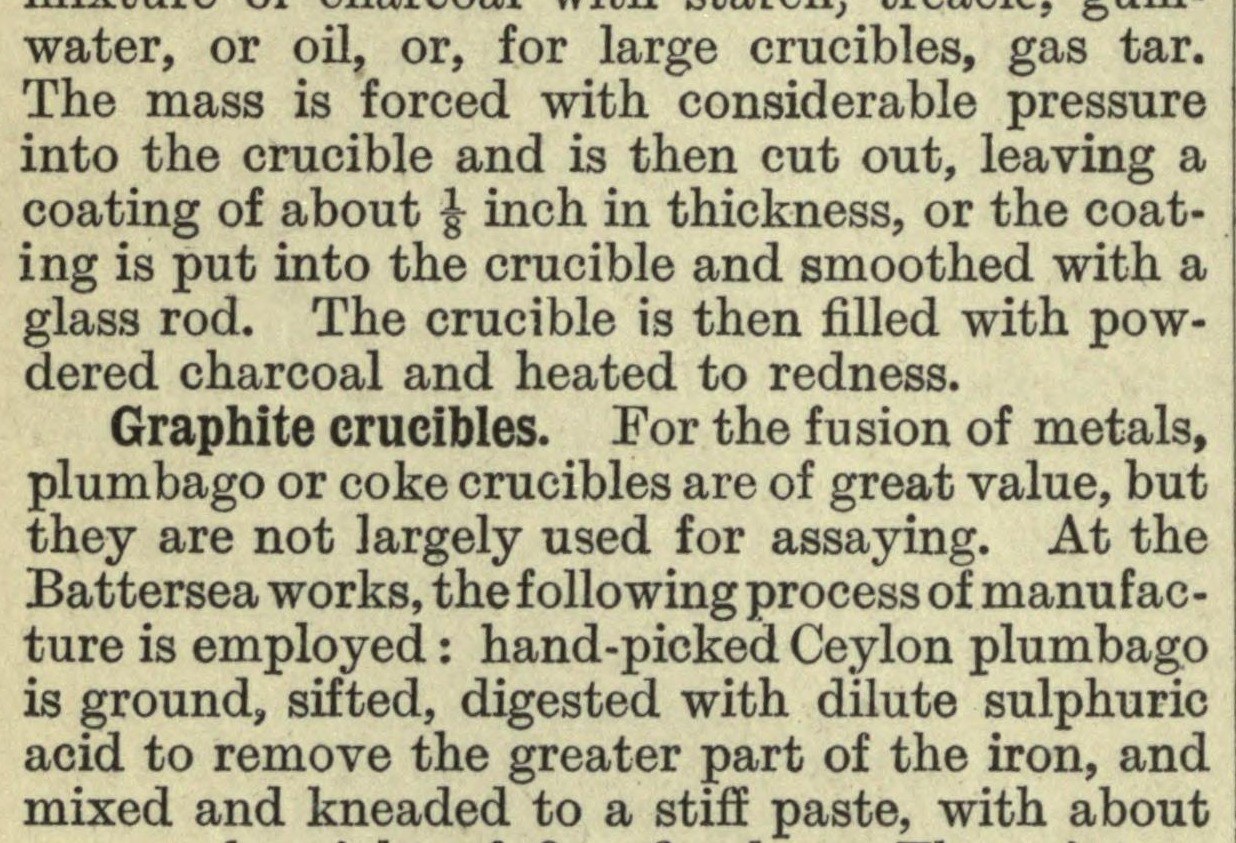


Graphite-Clay Crucible: Plumbago and Fireclay, the Battersea Works Way (Thorpe 1912)
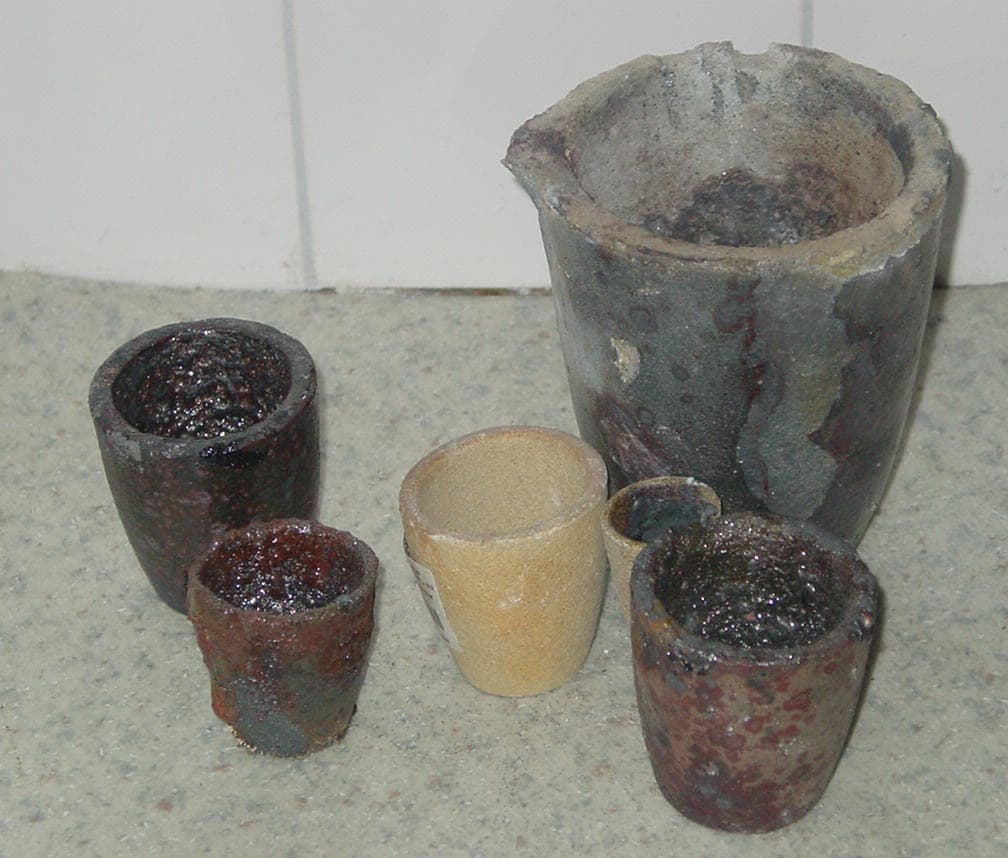
A graphite (plumbago) crucible is a melting pot of graphite bound with clay: fine grained, it stands the highest heats and sudden changes of temperature, and Thorpe counts it of great value for melting metals.
Thorpe's Dictionary of Applied Chemistry (1912) gives the Battersea works process: Ceylon plumbago ground, sifted and digested with dilute sulphuric acid to take out most of its iron, kneaded with about its own weight of fine fireclay, pugged, cut into blocks, pugged again, thrown on a wheel or moulded, dried and baked in saggars.
Acid strength, sizes and baking heat are not given.
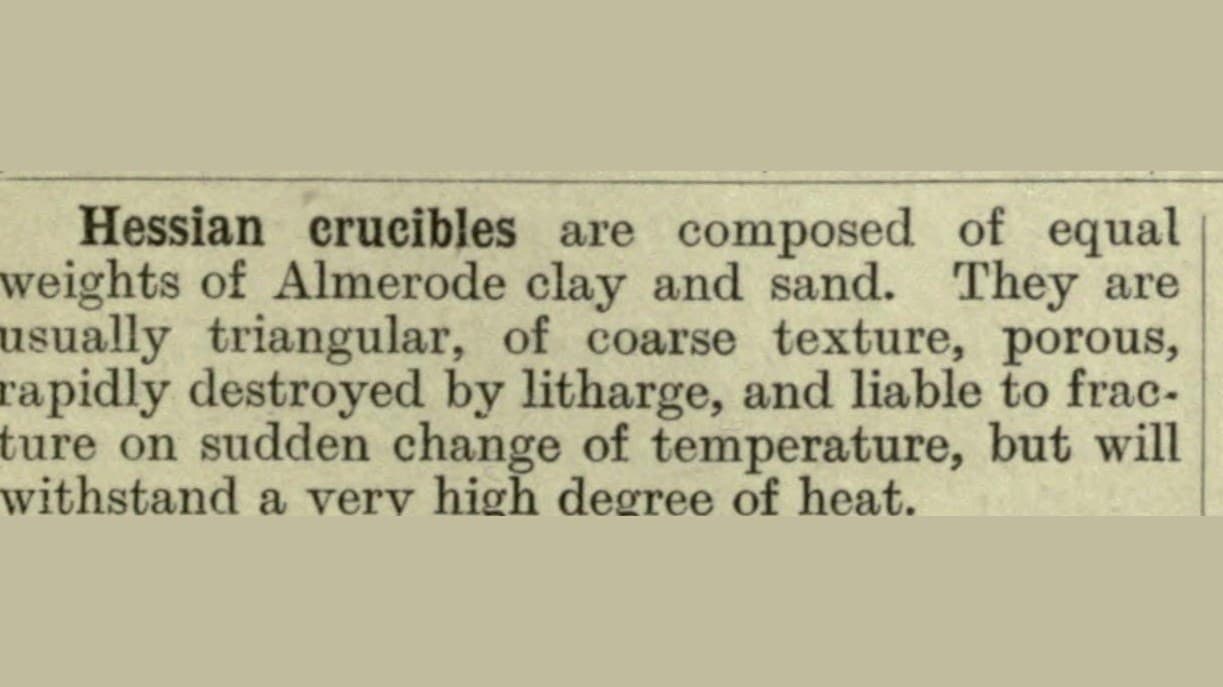
Source: Thorpe, Dictionary of Applied Chemistry vol. II (1912), CRUCIBLES, p. 170. Picture: that paragraph.
Intermediate
Several days with drying and baking
Instructions
1
1
Read Thorpe
Read Thorpe
"Hand-picked Ceylon plumbago is ground, sifted, digested with dilute sulphuric acid to remove the greater part of the iron, and mixed and kneaded to a stiff paste, with about an equal weight of fine fireclay."
2
2
Grind and clean the plumbago
Grind and clean the plumbago
Pick over the plumbago by hand, grind it and sift it. Digest it with dilute sulphuric acid to remove the greater part of its iron, which would otherwise pass into the melt; the strength and time are not given.
Materials for this step:
 Plumbago (Natural Graphite)1 half by weight
Tools needed:
 Grinding Mill
 Sieve
 Dilute Sulfuric Acid
 Water
 Nitrile Gloves
 Safety Glasses
3
3
Knead with fireclay and pug
Knead with fireclay and pug
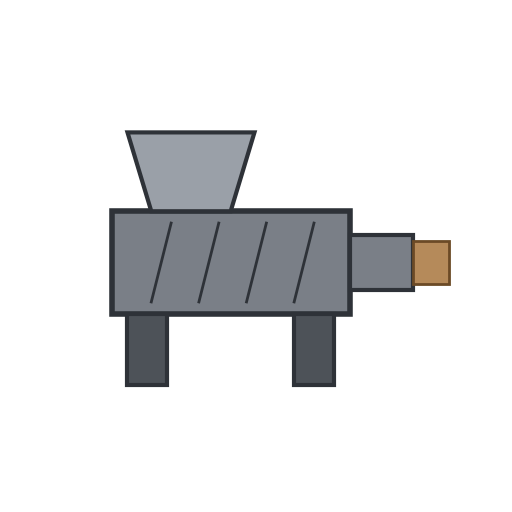
Mix the plumbago with about an equal weight of fine fireclay and knead it with water to a stiff paste. Pass it through a pug mill and cut the column into blocks. Pass the blocks through the mill again when you are ready to make crucibles.
Materials for this step:
 Refractory Clay1 half by weightWater1 to a stiff paste
Tools needed:
 Precision Digital Scale
 Pug Mill
4
4
Form the crucibles
Form the crucibles
Make the crucibles by hand on a wheel, or mould them. Sizes are not given (unknown).
Tools needed:
 Potter's Wheel
 Unknown Dimensions
5
5
Dry and bake in saggars
Dry and bake in saggars
Dry the crucibles, then bake them inside saggars. To slow the burning out of the graphite in use, a crucible may be dipped in a paste of clay and a solution of borax.
Tools needed:
 Sagger
 Kiln
 Borax Powder
6
6
History and honest limits
History and honest limits
Thorpe notes that graphite crucibles are of great value for melting metals but little used for assaying, that the graphite is slowly burnt by metal oxides and furnace gases, and that iron left in the graphite can pass into the metal. He also gives Digby's 1893 mixture of coarse and fine plumbago, Russian clay, china-stone and gas carbon, a different route.
The acid strength and time, the sizes and the baking heat are not given; refractory clay stands for his fine fireclay.
Materials
3- 1 half by weightPlaceholder
- 1 half by weightPlaceholder
- 1 to a stiff pastePlaceholder
Tools Required
13- Placeholder
- Placeholder
- Placeholder
- Placeholder
- Placeholder
- Placeholder
- Placeholder
- Placeholder
- Placeholder
- Placeholder
- Placeholder
- Placeholder
- Placeholder
This blueprint makes

Related Blueprints
These blueprints share knowledge with this one — techniques, materials, or principles that connect them in the learning graph.

CC0 Public Domain
This blueprint is released under CC0. You are free to copy, modify, distribute, and use this work for any purpose, without asking permission.
Support the Maker by purchasing products through their Blueprint where they earn a Maker Commission set by Vendors, or create a new iteration of this Blueprint and include it as a connection in your own Blueprint to share revenue.