
Hall-Héroult Process
Instructions
Why heat alone will not do it
Why heat alone will not do it
Iron oxide gives up its oxygen to carbon in a furnace. Aluminium oxide does not.
- Alumina, Al₂O₃, has an exceptionally high enthalpy of formation — the bond to oxygen is very strong.
- Carbon cannot pull that oxygen away at any temperature a furnace can reach before other problems take over.
- Alumina also melts at about 2072 °C, far too high to electrolyse directly.
Materials for this step:
 Graphite Electrode2 pieces
The cryolite trick
The cryolite trick
The breakthrough was a solvent, not a furnace.
- Molten cryolite, Na₃AlF₆, dissolves alumina.
- The bath runs at roughly 940-980 °C instead of 2072 °C.
- The dissolved alumina is now free to be split by electrolysis.
The cell
The cell
A carbon-lined steel box, carbon anodes hanging into the bath, and a very large direct current.
- The carbon lining is the cathode; molten aluminium collects on the floor of the cell.
- Carbon blocks dipping into the bath are the anodes.
- Molten aluminium is denser than the bath, so it pools underneath and is siphoned off.
2 Al₂O₃ + 3 C → 4 Al + 3 CO₂
The anodes are consumed — they are a reagent, not just a conductor, and are replaced continuously. A modern cell runs at 4-5 volts and up to 400,000 amperes.Where the electricity goes
Where the electricity goes
The cost of aluminium is very largely the cost of electricity.
- Roughly 13-15 kWh per kilogram of aluminium produced.
- Smelters are sited next to cheap power — hydroelectric dams, geothermal, or dedicated stations.
- Recycling aluminium takes about 5% of that energy, because the hard part has already been done.
History and context
History and context
Charles Martin Hall, working in a woodshed behind his family home in Oberlin, Ohio, produced aluminium buttons in February 1886. Paul Héroult, in France, filed for essentially the same process weeks earlier. The coincidence runs deeper than the invention: both men were born in 1863 and both died in 1914. The process carries both names, and both patents were upheld in their own countries.
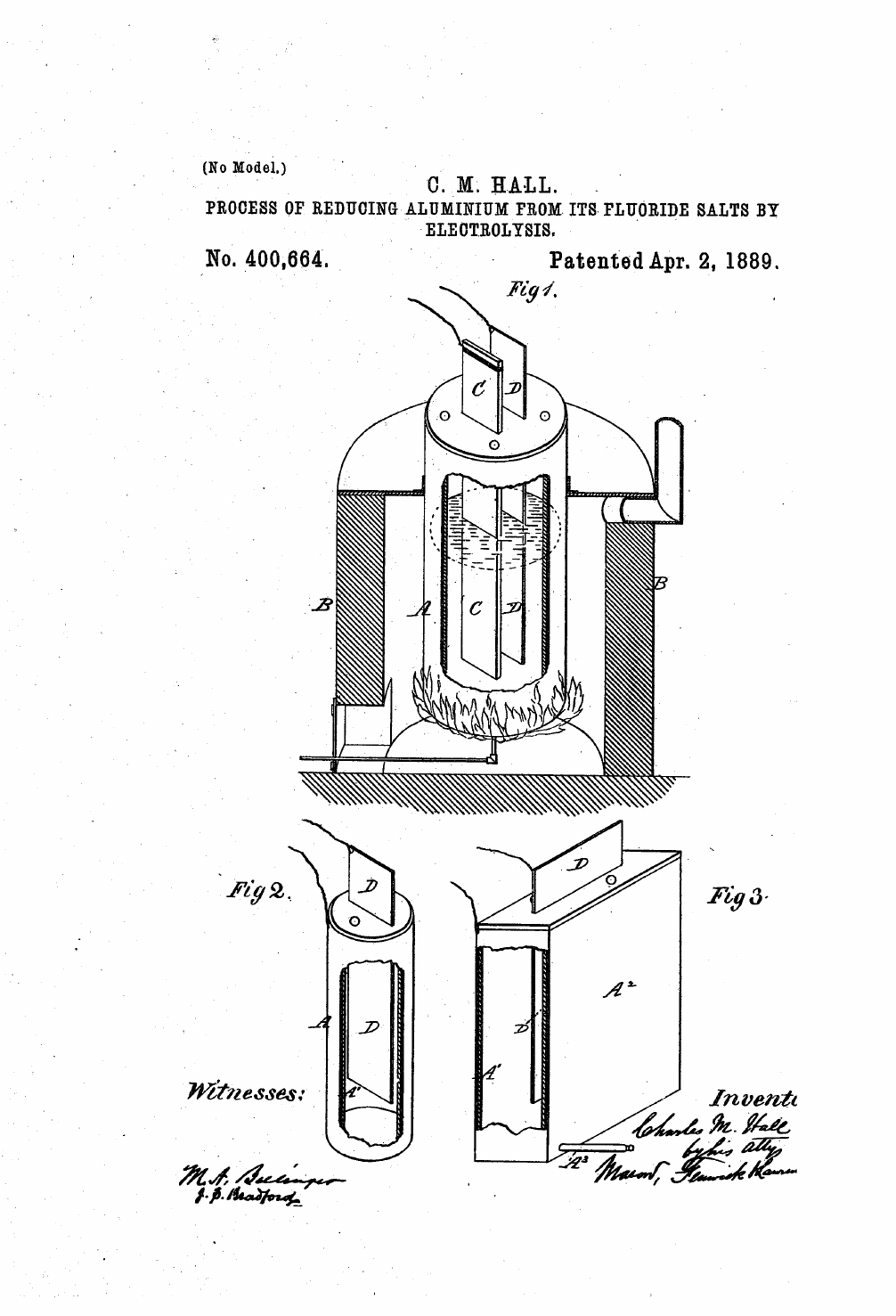
Hall's US patent 400,664, Process of reducing aluminium from its fluoride salts by electrolysis, was granted on 2 April 1889. Hall's company became Alcoa; Héroult went on to develop the electric arc furnace for steel.
The other half of the story is the ore. Electrolysis needs pure alumina, and bauxite is not pure. Karl Josef Bayer patented the process for extracting clean alumina from bauxite with hot caustic soda in 1888 — two years after Hall and Héroult. Neither process is much use without the other, and industrial aluminium really dates from the pair of them.
What it cost and what it costs. Aluminium fell from a precious metal to a commodity within about fifteen years. The modern process is essentially unchanged in principle, and its problems are unchanged too: it is enormously electricity-hungry, the consumed carbon anodes emit CO₂ directly as part of the chemistry rather than merely as fuel, and cells can emit perfluorocarbons — greenhouse gases thousands of times more potent than CO₂ — during process upsets.
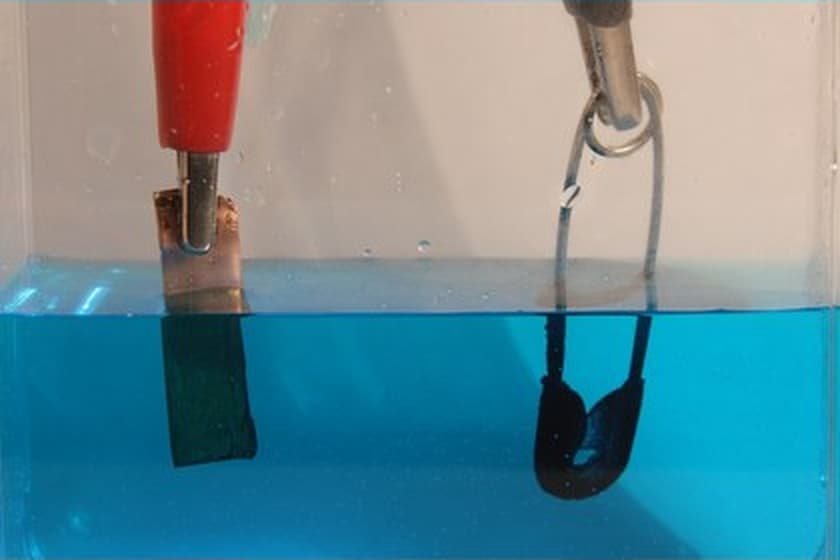
Why there is no build here. A working cell means molten fluoride salt at about 960 °C, which will destroy most containers and produces hydrogen fluoride if it meets moisture. There is no scaled-down version of this that is safe outside industry, and pretending otherwise would be dishonest. What you CAN do at bench scale is electroplating, which demonstrates electrolysis of a metal salt safely — a genuinely related process linked from this blueprint.
Materials
1- 2 piecesPlaceholder
Related Blueprints
These blueprints share knowledge with this one — techniques, materials, or principles that connect them in the learning graph.




CC0 Public Domain
This blueprint is released under CC0. You are free to copy, modify, distribute, and use this work for any purpose, without asking permission.
Support the Maker by purchasing products through their Blueprint where they earn a Maker Commission set by Vendors, or create a new iteration of this Blueprint and include it as a connection in your own Blueprint to share revenue.