Collaboration
ART
BEAUTY & WELLNESS
CRAFT
CULTURE & HISTORY
ENTERTAINMENT
ENVIRONMENT
FOOD & DRINKS
REVERSE ENGINEERING
SCIENCES
SPORTS
TECHNOLOGY
WEARABLES
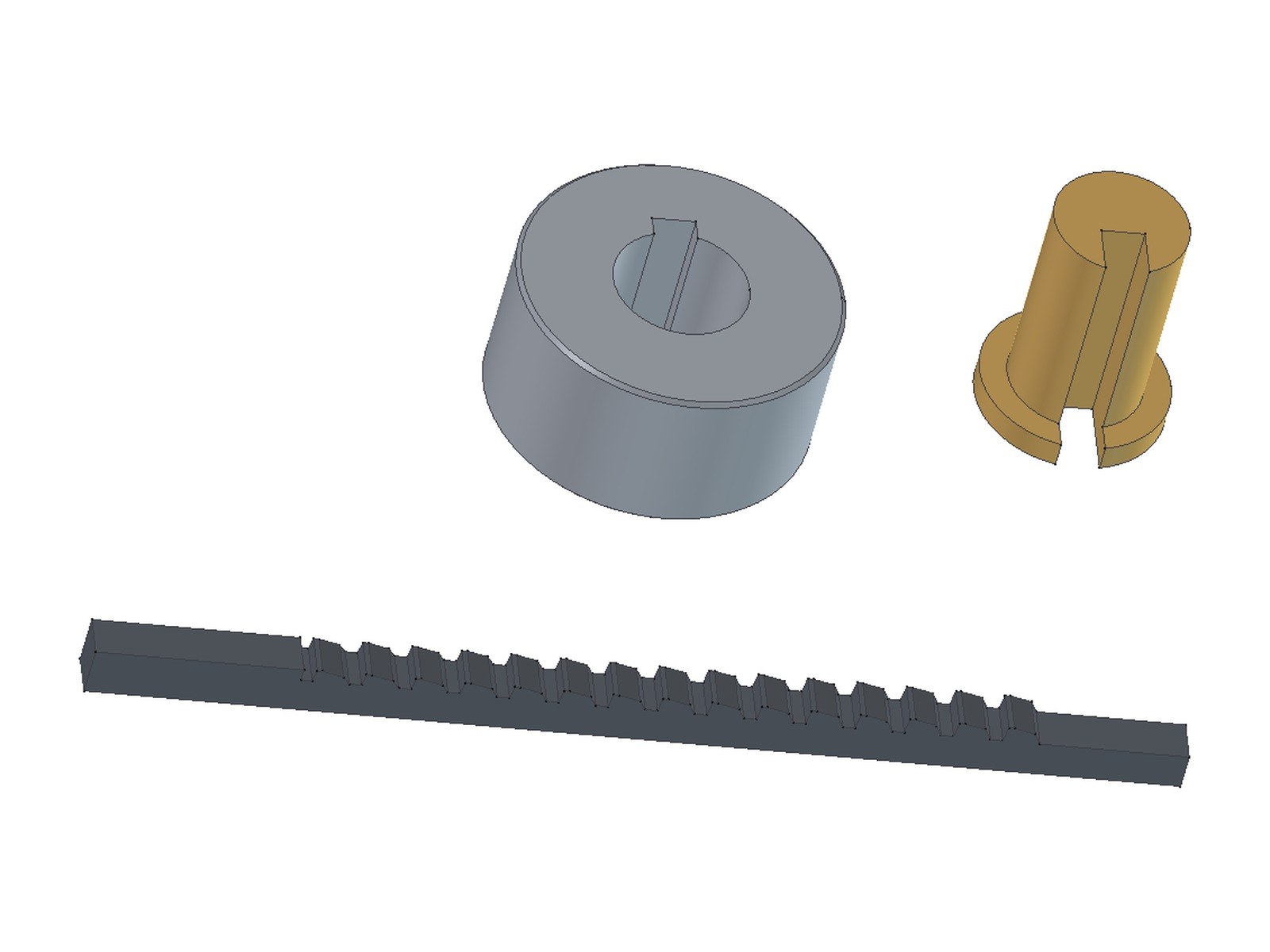


Keyway Broaching: Tooth Pitch, Rise per Tooth, Rake and Clearance by Metal and Hardness, Pushing Force
Cut a keyway in a bore with a keyway broach in an arbor press, and work out the broach criteria for your metal: tooth pitch and teeth in contact, rise per tooth and the number of teeth, rake and clearance by material and hardness, and the pushing force. Rules from Machinery's Handbook (1924), Hammond (1921), the US Navy and Metcut (1980).
Intermediate
About 1 hour per part
Instructions
1
1
How a keyway broach cuts
How a keyway broach cuts
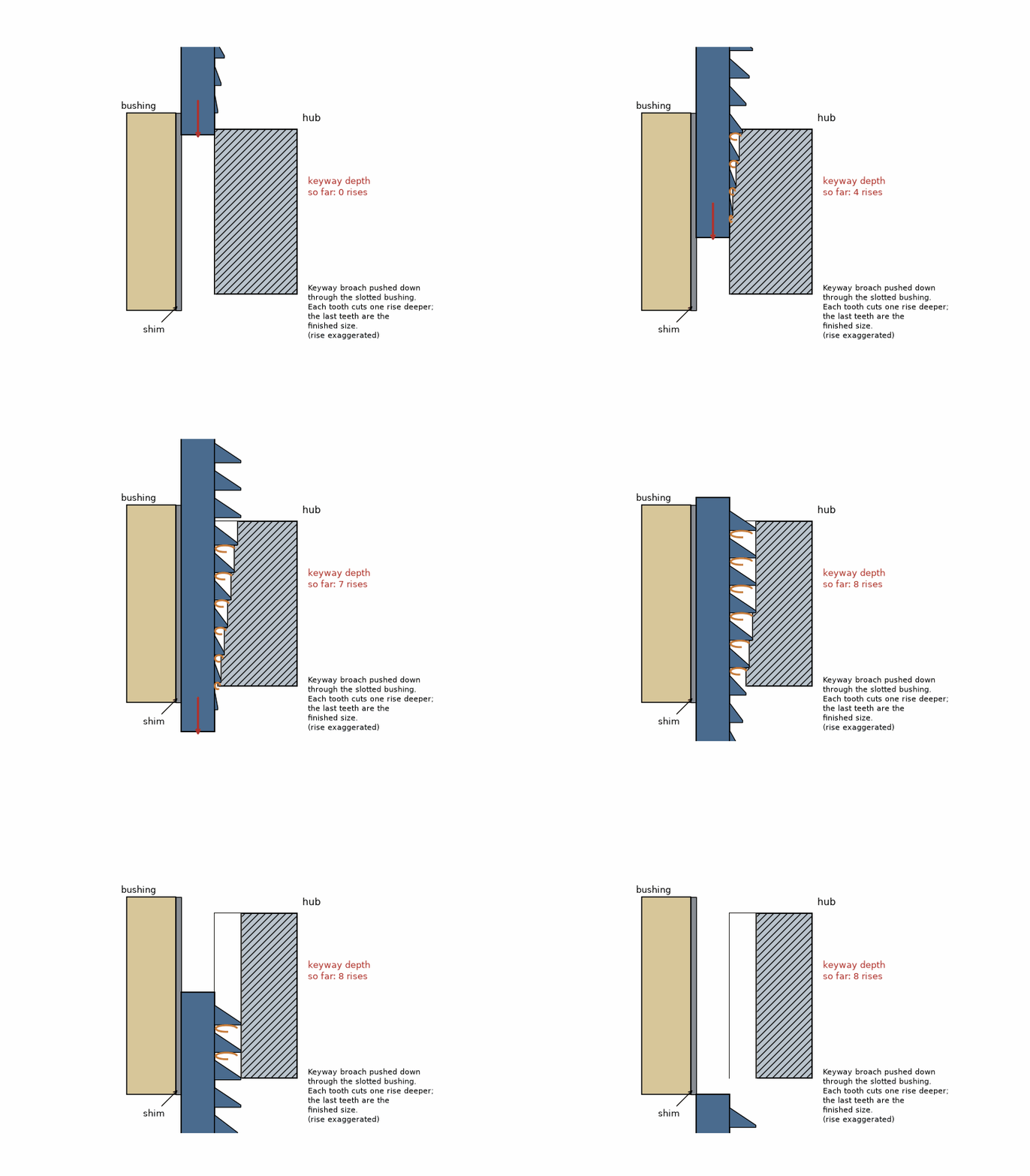
The broach slides through a slotted bushing in the bore. Each tooth stands a little higher than the one before (the rise), so each takes a thin chip and the keyway deepens tooth by tooth; the last teeth are the finished size and only clean up. Shims behind the broach set the depth for the next pass. Our animation; the rise is exaggerated.
2
2
Tooth pitch and teeth in contact
Tooth pitch and teeth in contact
Loading Jupyter Notebook...
3
3
Rise per tooth by metal
Rise per tooth by metal
Loading Jupyter Notebook...
4
4
Rake and clearance by hardness
Rake and clearance by hardness
Loading Jupyter Notebook...
5
5
Pushing force (estimate)
Pushing force (estimate)
Loading Jupyter Notebook...
6
6
Check the work hardness
Check the work hardness
Test the hub. Metcut's angles are by Brinell. For steel Hammond wants scleroscope 32-40: softer tears, harder "will rapidly destroy the broaches". He gives no Brinell or Rockwell figure; convert with a standard table (ASTM E140) if you test in Rockwell.
Tools needed:
 Rockwell Hardness Tester
7
7
Bore and bushing
Bore and bushing
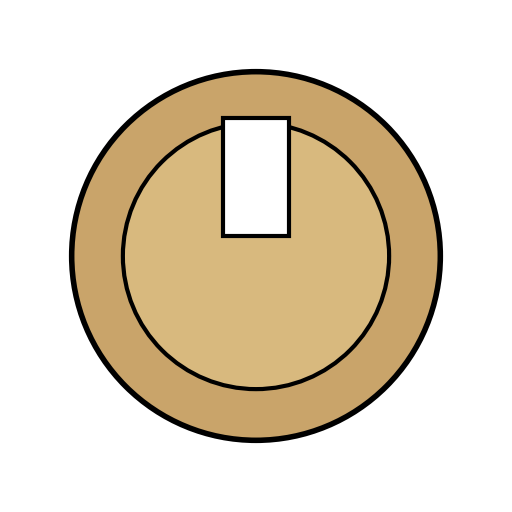
The bore must be to size: the broach's pilot should enter freely but not let the broach drop past the first tooth. Fit the bushing snug in the bore, slot where the keyway goes.
Materials for this step:
 Bored Hub Blank1 piece
Tools needed:
 Keyway Broach Bushing
 Vernier Caliper
8
8
Set up in the press
Set up in the press
Set hub, bushing and broach square under the arbor press, rigid and true. Oil the broach: broaching oil is best; lard or soluble oil will help.
Tools needed:
 Arbor Press
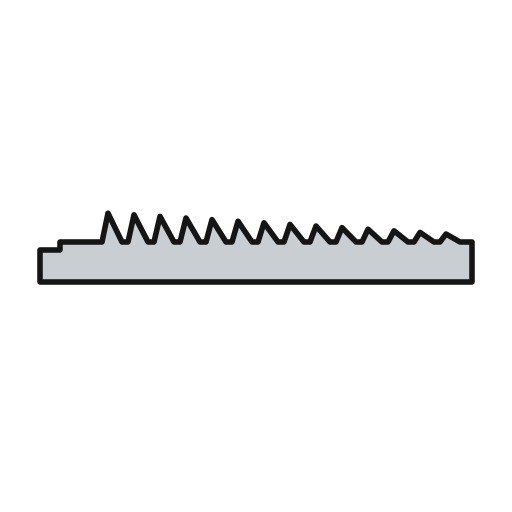 Keyway Broach
 Cutting Oil
9
9
Push it through
Push it through
Push with slow, even pressure. Never bring the broach back up through the hole: push it on through and catch it on a soft cushion.
Tools needed:
Arbor Press Cotton Cloth
10
10
Shim and repeat
Shim and repeat
Put the next shim behind the broach to set the next depth, oil, and push through again. Repeat until the keyway is deep enough.
Tools needed:
 Broach ShimCutting Oil
11
11
Measure the keyway
Measure the keyway
Check the width and the depth from the opposite side of the bore.
Tools needed:
Vernier Caliper Micrometer
12
12
Troubleshooting
Troubleshooting
Broaching problems and fixes.
Flow
Loading...
13
13
Sources and honest limits
Sources and honest limits
*Machinery's Handbook* 6th ed. (1924) pp. 1135-1137 (first printed in Jones, *Broaching*, 1914); Hammond, *Broaching Practice* (1921) pp. 6, 7, 44; US Navy, *Machinery Repairman 3 & 2* (1990) p. 3-24; Metcut, *Machining Data Handbook* 3rd ed. (1980) Table 15.16 and pp. 17-8 to 17-20, © Metcut, cited. Not in any source we could read: cutting speed by hardness (Hammond gives 5-6 ft/min for 1921 carbon-steel broaches) and a Brinell or Rockwell limit. The force formula is our derivation. Ours: the animation, the example sizes.
Materials
1- 1 piecePlaceholder
Tools Required
9- Placeholder
- Placeholder
- Placeholder
- Placeholder
- Placeholder
- Placeholder
- Placeholder
- Placeholder
- Placeholder
This blueprint makes
Related Blueprints
These blueprints share knowledge with this one — techniques, materials, or principles that connect them in the learning graph.
CC0 Public Domain
This blueprint is released under CC0. You are free to copy, modify, distribute, and use this work for any purpose, without asking permission.
Support the Maker by purchasing products through their Blueprint where they earn a Maker Commission set by Vendors, or create a new iteration of this Blueprint and include it as a connection in your own Blueprint to share revenue.