ART
BEAUTY & WELLNESS
CRAFT
CULTURE & HISTORY
ENTERTAINMENT
ENVIRONMENT
FOOD & DRINKS
REVERSE ENGINEERING
SCIENCES
SPORTS
TECHNOLOGY
WEARABLES


Liftable-Breaker Dasher Churn: Breakers Stand Still to Churn, Then Lift and Turn to Gather
Dickinson made the breakers do two jobs: stand still while the cream is churned, then turn with the dashers to gather the butter.
Isaac L. Dickinson of Richmond, Wayne County, Indiana, received US 10,487, dated 31 January 1854, for "Dickinson's Improved Churn": perforated dashers on a shaft turned by a crank through bevel wheels, between perforated breakers joined by arms through which the shaft passes, "held stationary by pins entering holes in the bottom of the tub." When the butter is separated the breakers are lifted; the dashers' lower ends enter slots in them, held by small springs, and both "revolve together" to collect the butter. An oblique hole through the shaft admits air.
This rung works out the speeds, then prints the base plate, breaker frame, dasher, crown wheel, pinion and standard, builds the churn, and makes butter.
Intermediate
About 4 hours, plus printing
Instructions
1
1
Still breakers, turning dashers
Still breakers, turning dashers
Loading Jupyter Notebook...
2
2
A revolving dasher with still breakers before it
A revolving dasher with still breakers before it
The embedded blueprint beats the cream back with fixed slats. Dickinson's breakers stand still while churning and then turn with the dashers to gather the butter.
3
3
Read US 10,487
Read US 10,487
"The cream or milk being put into the tub, the dashers are revolved around the shaft by turning the crank e, the breakers remaining stationary, when the butter is separated the breakers are elevated as above described, and revolve with the dashers forming the whole sweep of the tube, for the purpose of collecting the butter—the dasher and breakers being held together in this position by the springs i, i, before mentioned."
4
4
Print the parts
Print the parts
Print the base plate with its pivot and two pin holes (/uploads/blueprints/liftable-breaker-dasher-churn-base-plate.stl), the breaker frame flat on its face (/uploads/blueprints/liftable-breaker-dasher-churn-breaker-frame.stl), the dasher standing up (/uploads/blueprints/liftable-breaker-dasher-churn-dasher.stl), the 36-tooth crown wheel (/uploads/blueprints/liftable-breaker-dasher-churn-crown-wheel.stl), the 12-tooth pinion (/uploads/blueprints/liftable-breaker-dasher-churn-pinion.stl) and the standard (/uploads/blueprints/liftable-breaker-dasher-churn-standard.stl). Print in PETG at 0.2 mm layers, 30 % infill, 4 walls; wash before first use.
Materials for this step:
 PETG Filament1 piece
Tools needed:
 FDM 3D Printer
5
5
Tub, shaft and frame
Tub, shaft and frame
Use a straight-sided round food-grade container about 190 mm across inside and 250 mm deep. Lay the base plate in its bottom. Drill a 3 mm hole slantwise through a 10 mm stainless rod near its top, inside the tub, as his air hole m. Slide the breaker frame down over the rod so its pins drop into the base plate's holes, then slide on the dasher so its boards sit just above the frame's bottom bar, and tighten its set screw. Stand the rod's foot in the pivot.
Materials for this step:
 Food-Grade Storage Container1 piece
 Mild Steel Rod1 piece
 Machine Screws1 piece
Tools needed:
 Cordless Drill
 Drill Bit Set
 Hacksaw
 Screwdriver Set
6
6
Lid, gears and crank
Lid, gears and crank
Cut the container's lid in half and fix one half over the tub with a hole for the rod. Fix the pinion on the rod's top. Screw the standard to the lid half and run a short 10 mm rod through its bearing into the crown wheel so its teeth mesh the pinion; screw a dowel handle into the crown wheel's boss.
Materials for this step:
Mild Steel Rod1 piece Hardwood Dowels1 piece
 #8 x 1" Wood Screw1 pieceMachine Screws1 piece
Tools needed:
HacksawScrewdriver SetCordless Drill7
7
The build in 3D
The build in 3D
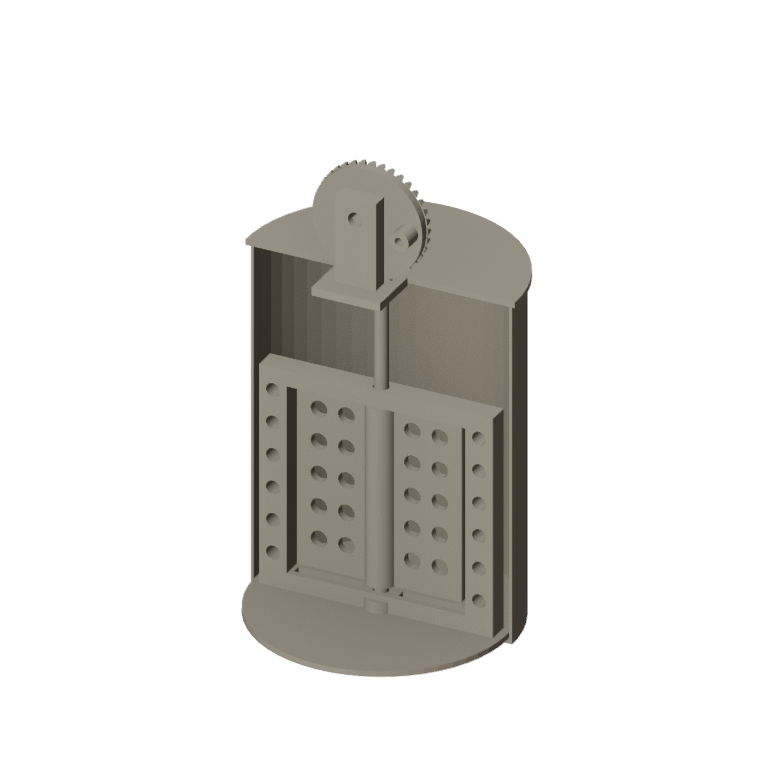
FreeCAD model of this build, not of the patent: the tub cut away to show the base plate, the breaker frame pinned to it and the dasher on the rod between the breakers, with the crown wheel and pinion on the half lid.
8
8
Churn, then lift and gather
Churn, then lift and gather
Let the heavy cream stand until it reaches about 15 °C, checked with the thermometer. Pour in 2 litres and crank steadily; time until the butter comes. Lift the breaker frame by its arm until its pins leave the base plate and its slots take the dashers' lower ends, then crank on slowly so the whole frame sweeps the butter together. Pour off the buttermilk, add cold water, churn a little and pour off again until it runs clear; work in a pinch of salt and weigh the butter.
Materials for this step:
 Heavy Cream2000 ml
 Coarse Sea Salt1 piece
 Water1 piece
Tools needed:
 Leave-In Probe Thermometer
 Stopwatch
 Digital Kitchen Scale
 Stainless Steel Mixing Bowl (Large)
9
9
Breakers that turn, slots that will not hold
Breakers that turn, slots that will not hold
Liftable-breaker churn troubleshooting.
Flow
Loading...
10
10
History and honest limits
History and honest limits
**Isaac L. Dickinson** of Richmond, Wayne County, Indiana, received US 10,487, dated 31 January 1854 (the drawing sheet reads "I. L. Dickinson"). The specification uses the letter i for both the lid's staples and the dashers' springs. He claimed the combination of the rotating dashes with the breakers, "so that said breakers may remain stationary, while churning and revolving with the dashers to collect the butter."
**Honest limits.** A container, printed parts and a crown wheel with a spur pinion stand in for his tub and bevel wheels; a raised rib stands in for each spring. FDM prints hold food in their layer lines, so wash well and replace when worn. Your times and weights are the result.
Materials
9- 1 piecePlaceholder
- 1 piecePlaceholder
- 1 piecePlaceholder
- 2 piecesPlaceholder
- 1 piecePlaceholder
- 1 piecePlaceholder
- 2000 mlPlaceholder
- 1 piecePlaceholder
- 1 piecePlaceholder
Tools Required
9- Placeholder
- 1 vendor sell this, none ship to you yetPlaceholder
- Placeholder
- Placeholder
- Placeholder
- Placeholder
- Placeholder
- Placeholder
- Placeholder
Design Files
1Related Blueprints
These blueprints share knowledge with this one — techniques, materials, or principles that connect them in the learning graph.
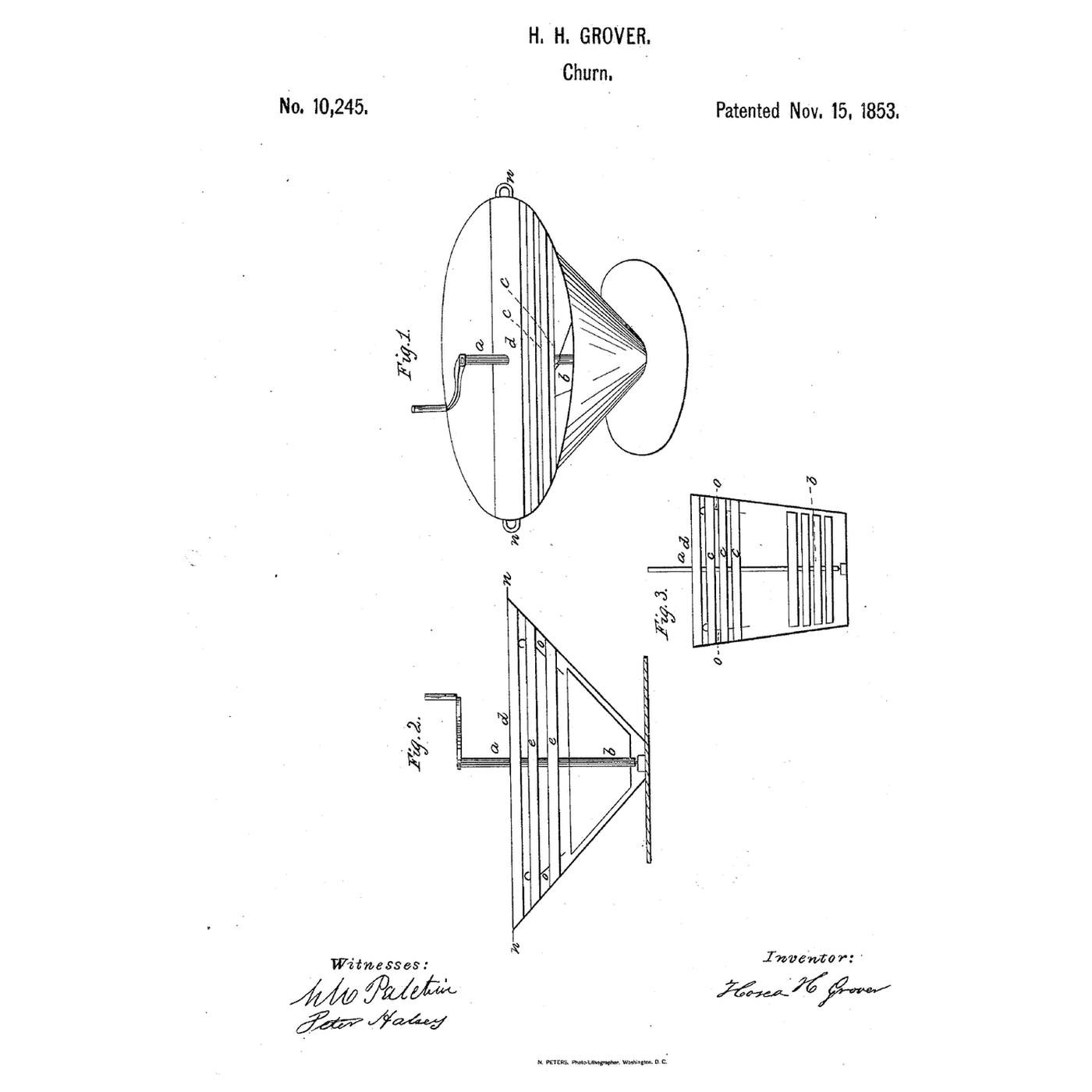
Flaring-Tub Slat-Reactor Churn: The Cream Climbs the Flare and Is Beaten Back by Slats
by TheChef
FOOD & DRINKS
2
0
0
0
0
0
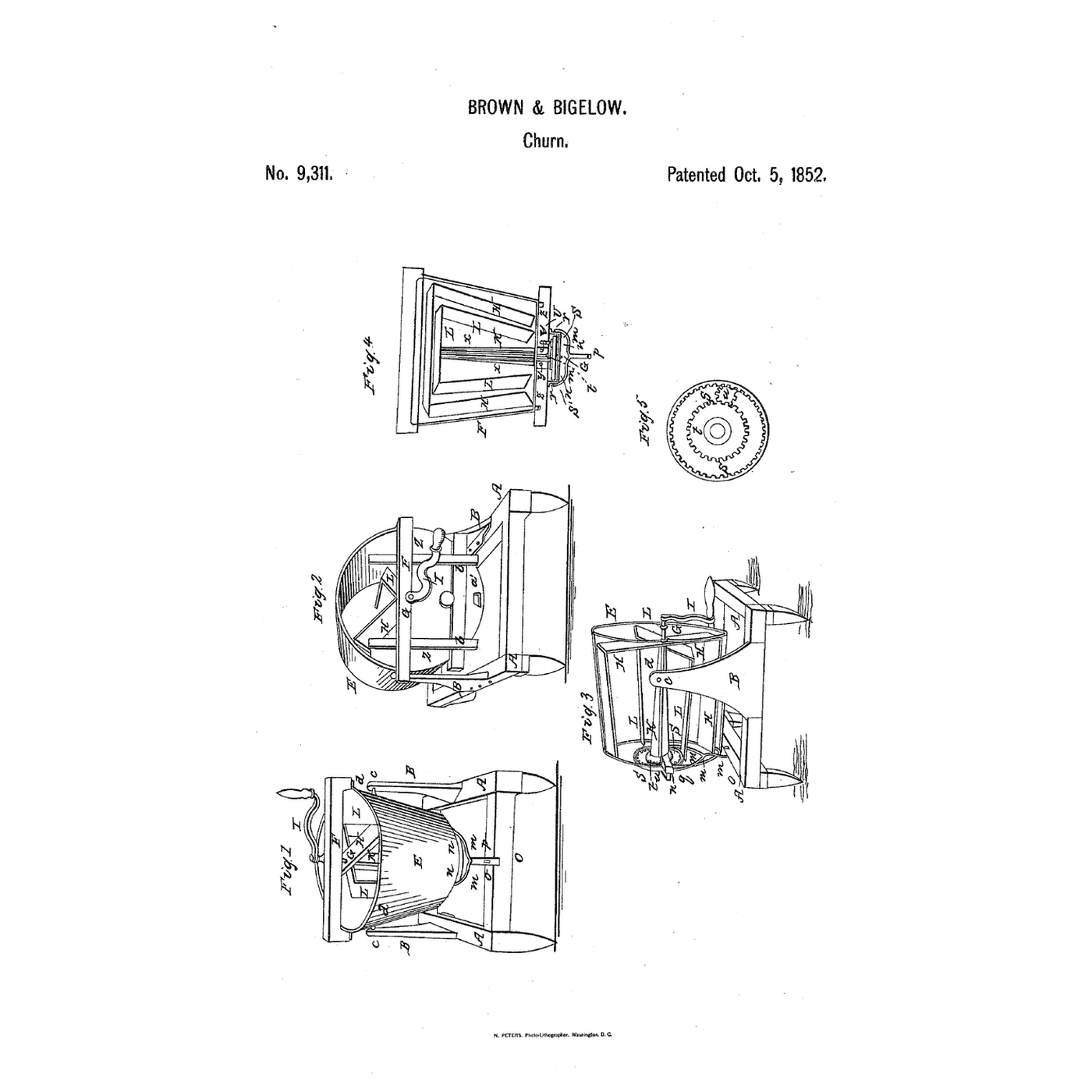
Tilting-Tub Counter-Fan Churn: Two Fans Turn Opposite Ways, the Tub Tips to Drain and Work
by Martin
FOOD & DRINKS
2
0
0
0
0
0
Churning Butter from Cream — The 5,000-Year-Old Fat Separation
by TheChef
CRAFT
47
0
0
0
0
0
CC0 Public Domain
This blueprint is released under CC0. You are free to copy, modify, distribute, and use this work for any purpose, without asking permission.
Support the Maker by purchasing products through their Blueprint where they earn a Maker Commission set by Vendors, or create a new iteration of this Blueprint and include it as a connection in your own Blueprint to share revenue.