ART
BEAUTY & WELLNESS
CRAFT
CULTURE & HISTORY
ENTERTAINMENT
ENVIRONMENT
FOOD & DRINKS
REVERSE ENGINEERING
SCIENCES
SPORTS
TECHNOLOGY
WEARABLES
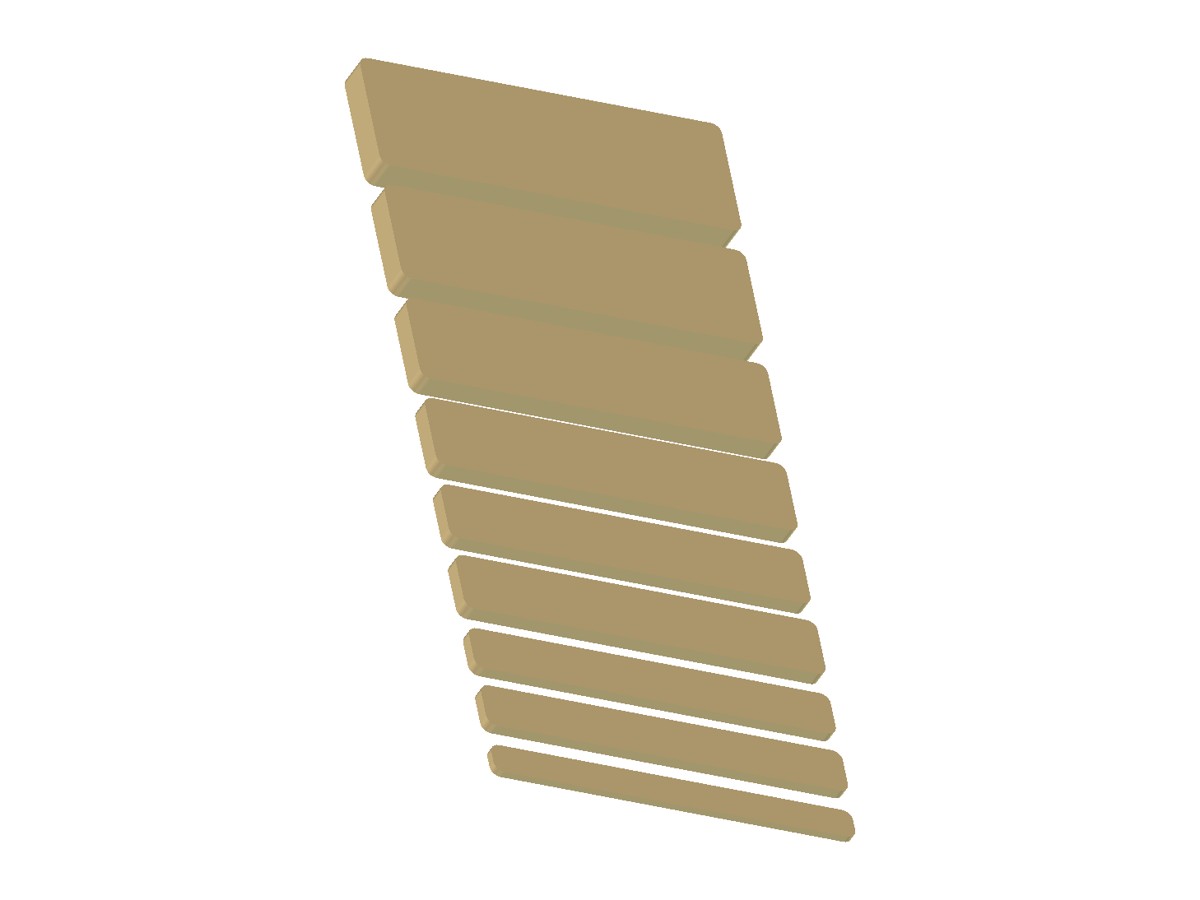


Loop Sticks: a Graded Set of Hardwood Sticks for Shaping Strap Loops (Hasluck, Harness Making, 1904)
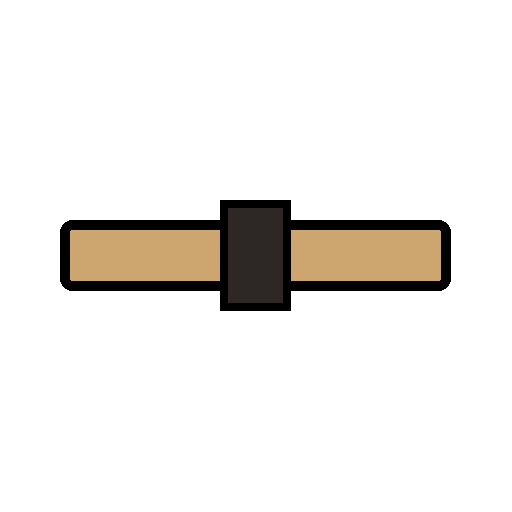
A set of flat hardwood sticks, 1/2 in. to 2 in. wide, that the harness maker puts inside a leather loop (the keeper on a buckled strap) to beat it flat and square and to clinch the nails against. Hasluck's Harness Making (1904) gives the range of sizes and says to have two of some, for work done in pairs.
Beginner
About 3 hours
Instructions
1
1
Leather keepers shaped square
Leather keepers shaped square
Stitching leather keepers and blocking them square (g mac). A loop stick is what goes inside while you shape one.
2
2
Hasluck's loop sticks, 1904
Hasluck's loop sticks, 1904
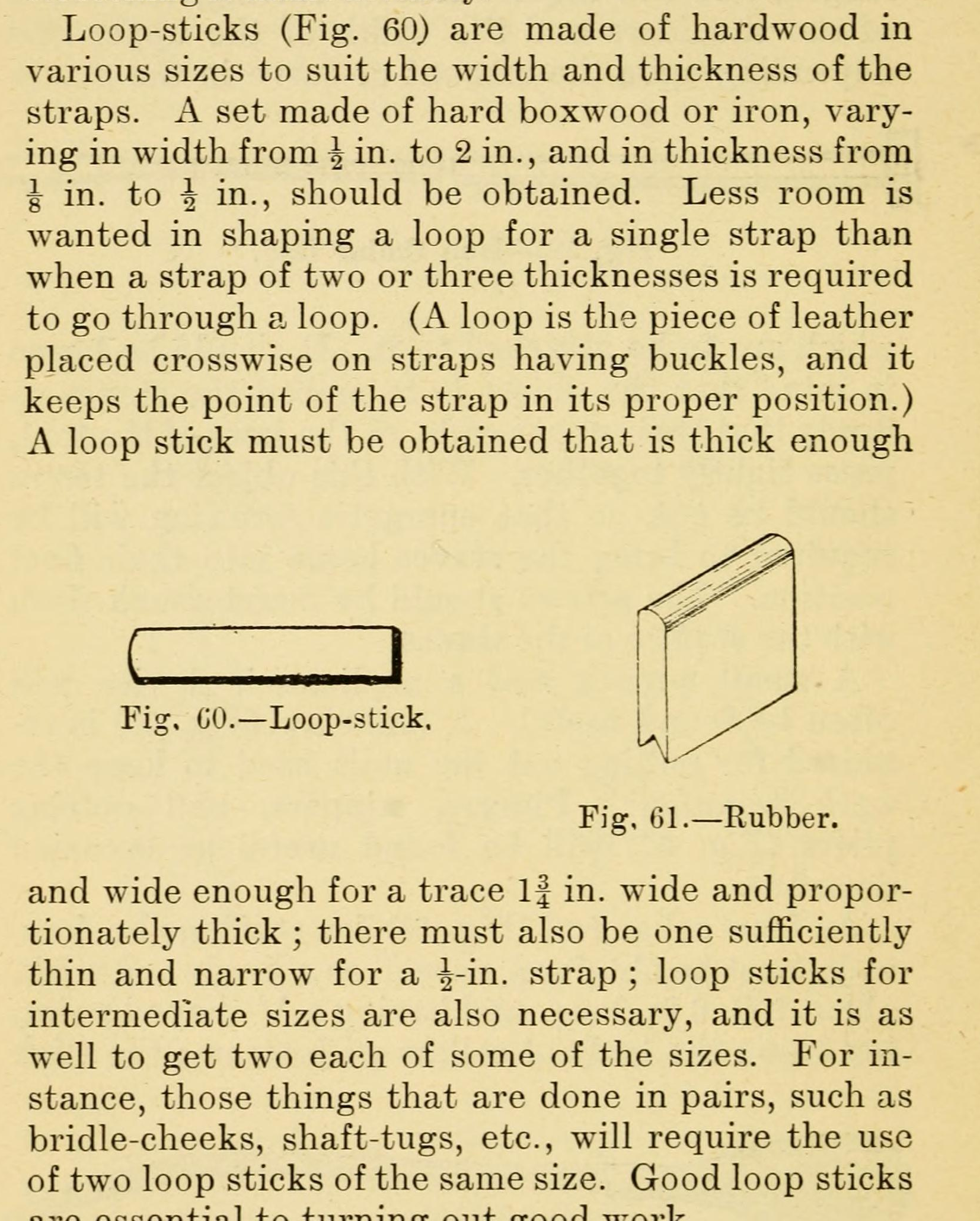
Harness Making p. 28: loop sticks of hardwood, sized to the width and thickness of the straps; a set of hard boxwood or iron from 1/2 in. to 2 in. wide and 1/8 in. to 1/2 in. thick. A loop for two or three thicknesses of strap needs a thicker stick than one for a single strap. Have one big enough for a 1 3/4 in. trace, one for a 1/2 in. strap, sizes between, and two of some sizes for pairs such as bridle cheeks and shaft tugs.
3
3
Cut the set
Cut the set
Rip and plane close-grained hardwood (boxwood if you can get it) to these widths and thicknesses, each 6 in. (152 mm) long: 1/2 x 1/8 in. (12.7 x 3.2 mm); 3/4 x 3/16 in. (19.1 x 4.8 mm) x 2; 1 x 1/4 in. (25.4 x 6.4 mm) x 2; 1 1/4 x 5/16 in. (31.8 x 7.9 mm); 1 1/2 x 3/8 in. (38.1 x 9.5 mm); 1 3/4 x 7/16 in. (44.5 x 11.1 mm); 2 x 1/2 in. (50.8 x 12.7 mm). Check each with the caliper.
Materials for this step:
 Hardwood Board1 piece (about 160 x 300 x 15 mm)
Tools needed:
 Hand Saw
 Block Plane
 Marking Gauge
 Combination Square
 Bench Vise
 Digital Caliper 6-Inch
4
4
Shape and finish
Shape and finish
Keep the faces flat and the long edges square so the loops come out square. Round the four corners a little (about 4 mm), smooth all over, ease the edges, and rub in a little linseed oil. Mark each stick with its size.
Materials for this step:
 Linseed Oil10 ml
Tools needed:
 Wood Rasp
 Sandpaper
5
5
Use a loop stick
Use a loop stick
Choose the stick that matches the strap, thicker if two or three thicknesses must pass the loop. Put it inside the loop, beat the loop gently until it is flat and square, and clinch the nails that hold the loop against the stick, leaving it inside while you nail the other side (Hasluck pp. 71 and 98).
6
6
Troubleshooting
Troubleshooting
Loop problems and fixes.
Flow
Loading...
7
7
History and honest limits
History and honest limits
From Paul N. Hasluck (ed.), Harness Making (1904), p. 28, Fig. 60, with use on pp. 71 and 98. Hasluck gives the range only: the sizes between, the thickness for each width, the 6 in. length and the oil finish are ours. For the biggest loops he uses an iron stick. Not made by us yet.
Materials
2- 1 piece (about 160 x 300 x 15 mm)Placeholder
- 10 mlPlaceholder
Tools Required
8- Placeholder
- Placeholder
- Placeholder
- Placeholder
- Placeholder
- Placeholder
- Placeholder
- Placeholder
This blueprint makes
Related Blueprints
These blueprints share knowledge with this one — techniques, materials, or principles that connect them in the learning graph.
CC0 Public Domain
This blueprint is released under CC0. You are free to copy, modify, distribute, and use this work for any purpose, without asking permission.
Support the Maker by purchasing products through their Blueprint where they earn a Maker Commission set by Vendors, or create a new iteration of this Blueprint and include it as a connection in your own Blueprint to share revenue.