Collaboration
ART
BEAUTY & WELLNESS
CRAFT
CULTURE & HISTORY
ENTERTAINMENT
ENVIRONMENT
FOOD & DRINKS
REVERSE ENGINEERING
SCIENCES
SPORTS
TECHNOLOGY
WEARABLES
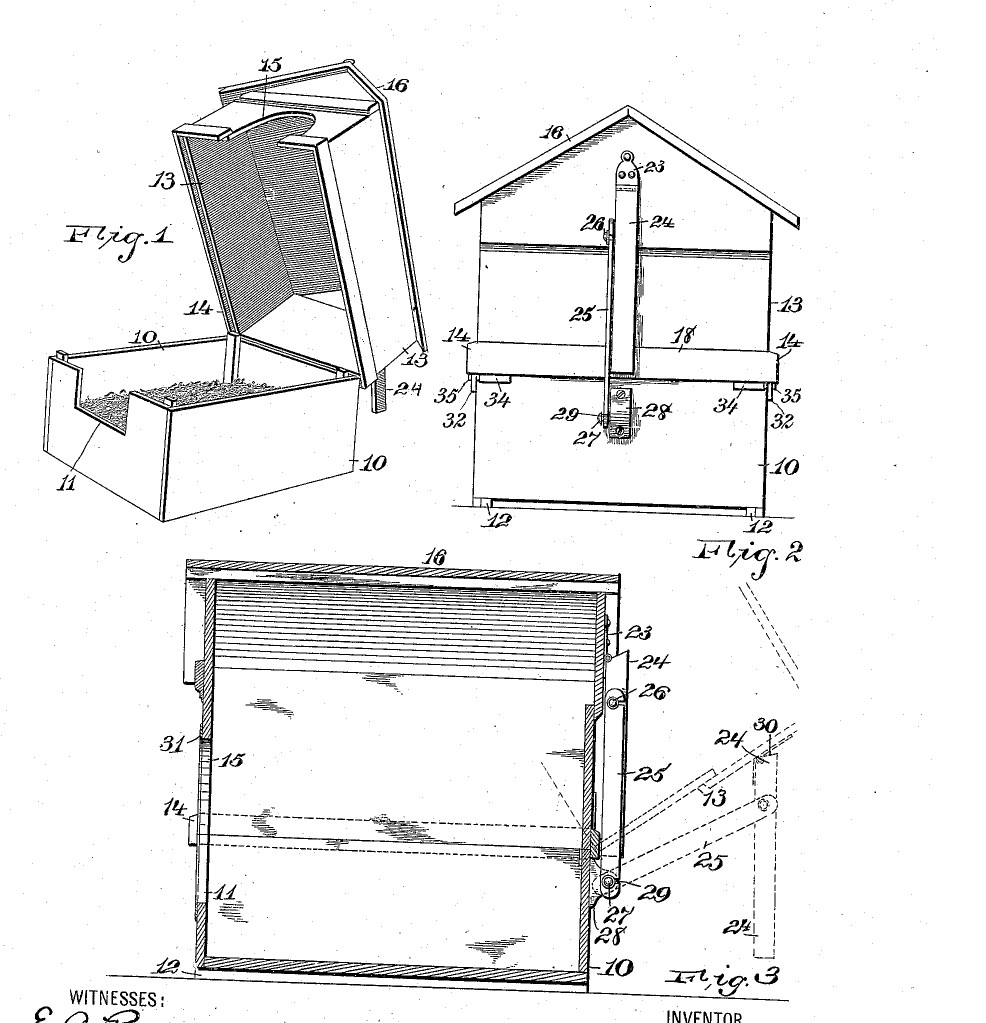


Dog Kennel Whose Top Tilts Back on Lift-Off Hinges to Air and Clean It (Minion, 1909)
John S. Minion of Newark received US 920,975, dated 11 May 1909, for a kennel in two parts. The top half, with the roof, sits on the bottom half and hinges at the back on slotted plates and studs, so it can be tilted back to let the sun in and clean the floor, or lifted right off. A swinging arm drops down by itself to hold it open.
We build it from pine. All sizes are ours.
Intermediate
About 1 day
Instructions
1
1
Size for the dog
Size for the dog
Loading Jupyter Notebook...
2
2
Read US 920,975
Read US 920,975
"The upper portion can be tilted back as shown in Fig. 1 so as to permit the cleaning of the lower portion, and also allow sunlight to penetrate therein over its whole surface, which makes a sanitary structure."
3
3
Build the lower portion
Build the lower portion
Build an open box of pine boards with upright sides and a floor, his portion 10, raised on two strips 12 so air passes under it. Cut the entrance 11 in the front.
Materials for this step:
 Pine Board1 piece
 Galvanized Nails1 piece
Tools needed:
 Tape Measure
 Hand Saw
 Coping Saw
 Claw Hammer
4
4
Build the upper portion
Build the upper portion
Build the top half, his portion 13, with sides that stand on the lower sides, a gabled roof 16, and an opening 15 matching the entrance. Nail strips 14 round its lower edge outside so they overlap the lower portion, shed water and make a tight joint.
Materials for this step:
Pine Board1 pieceGalvanized Nails1 pieceTools needed:
Hand SawCoping SawClaw Hammer5
5
Fit the lift-off hinge
Fit the lift-off hinge
Screw a flat-bar plate to the back of each lower side, projecting behind, with a slot cut in its top edge (his plates 32 and slots 33). Screw a plate with a bolt as a stud to each side of the upper portion so the studs drop into the slots when the top is set down (his plates 34 and studs 35). The top now tilts back on the studs or lifts off.
Materials for this step:
 Mild Steel Flat Bar1 piece
 Carriage Bolt1 piece
 Wood Screws1 piece
Tools needed:
 Hacksaw
 File Set
 Drill Press
 Drill Bit Set
 Screwdriver Set
6
6
Fit the prop arm
Fit the prop arm
Hang a flat-bar arm from a hinge at the top of the back of the upper portion (his arm 24 and hinge 23). Join its lower part to a bracket on the lower portion with a link (his link 25 and bracket 28), slotted so it can be unhooked. When the top is tilted back, the arm swings down to the ground and props it.
Materials for this step:
Mild Steel Flat Bar1 piece Butt Hinge1 pieceCarriage Bolt1 pieceWood Screws1 piece
Tools needed:
HacksawDrill PressDrill Bit SetScrewdriver Set7
7
Protect the entrance
Protect the entrance
Screw a strip of flat bar round the edge of the entrance, his iron band 31, where a chained dog wears it.
Materials for this step:
Mild Steel Flat Bar1 pieceWood Screws1 pieceTools needed:
HacksawDrill PressDrill Bit SetScrewdriver Set8
8
Troubleshooting
Troubleshooting
Kennel troubleshooting.
Flow
Loading...
9
9
History and honest limits
History and honest limits
**John S. Minion** of Newark, US 920,975, dated 11 May 1909, filed 21 May 1908. He claimed "a kennel comprising a bottom portion having vertical sides, a top portion with vertical sides resting on the sides of the bottom portion, hinges connecting the sides of the bottom and top portions on one end, an arm swinging from its top end on the hinged end of the top portion, and a link pivoted to the bottom portion and to the arm". He gives no sizes; the pine, all sizes and the flat-bar and bolt fittings are ours.
Materials
6- 1 piecePlaceholder
- 2 piecesPlaceholder
- 1 piecePlaceholder
- 2 piecesPlaceholder
- 3 piecesPlaceholder
- 1 piecePlaceholder
This blueprint makes
Related Blueprints
These blueprints share knowledge with this one — techniques, materials, or principles that connect them in the learning graph.

CC0 Public Domain
This blueprint is released under CC0. You are free to copy, modify, distribute, and use this work for any purpose, without asking permission.
Support the Maker by purchasing products through their Blueprint where they earn a Maker Commission set by Vendors, or create a new iteration of this Blueprint and include it as a connection in your own Blueprint to share revenue.