ART
BEAUTY & WELLNESS
CRAFT
CULTURE & HISTORY
ENTERTAINMENT
ENVIRONMENT
FOOD & DRINKS
REVERSE ENGINEERING
SCIENCES
SPORTS
TECHNOLOGY
WEARABLES


Mordants Beyond Alum: Why Cotton Needs Tannin and Iron Needs Restraint
A mordant is a metal salt that bonds to the fibre at one end and to the dye at the other. Without one, most natural dyes rinse straight out.
Alum on wool is the foundation and has its own blueprint. This rung is the next rung up: why the same alum does very little on cotton, what tannin does about it, what iron does to a colour as well as to its fastness, and which historical mordants are not worth using now.
The chemistry is worth knowing because it explains the recipes rather than replacing them.
Intermediate
5 hours
Instructions
1
1
Protein takes a mordant; cellulose barely does
Protein takes a mordant; cellulose barely does
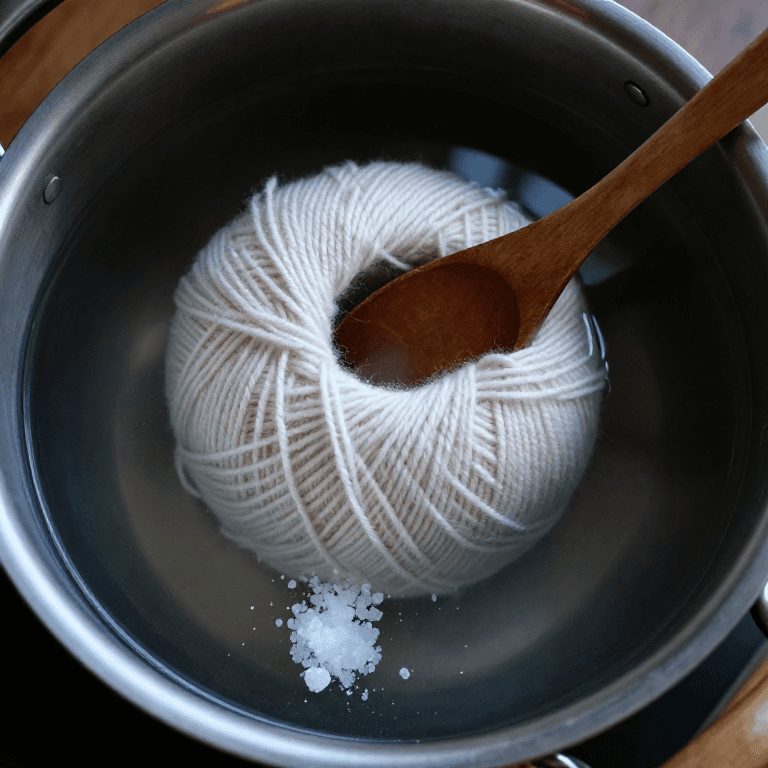
Wool and silk are proteins. Their chains carry amino and carboxyl groups all along them, and a metal ion such as aluminium bonds readily to those. That is why 15% alum on wool simply works.
Cotton, linen and hemp are cellulose — long chains of sugar rings with hydroxyl groups and very little else. Aluminium has almost nothing to hold onto, so alum alone on cotton gives a pale, patchy, poorly fast result. This is the single commonest disappointment in natural dyeing, and it is not a technique failure.
The answer worked out centuries ago is to give the cellulose something to hold the metal: **tannin**. Tannins bond to cellulose, and metal ions bond to tannins, so the tannin acts as a bridge between the fibre and the mordant.
That is why every serious cotton recipe has a tannin step in it and no wool recipe needs one.
Materials for this step:
 Cotton Fabric (Lightweight)2 m
 Undyed Wool Yarn1 skein
 Alum (Potassium Alum)1 piece
Tools needed:
 Stockpot
 Precision Scale
2
2
The tannin then alum sequence for cellulose
The tannin then alum sequence for cellulose
The classic cellulose preparation is **scour, tannin, alum**, and often tannin and alum twice over for a deep shade.
**Tannin bath.** Oak galls, sumac, myrobalan or tara at roughly 8 to 15% WOF, dissolved in hot water, the fibre entered warm and left overnight as it cools. Gallnuts are the strongest and the least coloured; sumac and myrobalan both carry a yellow of their own that shifts the final shade.
**Alum bath.** 15 to 20% WOF alum, warm, again left to cool. Some recipes add washing soda to the alum bath to help the aluminium fix; that is real, and it is also why the alum bath for cotton is not the same as the one for wool.
Rinse lightly between the two but do not scrub. The tannin is meant to stay on the fibre.
A tannin-mordanted cotton looks faintly cream or buff before dyeing. That is normal and it is the reason a pure white is difficult on cellulose with natural dyes.
Materials for this step:
Cotton Fabric (Lightweight)2 m Linen Fabric1 m
 Oak Galls1 pieceAlum (Potassium Alum)1 piece
 Washing Soda1 piece
Tools needed:
StockpotPrecision Scale Thermometer
 Rubber Gloves
 Fine Mesh Strainer
3
3
Iron: a modifier as much as a mordant
Iron: a modifier as much as a mordant
Ferrous sulfate is the other mordant every dyer ends up using, and it behaves differently from alum in two ways.
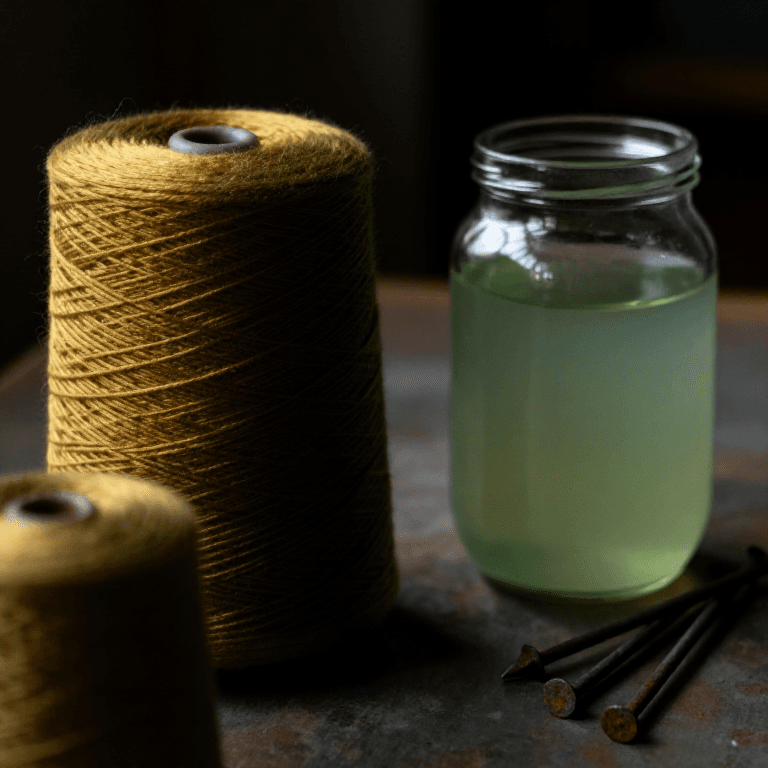
**It changes the colour, strongly.** Iron darkens and dulls: yellows go olive, reds go plum or brown, and a tannin-rich dye plus iron goes grey to black — which is how iron-gall ink and most historical blacks were made. Alum is close to colour-neutral; iron never is.
**A little goes a very long way.** 1 to 4% WOF is a normal amount. At much more than that the fibre is harsh, and on wool and silk iron in quantity actually weakens the fibre over years — historical black silks are notorious for shattering for exactly this reason.
It can be used before dyeing as a mordant, or afterwards as a modifier dip, which is what the iron-saddening blueprint covers in detail. Used afterwards it is far easier to control, because the colour can be watched and the fibre lifted when it is right.
Keep an iron pot and an iron spoon separate from everything else. Iron contamination of an alum bath is invisible until the colour comes out muddy.
Materials for this step:
 Ferrous Sulfate1 pieceUndyed Wool Yarn2 skeinsOak Galls1 piece
Tools needed:
StockpotPrecision Scale Glass Jars with LidsRubber Gloves
 Tongs
Tongs4
4
What cream of tartar does, and what to leave alone
What cream of tartar does, and what to leave alone
**Cream of tartar** at 6 to 8% WOF is added to the alum bath for wool. It acidifies the bath, which helps the aluminium take up evenly, and it keeps the wool soft where alum alone can leave it slightly sticky. It also brightens some reds. It is not itself a mordant.
Three traditional mordants are better left in the history books:
**Chrome** (potassium dichromate) gives beautiful deep colours and is a confirmed carcinogen whose waste cannot responsibly go down a drain.
**Tin** (stannous chloride) brightens scarlets dramatically and embrittles the fibre badly if overdone; it is also an irritant.
**Copper** (copper sulfate) shifts colours green and is toxic to aquatic life at very low concentration.
Alum, tannin and iron cover most of what the others did, and all three can be used in a domestic kitchen and disposed of sensibly. Alum-spent baths can go on the garden in moderation; iron baths should be diluted heavily first.
Whatever is used: dedicated pots, gloves, a mask when weighing powders, and nothing that will later hold food.
Materials for this step:
Alum (Potassium Alum)1 piece Cream of Tartar1 pieceUndyed Wool Yarn2 skeins
Tools needed:
Precision Scale Dust Mask
 Chemical-Resistant GlovesStockpot
 Index Cards
Materials
8- Placeholder
- 5 skeinsPlaceholder
- 3 piecesPlaceholder
- 1 mPlaceholder
- 1 piecePlaceholder
- 1 piecePlaceholder
- 1 piecePlaceholder
- 1 piecePlaceholder
This blueprint makes
Related Blueprints
These blueprints share knowledge with this one — techniques, materials, or principles that connect them in the learning graph.

CC0 Public Domain
This blueprint is released under CC0. You are free to copy, modify, distribute, and use this work for any purpose, without asking permission.
Support the Maker by purchasing products through their Blueprint where they earn a Maker Commission set by Vendors, or create a new iteration of this Blueprint and include it as a connection in your own Blueprint to share revenue.