Collaboration
ART
BEAUTY & WELLNESS
CRAFT
CULTURE & HISTORY
ENTERTAINMENT
ENVIRONMENT
FOOD & DRINKS
REVERSE ENGINEERING
SCIENCES
SPORTS
TECHNOLOGY
WEARABLES
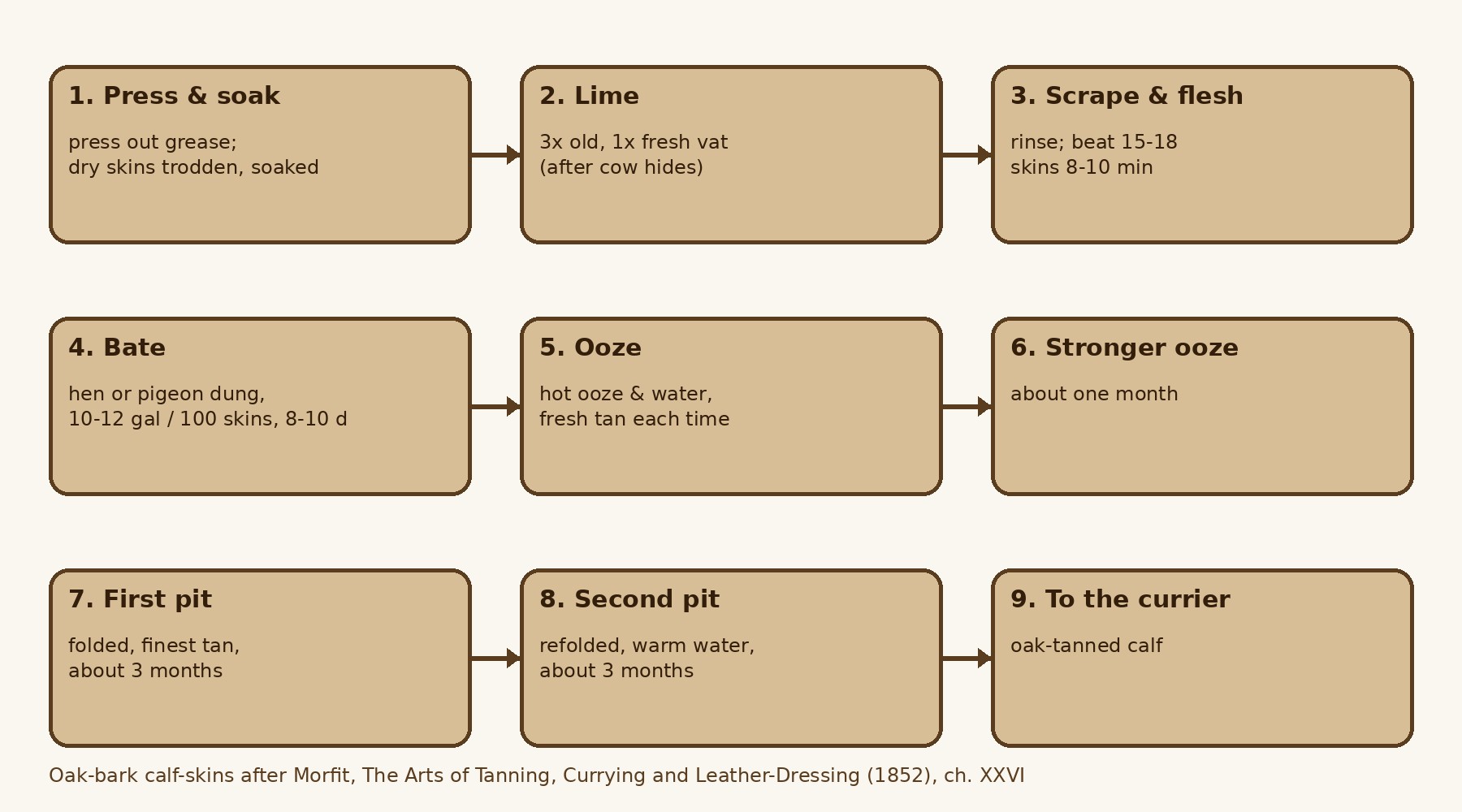


Oak-Bark Calf-Skins: Lime, Dung Bate, Ooze and Two Three-Month Pits of Finest Tan (Morfit, 1852)
How calf-skins were tanned with oak bark, from Campbell Morfit's Arts of Tanning, Currying and Leather-Dressing (1852): limed in weakened vats, scraped, fleshed and beaten, bated in hen or pigeon dung, brought up in hot ooze and stronger ooze for a month, then laid folded in the finest tan in two pits of about three months each, ready for the currier.
Advanced
About 7 months
Instructions
1
1
Bark and weight
Bark and weight
Loading Jupyter Notebook...
2
2
Read The Arts of Tanning, ch. XXVI
Read The Arts of Tanning, ch. XXVI
"The tanning of calf-skins is conducted much in the same way as that of small cow-hides."
3
3
Lime
Lime
Press the skins to expel the oily matter (dry skins are first trodden out and soaked). Pass them three times through old and once through fresh lime vats, using the vats after cow hides have weakened them, as calf cannot bear full-strength lime.
Materials for this step:
 Fresh Calfskin12 pieces
 Slaked Lime1 piece
Tools needed:
 Tanning Vat
4
4
Scrape, flesh and beat
Scrape, flesh and beat
Scrape off the lime, flesh carefully and rinse. Beat 15 to 18 skins in a tub for 8 to 10 minutes with wedge-shaped beaters 8-1/2 to 10 in high, after each rinsing (not needed where the skins are rinsed as often as six times).
Tools needed:
 Fleshing Beam
 Fleshing KnifeTanning Vat
 Wooden Mallet
5
5
Bate
Bate
To clear the last lime, grease and glue, bate them in water with pigeon's or hen's dung, 10 to 12 gallons of dung to 100 skins, for 8 to 10 days, handling often and scraping on the beam, until they become pelts. (Fresh dung can putrefy and stain.)
Materials for this step:
 Animal Dung1 piece
Tools needed:
Tanning VatFleshing BeamFleshing Knife6
6
Ooze
Ooze
Put the pelts in hot ooze and water, handled more often and more carefully than cow hides, with fresh tan each time; then in stronger ooze and tan for a month.
Materials for this step:
 Oak Bark (Crushed)4 pieces
Tools needed:
Tanning Vat7
7
Two pits
Two pits
Lay the skins in the pit folded lengthwise and unequally, spread with tan of the very finest quality, heads and tails (the thickest parts) with more; leave about 3 months. Take them out, clean off the tan, and lay them in a second pit of finest tan, folded the other way so the covered parts are now exposed; fill up, moisten with warm water (or warm bark infusion) and leave about 3 months. They are then ready for the currier.
Materials for this step:
Oak Bark (Crushed)6 piecesTools needed:
Tanning Vat8
8
Troubleshooting
Troubleshooting
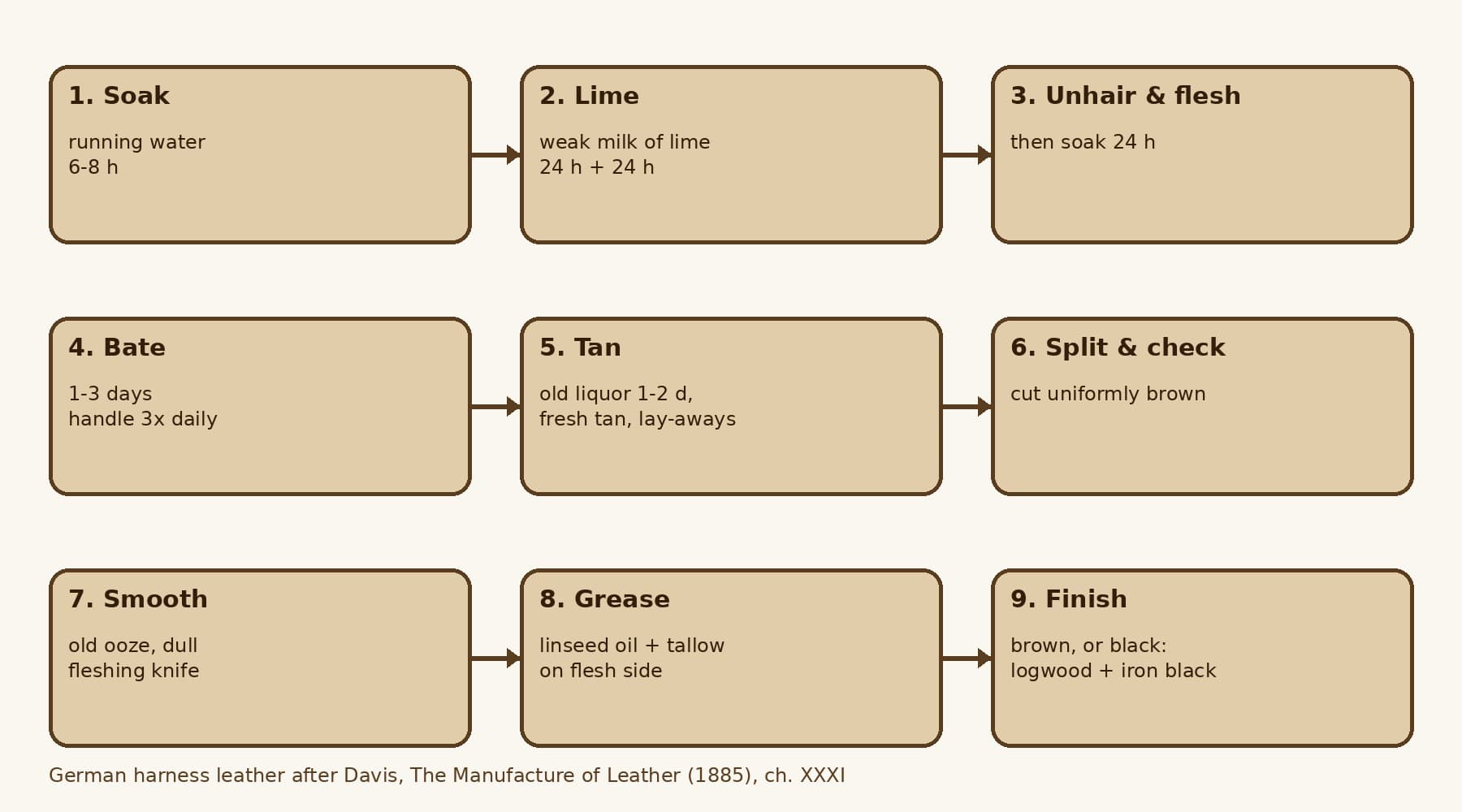
Calf tanning troubleshooting.
Flow
Loading...
9
9
History and honest limits
History and honest limits
From Campbell Morfit, **The Arts of Tanning, Currying, and Leather-Dressing** (Philadelphia, 1852), chapter XXVI (checked on the archive.org scan artsoftanningcur00morf, pp. 349-353), with Kampffmeyer's oak-bark trial. He gives no ooze strengths. The diagram hero, the per-skin arithmetic and the tools are ours.
Materials
4- 12 piecesPlaceholder
- 1 piecePlaceholder
- 1 piecePlaceholder
- 6 piecesPlaceholder
This blueprint makes
Related Blueprints
These blueprints share knowledge with this one — techniques, materials, or principles that connect them in the learning graph.
CC0 Public Domain
This blueprint is released under CC0. You are free to copy, modify, distribute, and use this work for any purpose, without asking permission.
Support the Maker by purchasing products through their Blueprint where they earn a Maker Commission set by Vendors, or create a new iteration of this Blueprint and include it as a connection in your own Blueprint to share revenue.