ART
BEAUTY & WELLNESS
CRAFT
CULTURE & HISTORY
ENTERTAINMENT
ENVIRONMENT
FOOD & DRINKS
REVERSE ENGINEERING
SCIENCES
SPORTS
TECHNOLOGY
WEARABLES

Opposed-Blade Cone Butter Worker: Blades Lift and Press the Butter in a Cone, Buttermilk Drains Below
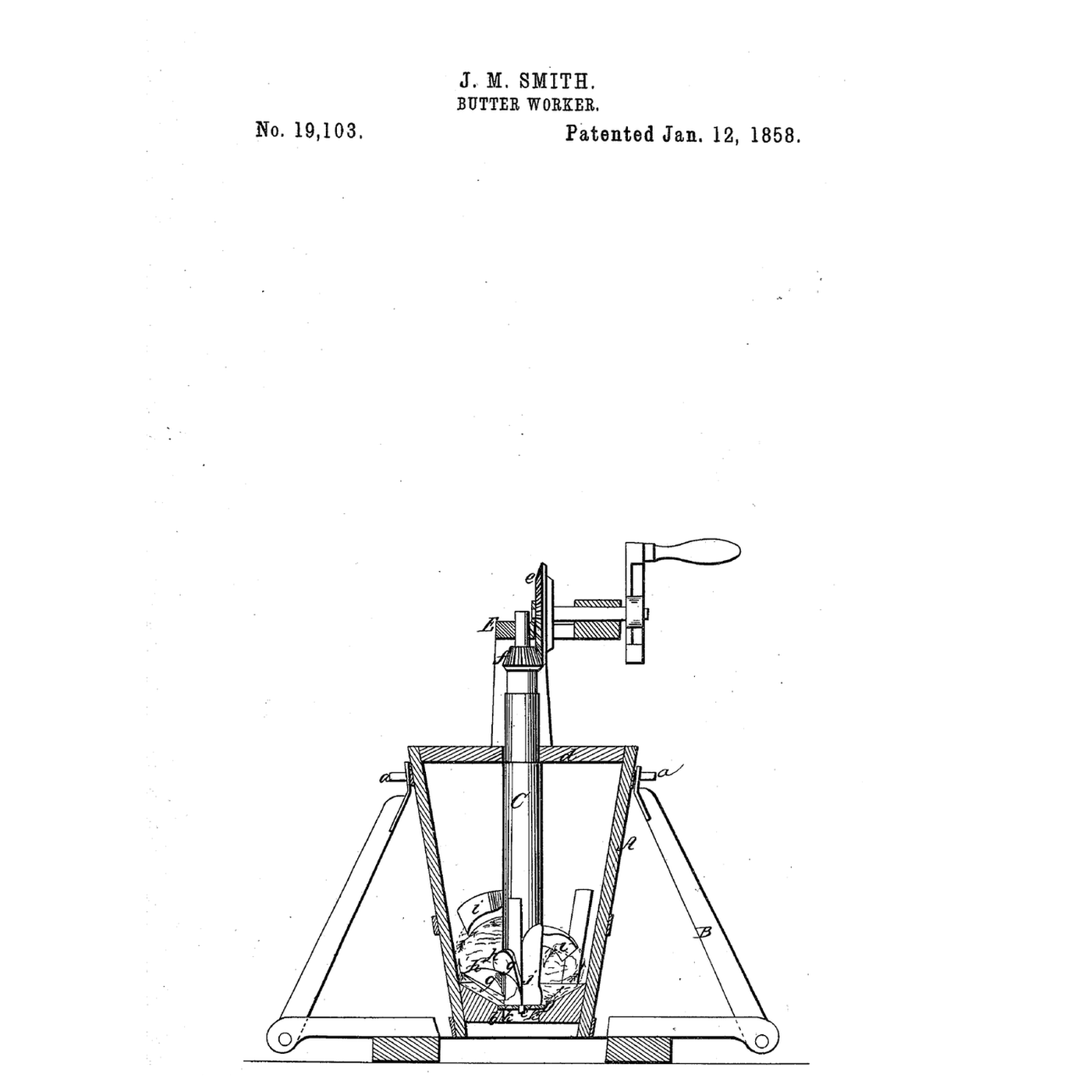
Justin M. Smith of Lyme, Connecticut, received US 19,103, dated 12 January 1858, for a butter-worker: an inverted conical case hung on pivots in a frame, a turning shaft with lower blades inclined upward and upper blades curved downward, and a perforated plate in the bottom, so the butter is rolled and pressed and the buttermilk runs out.
This rung prints the bottom plate and the two blade sets, builds the worker and works butter.
Intermediate
About 4 hours, plus printing
Instructions
1
1
Lifted and pressed down
Lifted and pressed down
Loading Jupyter Notebook...
2
2
A cone that drains at its point, before it
A cone that drains at its point, before it
Williams rolls a stick round a cone by hand; Smith turns opposed blades inside one.
3
3
Read US 19,103
Read US 19,103
"By subjecting the butter to the rolling and compressing action as described, its grain or molecules will not be broken, for it is not subjected to a direct pressure, the working of the butter resembling that given or produced by hand."
4
4
Print the parts
Print the parts
Print the bottom plate (/uploads/blueprints/opposed-blade-cone-butter-worker-bottom-plate.stl), the lower blades (/uploads/blueprints/opposed-blade-cone-butter-worker-lower-blades.stl) and the upper blades (/uploads/blueprints/opposed-blade-cone-butter-worker-upper-blades.stl). Print in PETG at 0.2 mm layers, 30 % infill, 4 walls; wash before first use.
Materials for this step:
 PETG Filament1 piece
Tools needed:
 FDM 3D Printer
5
5
Case and frame
Case and frame
Use a tapered food-grade bucket as the case, cut a hole in its bottom and seal the bottom plate over it with food-safe silicone. Hang the bucket in a pine frame on two bolts through its sides, as his pivots, so it can be tipped to empty.
Materials for this step:
 20-Liter Bucket1 piece
 Silicone Sealant1 piece
 Pine Board1 piece
 Carriage Bolt1 piece
 Flat Washer1 piece
 Hex Nut1 piece
Tools needed:
 Hole Saw Kit
 Cordless Drill
 Hand Saw
 Adjustable Spanner
6
6
Shaft and blades
Shaft and blades
Stand a 10 mm square hardwood shaft in the plate's step, cut a groove up one side of its foot for the buttermilk, push on the lower blades and, above them, the upper blades, and fit a crank on top through a pine bar across the bucket's mouth.
Materials for this step:
 Hardwood Dowels1 piecePine Board1 piece
 Wood Glue1 piece
Tools needed:
Hand SawCordless Drill Drill Bit Set
7
7
The patent drawing
The patent drawing
US 19,103 drawing sheet, public domain (expired patent).
8
8
Work the butter
Work the butter
Let the heavy cream stand until it reaches about 15 °C, checked with the thermometer. Churn 1.5 litres in any churn and drain the butter. Set a bowl under the worker, put the butter in and turn the crank steadily; the buttermilk runs out through the plate. Add a pinch of salt and turn on to work it in. Tip the case to empty it and weigh the butter.
Materials for this step:
 Heavy Cream1500 ml
 Coarse Sea Salt1 piece
Tools needed:
 Leave-In Probe Thermometer
 Stopwatch
 Digital Kitchen Scale
 Stainless Steel Mixing Bowl (Large)
9
9
Troubleshooting
Troubleshooting
Opposed-blade worker troubleshooting.
Flow
Loading...
10
10
History and honest limits
History and honest limits
**Justin M. Smith** of Lyme, New London County, Connecticut, US 19,103, 12 January 1858. He wrote that the blades mix the salt through evenly and carry off hardened buttermilk; those are his claims. He did not claim a rotating shaft with arms in a case broadly; he claimed the shaft with its arms in the suspended inverted conical case with the perforated plate. A bucket and printed parts stand in for his wooden case. FDM prints hold food in their layer lines, so wash well and replace when worn.
Materials
11- 1 piecePlaceholder
- 1 piecePlaceholder
- 1 piecePlaceholder
- 1 piecePlaceholder
- 1 piecePlaceholder
- 1 piecePlaceholder
- 1 piecePlaceholder
- 1 piecePlaceholder
- 1 piecePlaceholder
- 1500 mlPlaceholder
- 1 piecePlaceholder
Tools Required
10- Placeholder
- Placeholder
- 1 vendor sell this, none ship to you yetPlaceholder
- Placeholder
- Placeholder
- Placeholder
- Placeholder
- Placeholder
- Placeholder
- Placeholder
Related Blueprints
These blueprints share knowledge with this one — techniques, materials, or principles that connect them in the learning graph.
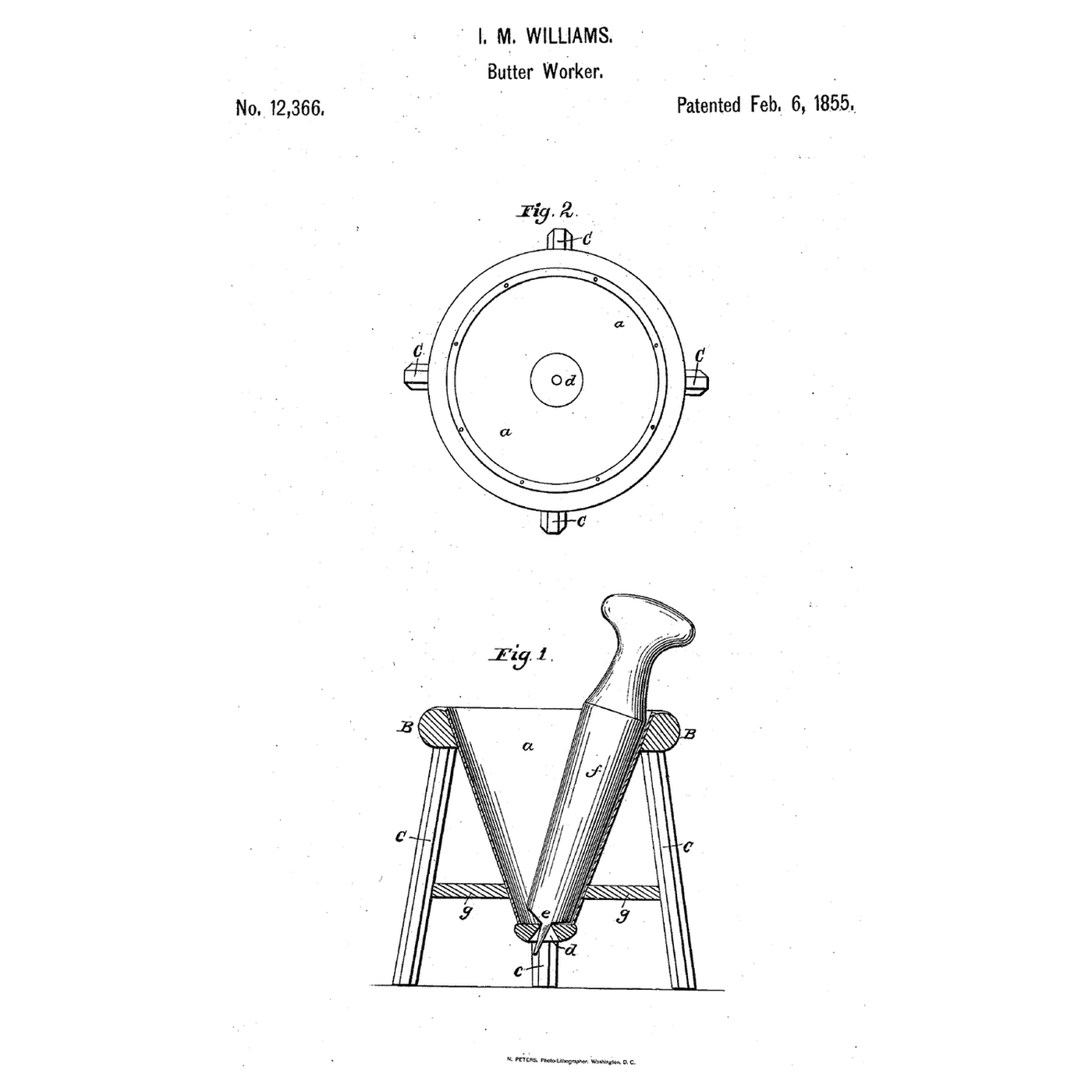
Cone-Bowl Roller Butter Worker: Roll a Conical Stick Round a Conical Bowl, the Buttermilk Drains Below
by YourGrandma
Woodworking
2
0
0
0
0
0
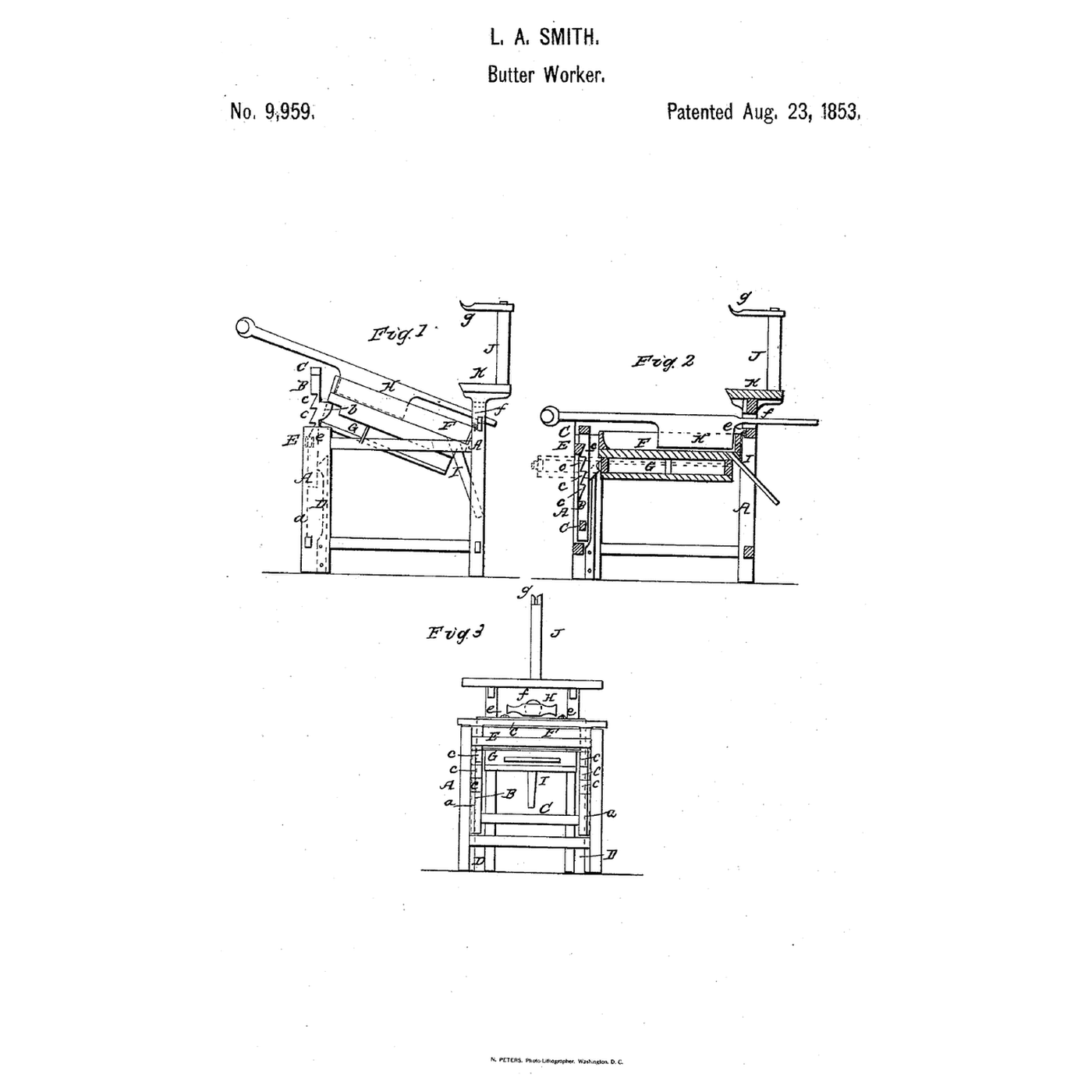
Ice-Drawer Butter Worker: An Ice Box Under the Tray, a Worker With Acute Edges
by YourGrandma
Woodworking
2
0
0
0
0
0
Churning Butter from Cream — The 5,000-Year-Old Fat Separation
by TheChef
CRAFT
47
0
0
0
0
0
CC0 Public Domain
This blueprint is released under CC0. You are free to copy, modify, distribute, and use this work for any purpose, without asking permission.
Support the Maker by purchasing products through their Blueprint where they earn a Maker Commission set by Vendors, or create a new iteration of this Blueprint and include it as a connection in your own Blueprint to share revenue.