ART
BEAUTY & WELLNESS
CRAFT
CULTURE & HISTORY
ENTERTAINMENT
ENVIRONMENT
FOOD & DRINKS
REVERSE ENGINEERING
SCIENCES
SPORTS
TECHNOLOGY
WEARABLES


PTFE Fine Powder: a Dispersion Stirred Until It Curdles (Lontz 1952)
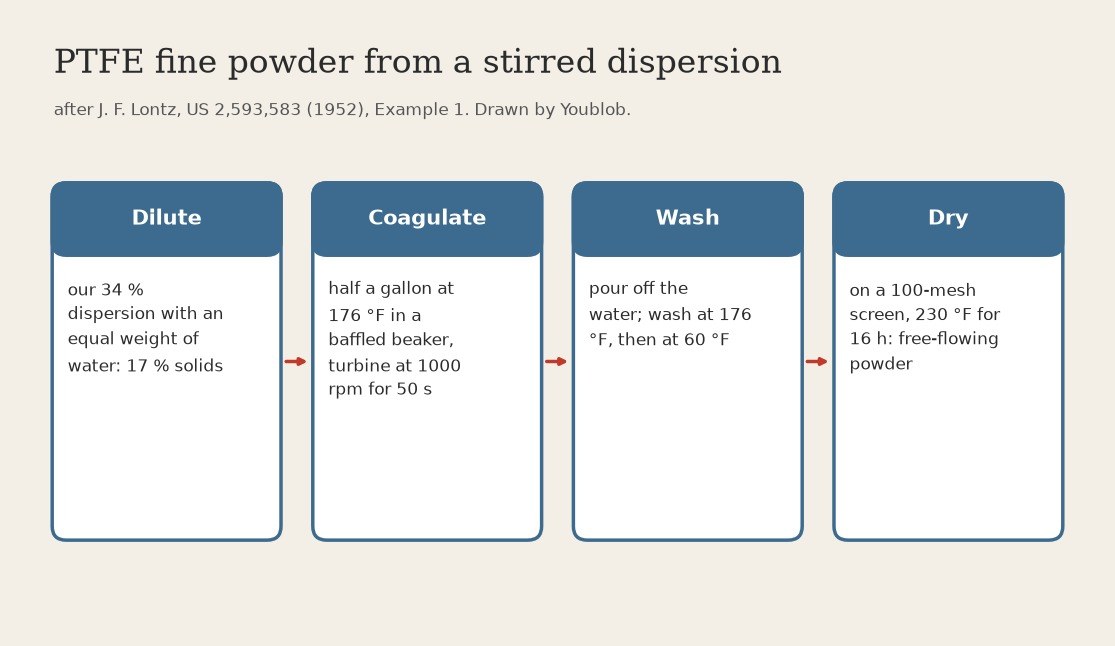
A PTFE dispersion is stable on the shelf, but stirred hard enough it curdles. Fifty seconds at 1000 rpm in a baffled beaker and the polymer floats up as a dry-looking, unwettable crumb. Washed and dried, it is a free-flowing powder for rolling into tape, or for cold lubricated extrusion.
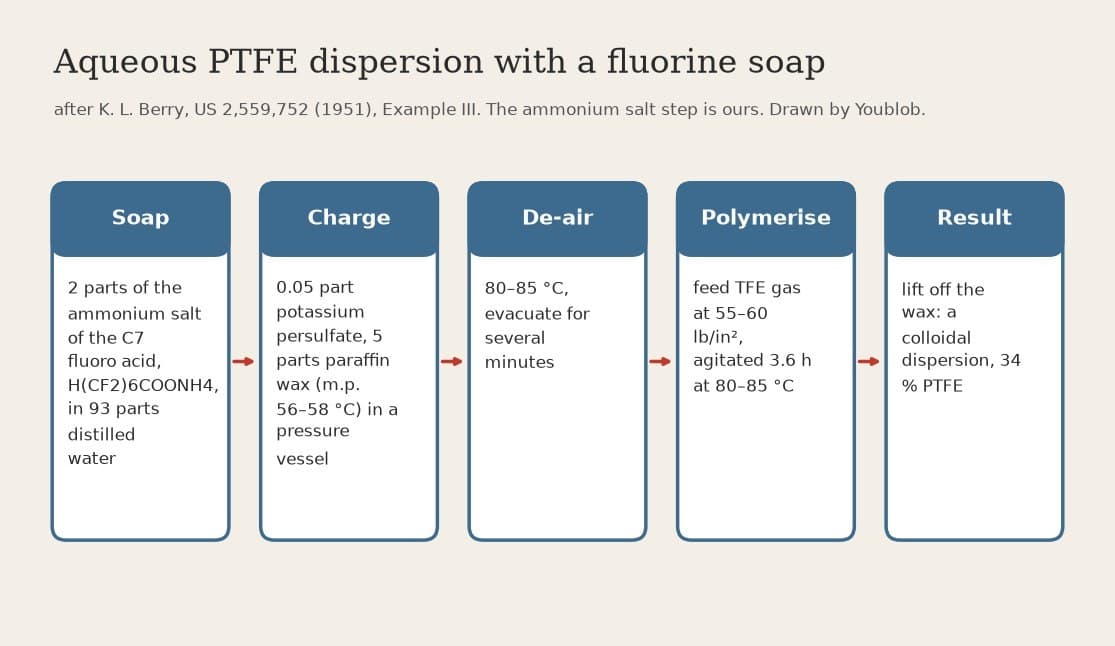
Source: J. F. Lontz (du Pont), US 2,593,583 (1952), Example 1. Lontz started from a dispersion made with disuccinic acid peroxide; ours is Berry's persulfate dispersion, diluted to his 17 %. Picture drawn by Youblob.
Intermediate
1 day
Instructions
1
1
Dilute the dispersion to 17 %
Dilute the dispersion to 17 %
Ours: stir the 34 % dispersion with an equal weight of distilled water to get 17 % solids, the strength Lontz used.
Materials for this step:
 Aqueous PTFE Dispersion1 part
 Distilled Water1 part
Tools needed:
 Balance Scale
 Glass Jars with Lids
2
2
Set up the baffled beaker
Set up the baffled beaker
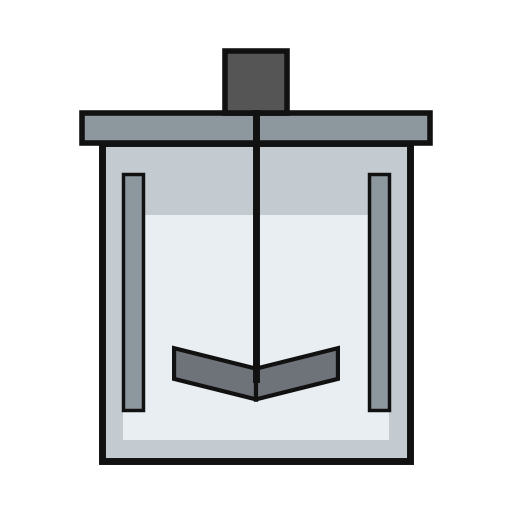
A 1-gallon stainless beaker, 6.5 in across and 7.5 in deep, with four baffles about ⅜ × 1 in hanging from the cover to within 3 in of the bottom. Stirrer: open turbine, 4 blades 1½ in high, 5 in across, reaching to within 1 in of the bottom.
Tools needed:
 Baffled Stirred Tank
 Stirrer
3
3
Stir hard at 176 °F for 50 seconds
Stir hard at 176 °F for 50 seconds
Put in half a gallon of the 17 % dispersion and heat it to 176 °F (80 °C). Run the stirrer at 1000 rpm for 50 seconds (Lontz measured 0.72 hp per gallon). The polymer coagulates and floats, unwetted, on top.
Tools needed:
Baffled Stirred TankStirrer Hot Plate
 Thermometer
4
4
Wash hot, then cold
Wash hot, then cold
Pour off the water. Wash the polymer with hot water at 176 °F, then with cold water at 60 °F (16 °C), and drain.
Tools needed:
Baffled Stirred TankThermometer5
5
Dry at 230 °F for 16 hours
Dry at 230 °F for 16 hours
Spread the wet polymer on a 100-mesh screen and dry it in an oven at 230 °F (110 °C) for 16 hours. It comes out a free-flowing granular powder that passes 6–8 mesh.
Tools needed:
 Fine Wire Mesh Sieve
 Drying OvenGlass Jars with Lids
Materials
2- 1 partPlaceholder
- 1 partPlaceholder
This blueprint makes
Related Blueprints
These blueprints share knowledge with this one — techniques, materials, or principles that connect them in the learning graph.
CC0 Public Domain
This blueprint is released under CC0. You are free to copy, modify, distribute, and use this work for any purpose, without asking permission.
Support the Maker by purchasing products through their Blueprint where they earn a Maker Commission set by Vendors, or create a new iteration of this Blueprint and include it as a connection in your own Blueprint to share revenue.