ART
BEAUTY & WELLNESS
CRAFT
CULTURE & HISTORY
ENTERTAINMENT
ENVIRONMENT
FOOD & DRINKS
REVERSE ENGINEERING
SCIENCES
SPORTS
TECHNOLOGY
WEARABLES
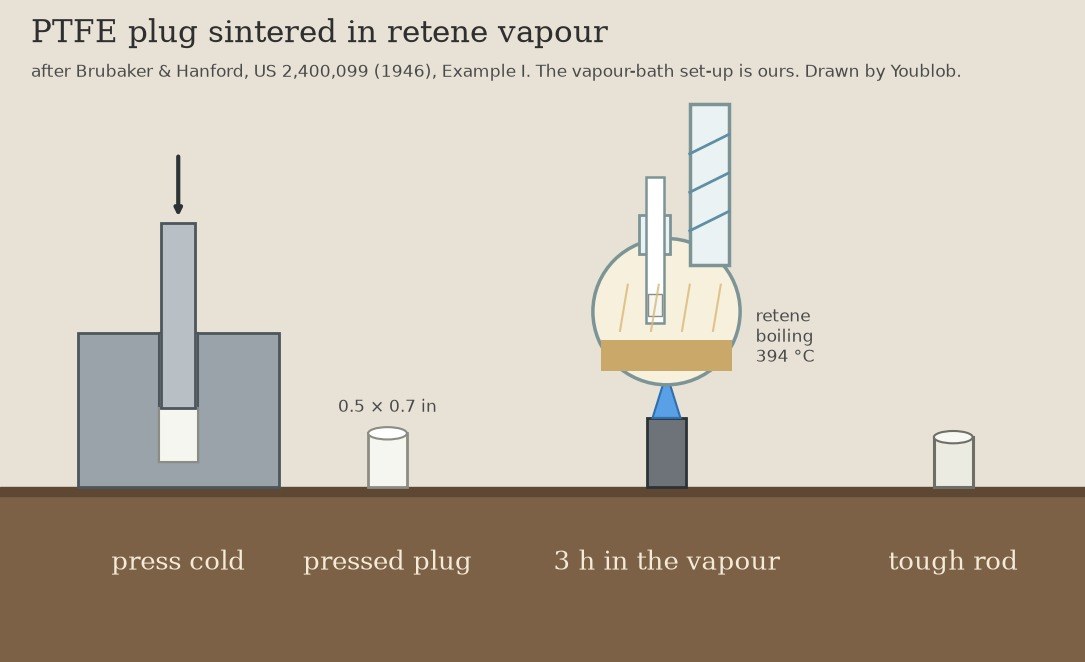


PTFE Rod: a Plug Sintered in Boiling Retene Vapour (Brubaker & Hanford 1946)
The first example of du Pont's way to shape PTFE: press a small rod of powder cold, then heat it above 327 °C out of the mould. Here the heat comes from the vapour of boiling retene, which boils at 394 °C, so the temperature holds steady by itself. The plug comes out sintered into one tough piece.
Source: M. M. Brubaker and W. E. Hanford (du Pont), US 2,400,099 (1946), Example I. The pressure is the patent's usual range, as the example gives none. The mould, press and the vapour-bath set-up are ours. Picture drawn by Youblob.
Advanced
1 day
Instructions
1
1
Press a plug from the powder
Press a plug from the powder
At room temperature, press small particles of PTFE in a mould into a plug 0.5 in across and 0.7 in long. The example gives no pressure; the patent's usual range is 100–3000 lb/sq in.
Materials for this step:
 PTFE Resin Powder1 as required for the plug
Tools needed:
 Compression Mould
 Hydraulic Press
 Ruler
2
2
Set up a retene vapour bath
Set up a retene vapour bath
Boil retene so its vapour fills the space round a glass tube. Ours: retene in a flask on a burner, a reflux condenser on top, and the tube standing in the vapour.
Tools needed:
 Retene
 Glass Distillation Flask
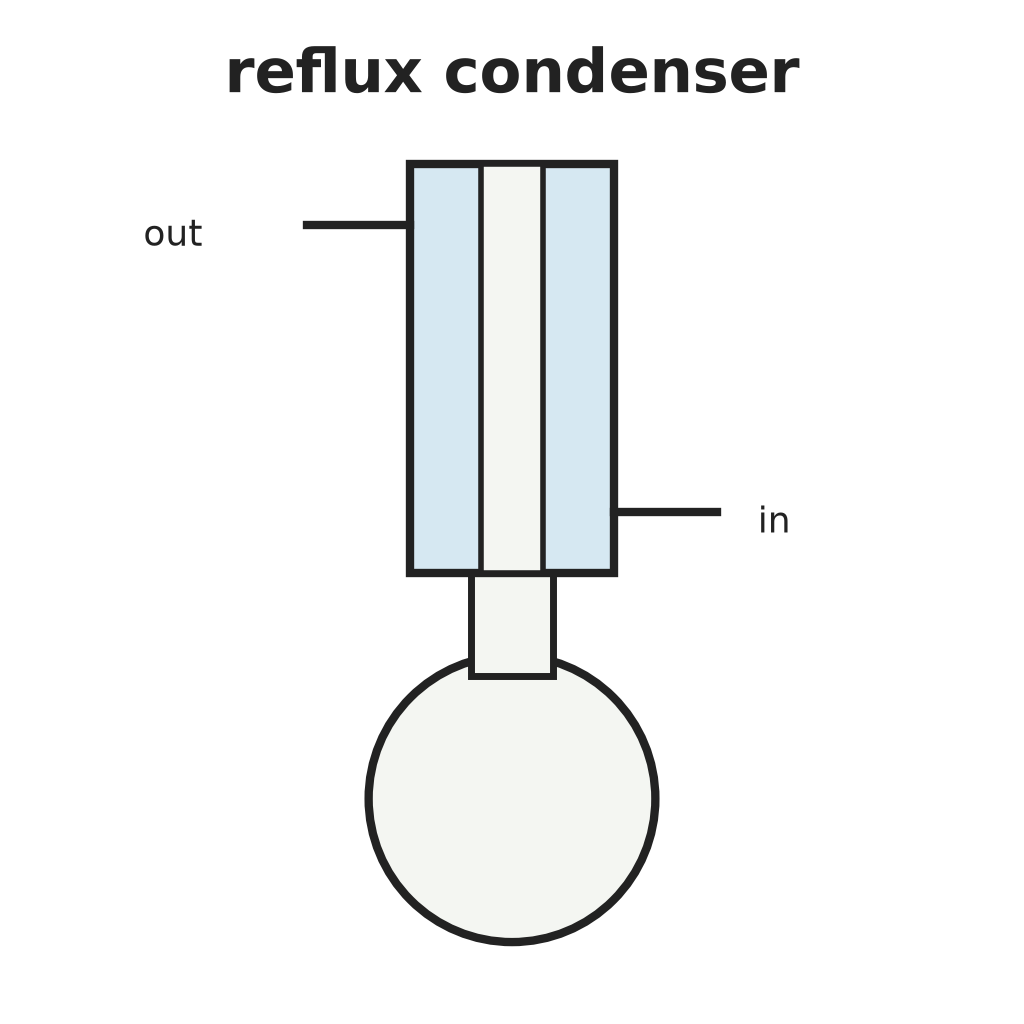 Reflux Condenser
 Bunsen Burner
 Test Tubes
3
3
Sinter for 3 hours
Sinter for 3 hours
Take the plug out of the mould, put it in the glass tube, and heat it in the vapour of boiling retene (394 °C) for 3 hours.
Tools needed:
Test TubesReteneBunsen Burner4
4
Cool it under the retene
Cool it under the retene
Remove the heat source and let the plug cool where it is. It is now sintered together into a tough mass.
Tools needed:
Test TubesMaterials
1- 1 as required for the plugPlaceholder
This blueprint makes

Related Blueprints
These blueprints share knowledge with this one — techniques, materials, or principles that connect them in the learning graph.


CC0 Public Domain
This blueprint is released under CC0. You are free to copy, modify, distribute, and use this work for any purpose, without asking permission.
Support the Maker by purchasing products through their Blueprint where they earn a Maker Commission set by Vendors, or create a new iteration of this Blueprint and include it as a connection in your own Blueprint to share revenue.