ART
BEAUTY & WELLNESS
CRAFT
CULTURE & HISTORY
ENTERTAINMENT
ENVIRONMENT
FOOD & DRINKS
REVERSE ENGINEERING
SCIENCES
SPORTS
TECHNOLOGY
WEARABLES
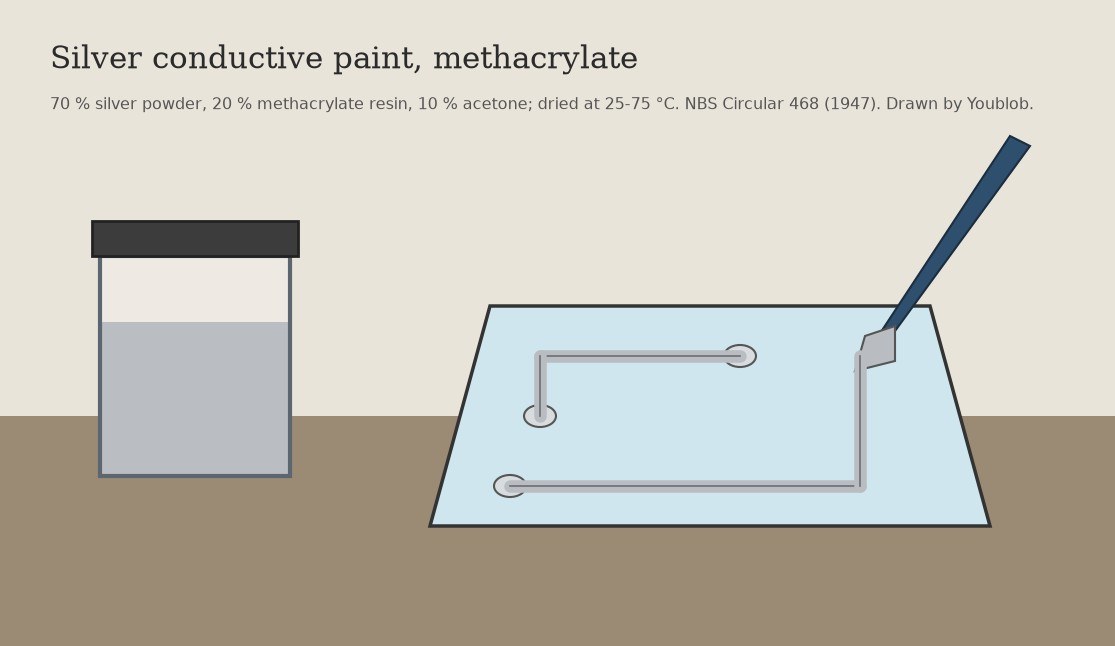


Silver Conductive Paint: Silver Powder in Methacrylate Resin and Acetone, Dried at 25-75 °C (NBS Circular 468, 1947)
A silver paint that conducts once it dries at room heat, with no firing, so it can go on plastics and be used to fix leads and draw conductors. Fine silver powder is held in methacrylate resin dissolved in acetone.
Source: Brunetti and Curtis, Printed Circuit Techniques, NBS Circular 468 (1947), Table 2, the column for thermoplastic plastics: 70 % silver powder, 20 % methacrylate or polystyrene resin, 10 % ketones, benzene, toluene or ethylene dichloride, dried at 25 to 75 °C. This is the methacrylate (acrylic) version. Ours: precipitated silver ground fine as the silver powder, and acetone of the four solvents. Picture drawn by Youblob.
Beginner
1 day
Instructions
1
1
Dissolve 20 g methacrylate resin in 10 g acetone
Dissolve 20 g methacrylate resin in 10 g acetone
For 100 g of paint: put 20 g methacrylate resin and 10 g acetone in a jar, close it and let the resin dissolve, stirring now and then. Ours: acetone, one of the four solvents NBS names. Fumes: work in the open air, gloves and goggles.
Materials for this step:
 Acrylic Pellets20 g
 Acetone10 g
Tools needed:
 Balance Scale
 Glass Jar
 Borosilicate Glass Rod
 Nitrile Gloves
 Chemical Splash Goggles
2
2
Grind 70 g silver powder fine and stir it in
Grind 70 g silver powder fine and stir it in
Grind 70 g silver powder fine and stir it into the resin solution until even. NBS asks for at least 50 % silver for a brushed paint; this one has 70 %. Ours: precipitated silver as the powder.
Materials for this step:
 Precipitated Silver70 g
Tools needed:
Balance Scale Mortar and PestleBorosilicate Glass Rod
3
3
Stir well, keep the jar closed
Stir well, keep the jar closed
Stir the paint thoroughly before each use, and keep the jar closed so the solvent does not evaporate and thicken it.
Tools needed:
Glass JarBorosilicate Glass Rod4
4
Brush on and dry at 25 to 75 °C
Brush on and dry at 25 to 75 °C
Brush the paint on and dry it at 25 to 75 °C to drive out the solvent. It then conducts. Brushing is ours; NBS also names spraying and screen stencils.
Tools needed:
 Fine Brushes
 Drying Oven
 Oven Thermometer
Materials
3- 20 gPlaceholder
- 10 gPlaceholder
- Placeholder
Tools Required
9- Placeholder
- Placeholder
- Placeholder
- Placeholder
- Placeholder
- Placeholder
- Placeholder
- Placeholder
- Placeholder
This blueprint makes
Related Blueprints
These blueprints share knowledge with this one — techniques, materials, or principles that connect them in the learning graph.


CC0 Public Domain
This blueprint is released under CC0. You are free to copy, modify, distribute, and use this work for any purpose, without asking permission.
Support the Maker by purchasing products through their Blueprint where they earn a Maker Commission set by Vendors, or create a new iteration of this Blueprint and include it as a connection in your own Blueprint to share revenue.