ART
BEAUTY & WELLNESS
CRAFT
CULTURE & HISTORY
ENTERTAINMENT
ENVIRONMENT
FOOD & DRINKS
REVERSE ENGINEERING
SCIENCES
SPORTS
TECHNOLOGY
WEARABLES


Single-Wire Potato Masher: One Length of Wire, No Solder
Wire mashers were made of many pieces soldered together, costly and weak where they joined.
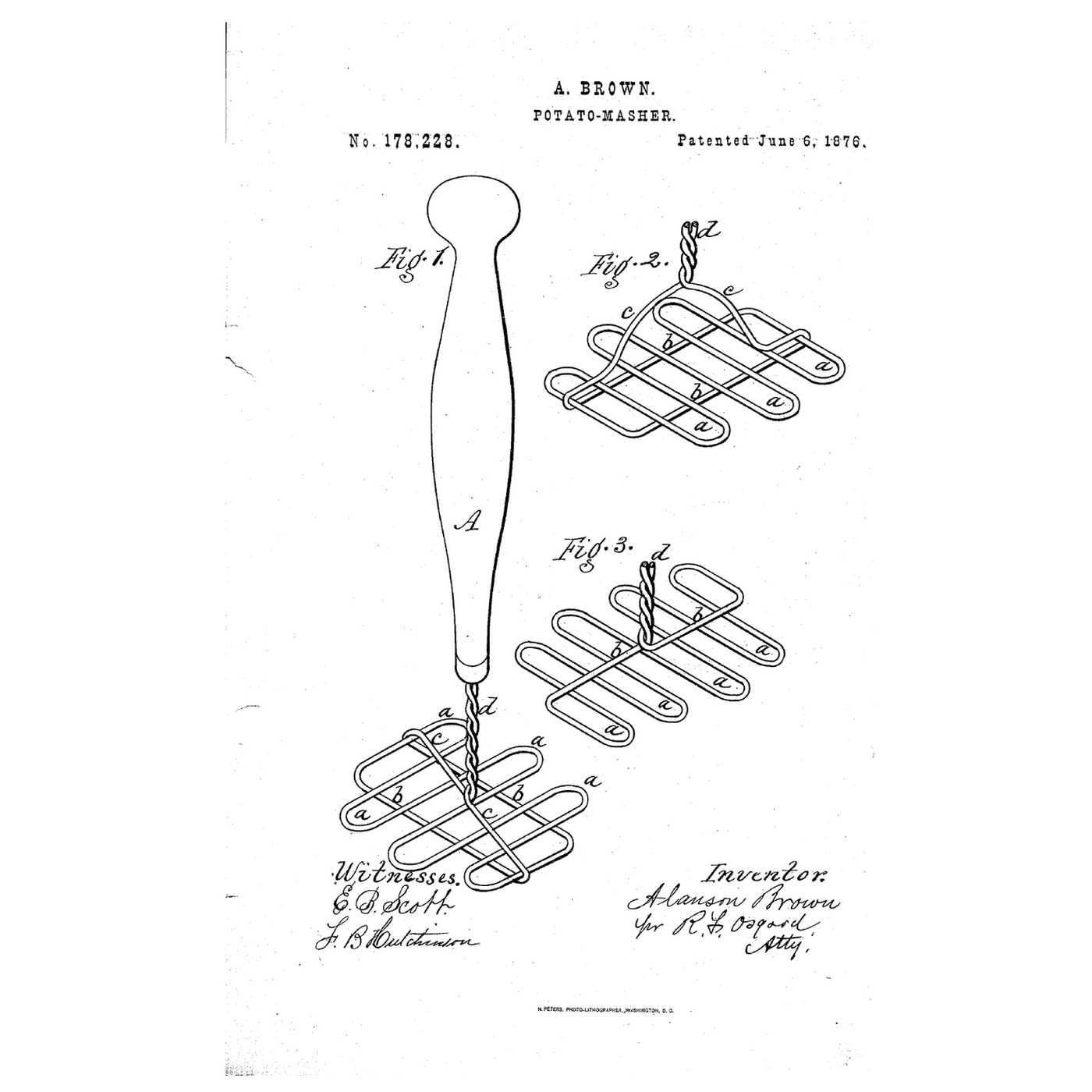
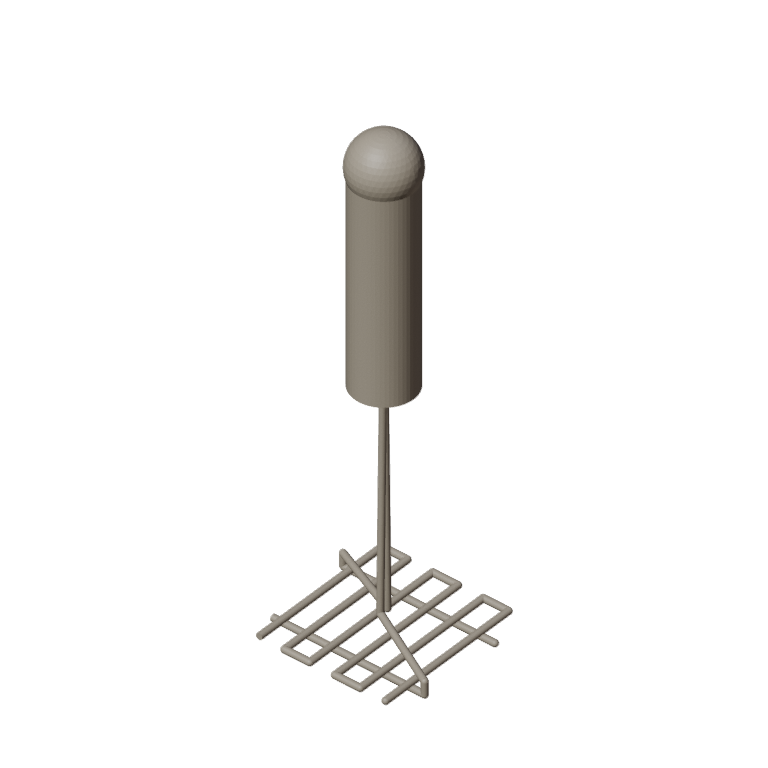
Alanson Brown of Rochester, New York, received US 178,228, dated 6 June 1876, for a potato masher "from a single piece of wire": the middle of the length bent into longitudinal coils that form the bed, its ends crossed under them as transverse lengths, then brought up and twisted together into a shank set in a handle. "These coils and cross-lengths mutually brace and support each other," and "no soldering or other attachment is required."
This rung works out the wire needed, then bends the masher from one length of stainless wire, prints the handle, and mashes a pan of potatoes.
Beginner
About 1 hour, plus printing
Instructions
1
1
One length of wire
One length of wire
Loading Jupyter Notebook...
2
2
A wire masher before it
A wire masher before it
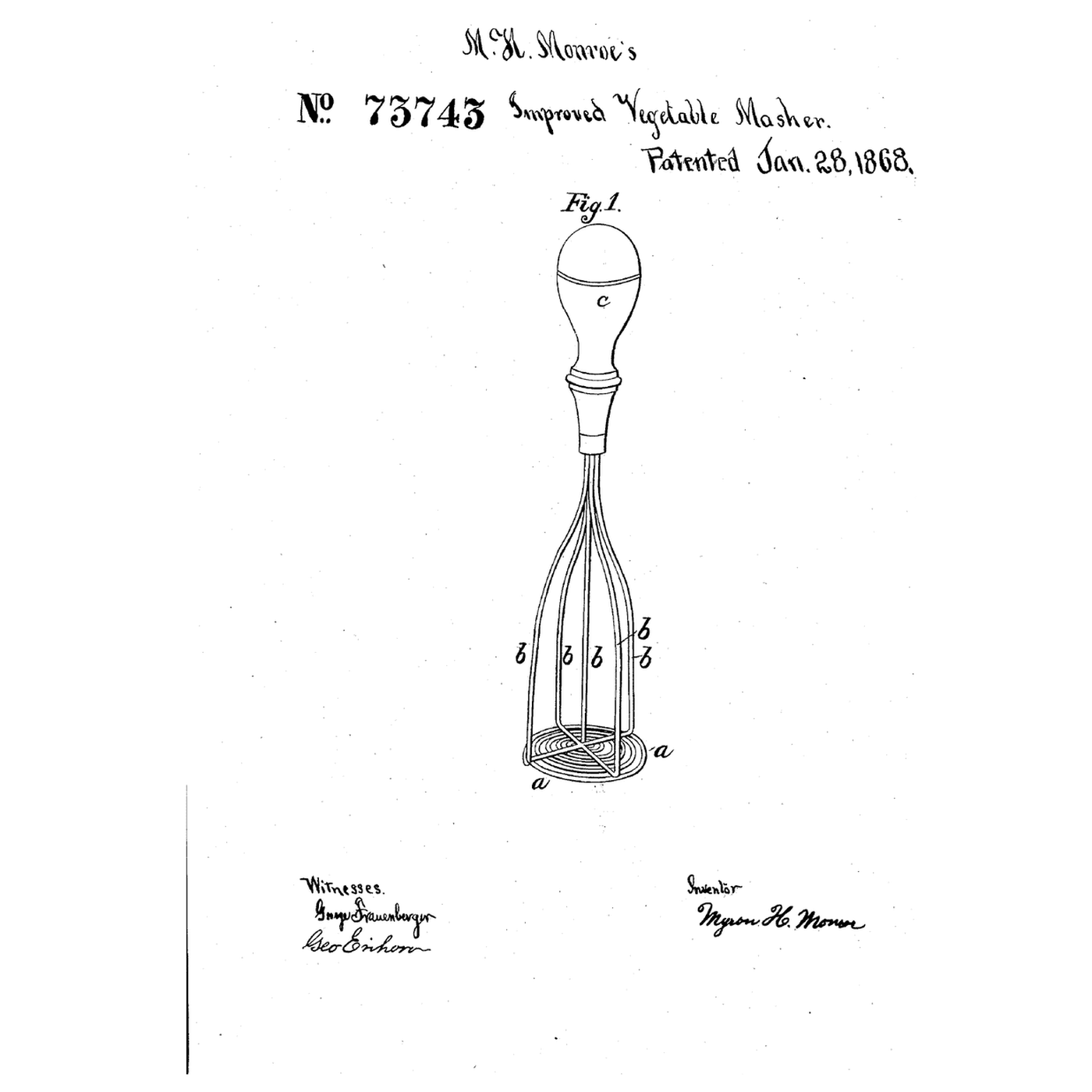
The embedded blueprint solders five braces to a wire coil. Brown makes the whole masher from one length with no solder.
3
3
Read US 178,228
Read US 178,228
"The object of this invention is to make a potato-masher from a single piece of wire, thereby insuring great cheapness, and so arranged that proper stiffness and strength of the mashing-surface are obtained. To accomplish this I make the coils a a in the center of the length of wire and cross them with the transverse lengths b b. These coils and cross-lengths mutually brace and support each other, and prevent yielding and springing of the coils, which would occur if they alone were used."
4
4
Bend the bed
Bend the bed
Take 1 m of 3 mm stainless wire, about his yard. Starting at its middle, bend six parallel coils 70 mm long and 12 mm apart, working out toward both ends.
Materials for this step:
 Stainless Steel Wire1 piece
Tools needed:
 Round-nose Pliers
 Flat-Nose Pliers
 Bench Vise
 Tape Measure
 Leather Work Gloves
5
5
Cross and twist
Cross and twist
Bend each end inward and cross it under the coils, bring it up the far side and over the top to the centre. Twist the two ends together for 120 mm as the shank.
Tools needed:
Flat-Nose PliersBench ViseLeather Work Gloves Clear Safety Glasses
6
6
Fit the handle
Fit the handle
Print the handle (/uploads/blueprints/single-wire-potato-masher-handle.stl). Print in PETG at 0.2 mm layers, 30 % infill, 4 walls; wash before first use. File the shank's end and epoxy it into the handle's bore.
Materials for this step:
 PETG Filament1 piece
 Two-Part Epoxy1 piece
Tools needed:
 FDM 3D Printer
 Files (Hand File)
7
7
The patent drawing
The patent drawing
US 178,228 drawing sheet, public domain (expired patent).
8
8
Cook and mash
Cook and mash
Boil 500 g of potatoes, peeled and quartered, for about 20 minutes until a knife slides in; drain. Mash with the wire masher and time it to no lumps; press hard on one corner and check whether the bed springs.
Materials for this step:
 Potatoes1 piece
 Water1 piece
Tools needed:
 Saucepan
 Stainless Steel Mixing Bowl (Large)
 Stopwatch
 Digital Caliper 6-Inch
9
9
A bed that springs, a shank that turns
A bed that springs, a shank that turns
Single-wire potato masher troubleshooting.
Flow
Loading...
10
10
History and honest limits
History and honest limits
**Alanson Brown** of Rochester, New York, filed US 178,228 on 8 November 1875; it is dated 6 June 1876. Wire mashers had usually been made with a volute face stayed by separate pieces united at the handle; his is bent and twisted only. His drawings show modifications with other coil arrangements. He claimed the coils, transverse lengths and twisted shank from a single length of wire.
**Honest limits.** Stainless wire and a printed handle stand in for his. Your times are the result.
Materials
5- 1 piecePlaceholder
- 1 piecePlaceholder
- 1 piecePlaceholder
- 1 piecePlaceholder
- 1 piecePlaceholder
Tools Required
12- Placeholder
- Placeholder
- Placeholder
- 1 vendor sell this, none ship to you yetPlaceholder
- Placeholder
- Placeholder
- Placeholder
- Placeholder
- Placeholder
- Placeholder
- Placeholder
- Placeholder
Related Blueprints
These blueprints share knowledge with this one — techniques, materials, or principles that connect them in the learning graph.

CC0 Public Domain
This blueprint is released under CC0. You are free to copy, modify, distribute, and use this work for any purpose, without asking permission.
Support the Maker by purchasing products through their Blueprint where they earn a Maker Commission set by Vendors, or create a new iteration of this Blueprint and include it as a connection in your own Blueprint to share revenue.