Collaboration
ART
BEAUTY & WELLNESS
CRAFT
CULTURE & HISTORY
ENTERTAINMENT
ENVIRONMENT
FOOD & DRINKS
REVERSE ENGINEERING
SCIENCES
SPORTS
TECHNOLOGY
WEARABLES
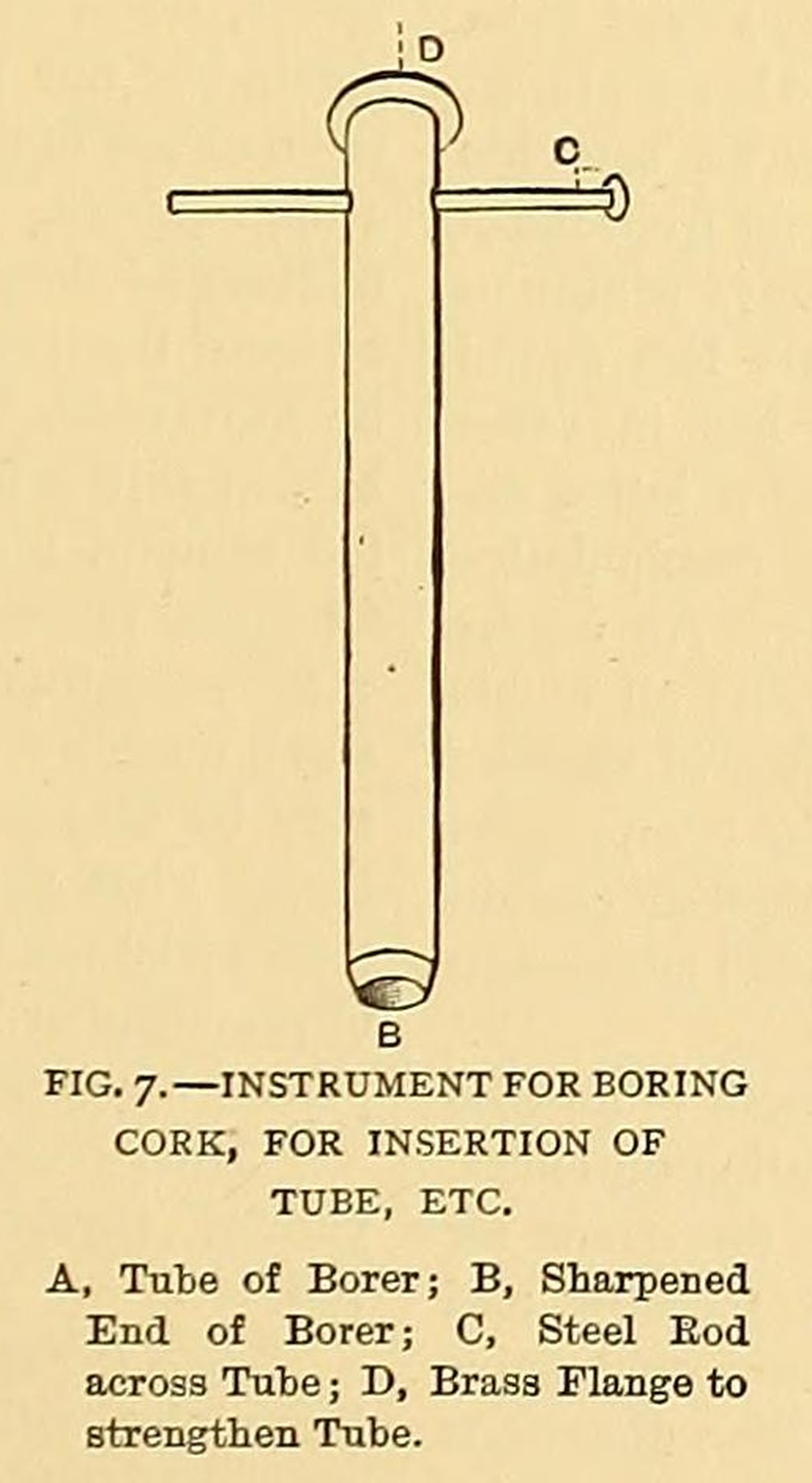


Cork Borer from Brass Tube: Edge Filed Like Two Gouges Back to Back, Steel Wire Handle (Soward, Amateur Work, 1881)
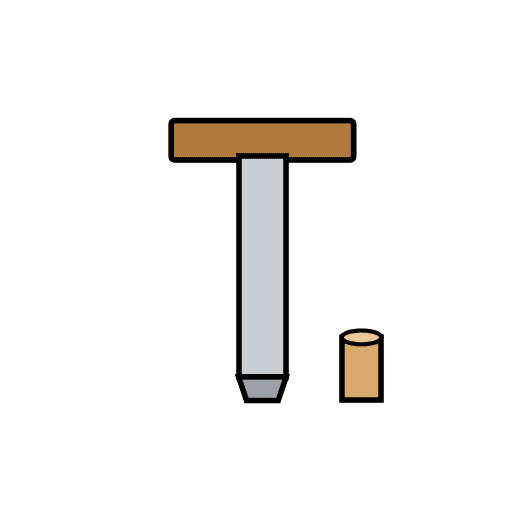
Alfred Soward's laboratory cork-borer from Amateur Work (1881): about 4 in. of brass tube the size of the hole, one end filed on the outside to a ring-shaped cutting edge, a brass flange on the other end to strengthen it, and a steel wire pushed through a cross hole as a handle. Turned like a gimlet, it cuts a clean, centred hole for a glass tube.
Beginner
An hour
Instructions
1
1
Read Soward
Read Soward
"This latter instrument is simply a piece of brass tube about 4 in. long, and of a diameter suited to the hole required."
2
2
Cut the tube
Cut the tube
Cut about 4 in. (100 mm) of brass tube whose outside diameter matches the hole you need (he takes 3/8 in., about 10 mm, for a glass tube). Square both ends.
Materials for this step:
 Brass Tube1 piece
Tools needed:
 Bench Vise
 Hacksaw
 Files (Hand File)
3
3
File the cutting edge
File the cutting edge
File one end on the outside only, all round, to a thin cutting edge: like two gouges put together with their hollow sides facing (B in his fig. 7). Leave the bore untouched.
Tools needed:
Bench ViseFiles (Hand File) Needle Files
4
4
Fit the flange
Fit the flange
Fit a small brass ring or flange round the other end to strengthen it (D in fig. 7). Ours: cut it from brass sheet and soft-solder it on.
Materials for this step:
 Brass Sheet1 piece
 Solder Wire1 piece
 Flux1 piece
Tools needed:
 Tin Snips
 Drill Press
 Drill Bit Set
 Soldering Iron
5
5
Cross hole and handle
Cross hole and handle
Below the flange, drill a hole straight across the tube for a piece of steel wire. Push the wire through so it stands at right angles to the tube as a handle (C in fig. 7, drawn with a head on one end).
Materials for this step:
 Steel Wire1 piece
Tools needed:
Drill PressDrill Bit SetFiles (Hand File)6
6
Troubleshooting
Troubleshooting
Cork borer troubleshooting.
Flow
Loading...
7
7
History and honest limits
History and honest limits
From Alfred W. Soward, "Filters: Their Construction and Maintenance" I, **Amateur Work, Illustrated**, vol. I (1881), pp. 131-133 and fig. 7 (checked on the archive.org scan amateurworkillus11881lond). To use it, hold the cork's small end against a wall or the bench edge, press on the centre of the large end and turn like a gimlet, giving the cork a quarter turn left after each quarter turn of the borer right. A bought set of four then cost 1s. He does not say how the flange is fixed: soft solder, the metric figures and the tools are ours.
Materials
5- 1 piecePlaceholder
- 1 piecePlaceholder
- 1 piecePlaceholder
- 1 piecePlaceholder
- 1 piecePlaceholder
This blueprint makes
Related Blueprints
These blueprints share knowledge with this one — techniques, materials, or principles that connect them in the learning graph.

CC0 Public Domain
This blueprint is released under CC0. You are free to copy, modify, distribute, and use this work for any purpose, without asking permission.
Support the Maker by purchasing products through their Blueprint where they earn a Maker Commission set by Vendors, or create a new iteration of this Blueprint and include it as a connection in your own Blueprint to share revenue.