ART
BEAUTY & WELLNESS
CRAFT
CULTURE & HISTORY
ENTERTAINMENT
ENVIRONMENT
FOOD & DRINKS
REVERSE ENGINEERING
SCIENCES
SPORTS
TECHNOLOGY
WEARABLES
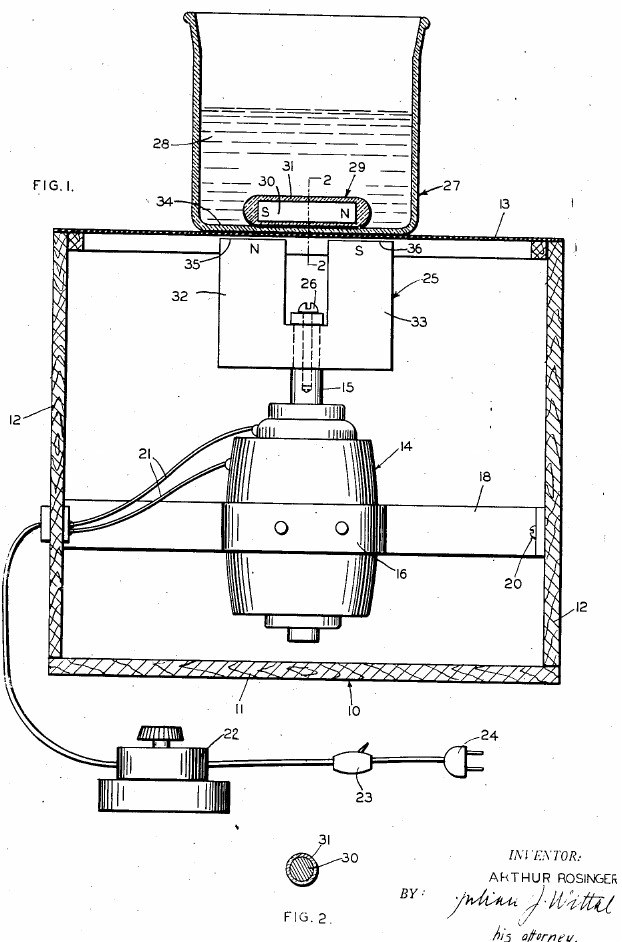


Stirrer: Magnetic Stirrer, a Turning Horseshoe Magnet under a Free Magnet Rod (Rosinger, US 2,350,534, 1944)
The magnetic stirrer of the chemistry lab. A small motor in a box spins a horseshoe magnet just under the thin lid. A little magnet rod sealed in an inert shell lies loose in the flask on top and spins with it, stirring the liquid into a deep vortex with nothing poking through the neck, so the flask can stay closed, under pressure or vacuum.
Result: a stirrer for laboratory liquids, speed set by a rheostat.
Source: A. Rosinger, US 2,350,534 (1944). Unknown: sizes, the motor and the magnet alloys. Picture: the patent drawing.
Intermediate
Unknown
Instructions
1
1
Build the box
Build the box
Make a box with a bottom, side walls and a removable top, all of non-magnetic material. Make the top as thin as you can. Not given: the material, sizes.
Materials for this step:
 Unknown Material1 non-magnetic box
Tools needed:
 Unknown Dimensions
2
2
Mount the motor and magnet
Mount the motor and magnet
Fix an electric motor in the middle of the box with its shaft upright, held by bands round its housing whose arms are screwed to the side walls. Fix a strong horseshoe permanent magnet on the shaft, poles up, so its pole faces turn as close under the thin top as possible. Not given: the motor, the magnet alloy.
Materials for this step:
 Electric Motor1 piece
 Unknown Metal1 bands and arms
 Horseshoe Magnet1 piece
Tools needed:
 Screwdriver Set
3
3
Wire the speed control
Wire the speed control
Lead the motor wires out of the box through a regulating rheostat and a switch to a cord with a plug. The rheostat sets the motor speed, and so the stirring speed.
Materials for this step:
 Rheostat1 piece
 Toggle Switch1 piece
 Flexible Cord with Plug1 piece
Tools needed:
Screwdriver Set4
4
Make the stirring rod
Make the stirring rod
Take a small round permanent magnet rod, shorter than the width of the flask's bottom, and seal it in a thin shell of an inert material (porcelain, glass, Bakelite or a suitable plastic) so it cannot affect the liquid. Where bare iron or steel would do no harm, the shell may be left off. Ours: a sealed glass tube for the shell.
Materials for this step:
 Bar Magnet Set1 rod magnet
 Glass Tube1 shell
Tools needed:
 Bunsen Burner
5
5
Stir
Stir
Stand a non-magnetic flask or beaker of the liquid on the box and drop in the rod. Switch on and set the speed: the rod follows the turning magnet and whips the liquid into a deep vortex. Set the rod off-centre and it both spins and travels round the bottom, stirring faster still. The vessel can be closed, since no shaft goes in.
Tools needed:
 Glass Beaker
Materials
9- 1 non-magnetic boxPlaceholder
- 1 piecePlaceholder
- 1 bands and armsPlaceholder
- 1 piecePlaceholder
- 1 piecePlaceholder
- Placeholder
- 1 piecePlaceholder
- 1 rod magnetPlaceholder
- 1 shellPlaceholder
Tools Required
4- Placeholder
- Placeholder
- Placeholder
- Placeholder
This blueprint makes
CC0 Public Domain
This blueprint is released under CC0. You are free to copy, modify, distribute, and use this work for any purpose, without asking permission.
Support the Maker by purchasing products through their Blueprint where they earn a Maker Commission set by Vendors, or create a new iteration of this Blueprint and include it as a connection in your own Blueprint to share revenue.