ART
BEAUTY & WELLNESS
CRAFT
CULTURE & HISTORY
ENTERTAINMENT
ENVIRONMENT
FOOD & DRINKS
REVERSE ENGINEERING
SCIENCES
SPORTS
TECHNOLOGY
WEARABLES
Hazardous


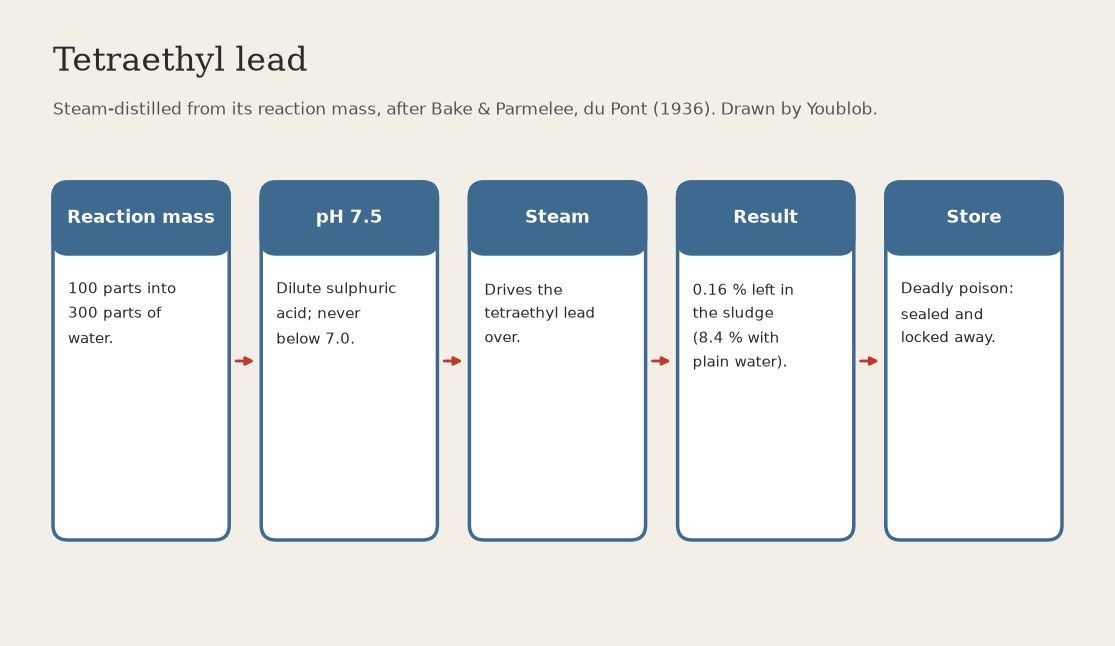
Tetraethyl Lead: Steam-Distilled from the Reaction Mass in Water Brought to pH 7.5 with Dilute Sulphuric Acid (Bake & Parmelee, du Pont, US 2,038,703)
The tetraethyl lead in the reaction mass clings to fine lead particles, in a mass like wet sand that cannot be filtered or poured off. It is driven out with steam. Du Pont found that making the water slightly less alkaline, to pH 7.5, lets almost all of it come over.
Result (Ex. 3): only 0.16 % of tetraethyl lead left in the lead sludge, against 8.4 % with plain water.
Variable: what goes in the water. Plain water 8.4 % left; 0.2 part Turkey red oil 3.2 %; sulphuric acid to pH 9.3 0.35 %; acetic acid to pH 7.5 0.17 %; ammonium sulphate 0.19 %. Do not go below pH 7.0 (claims).
Source: Bake & Parmelee, US 2,038,703 (1936). Not given: how the tetraethyl lead is parted from the condensed water. Danger: tetraethyl lead is a deadly poison, absorbed through skin and from its vapour. Picture drawn by Youblob.
Expert
1 day
Hazardous content
This blueprint contains hazardous procedures. Log in and enable hazardous content in your account settings to view the step-by-step instructions.
Sign inThis blueprint makes
Related Blueprints
These blueprints share knowledge with this one — techniques, materials, or principles that connect them in the learning graph.

CC0 Public Domain
This blueprint is released under CC0. You are free to copy, modify, distribute, and use this work for any purpose, without asking permission.
Support the Maker by purchasing products through their Blueprint where they earn a Maker Commission set by Vendors, or create a new iteration of this Blueprint and include it as a connection in your own Blueprint to share revenue.