ART
BEAUTY & WELLNESS
CRAFT
CULTURE & HISTORY
ENTERTAINMENT
ENVIRONMENT
FOOD & DRINKS
REVERSE ENGINEERING
SCIENCES
SPORTS
TECHNOLOGY
WEARABLES
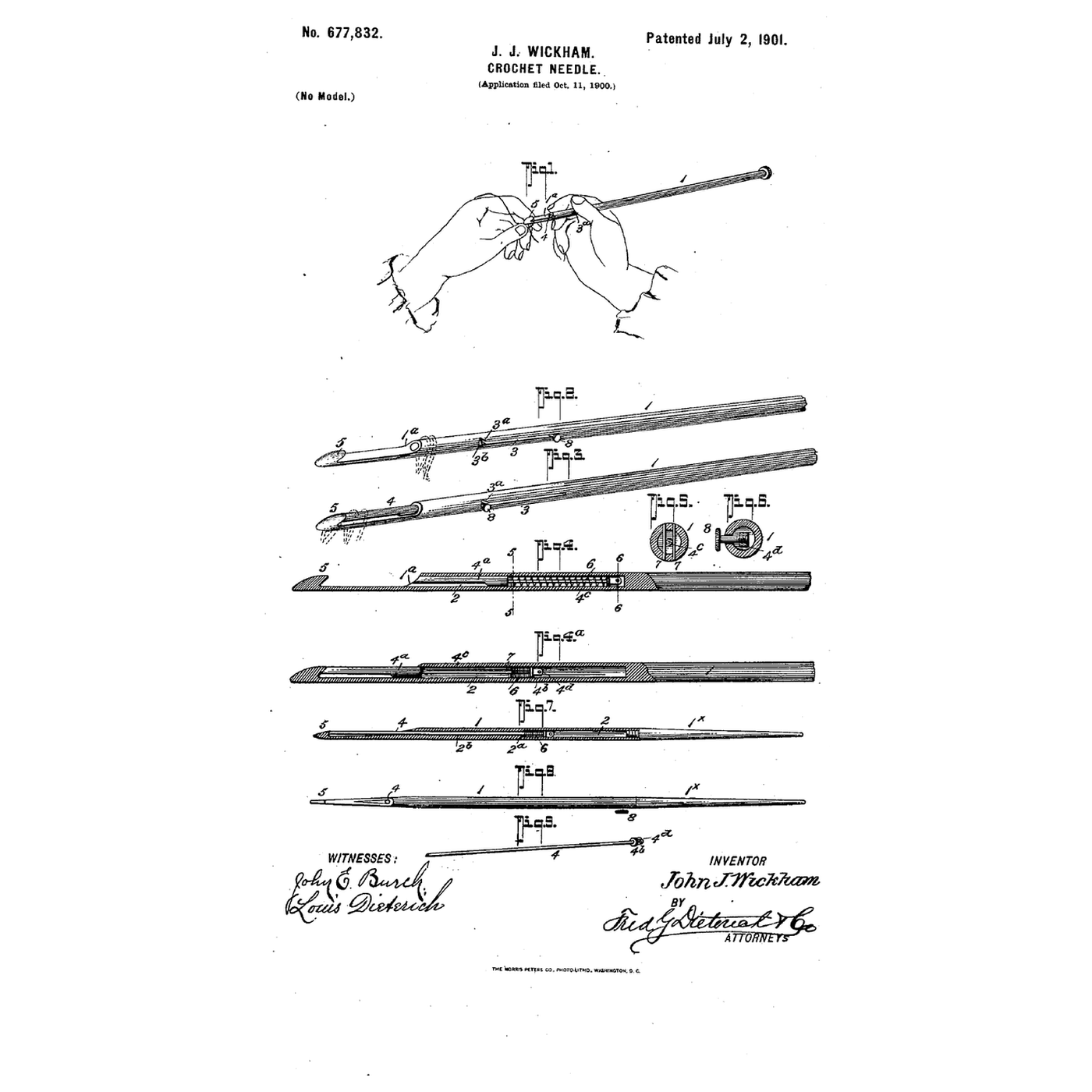


The Bridge-Closed Crochet Needle: A Sliding Bolt Covers the Barb While the Loop Is Drawn Through
Drawing the hook of a crochet needle back through the loops on it takes care: the barb catches in the loops, disarranging the stitches or breaking the thread, most often in worsted and other fluffy yarn.
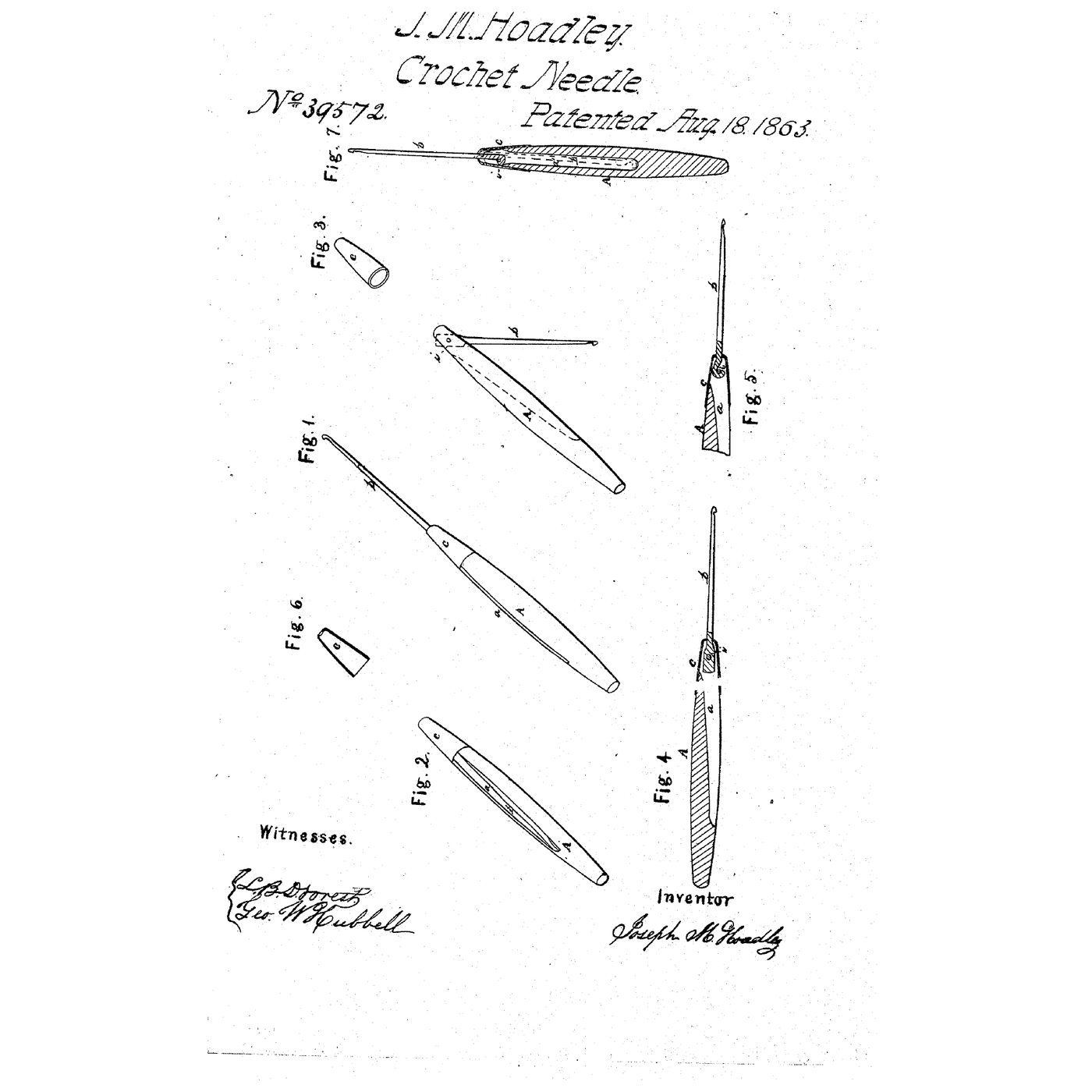
John J. Wickham of Washington, District of Columbia, received US 677,832, dated 2 July 1901, for a crochet needle with "a movable member adapted to be slipped into position and form, as it were, a 'bridge' for extending over the hook or barbed end of the needle". The bridge slides in a bore behind the hook, is held back by a spring, and is pushed forward by a finger-piece in a side slot, where a shoulder at the end of the slot holds it.
This rung works out the force the lock must hold, then builds a large needle with a spring bridge and a locking slot, and crochets with the bridge open and closed.
Advanced
About 5 hours
Instructions
1
1
Spring force at the lock
Spring force at the lock
Loading Jupyter Notebook...
2
2
A hook closed by a latch before it
A hook closed by a latch before it
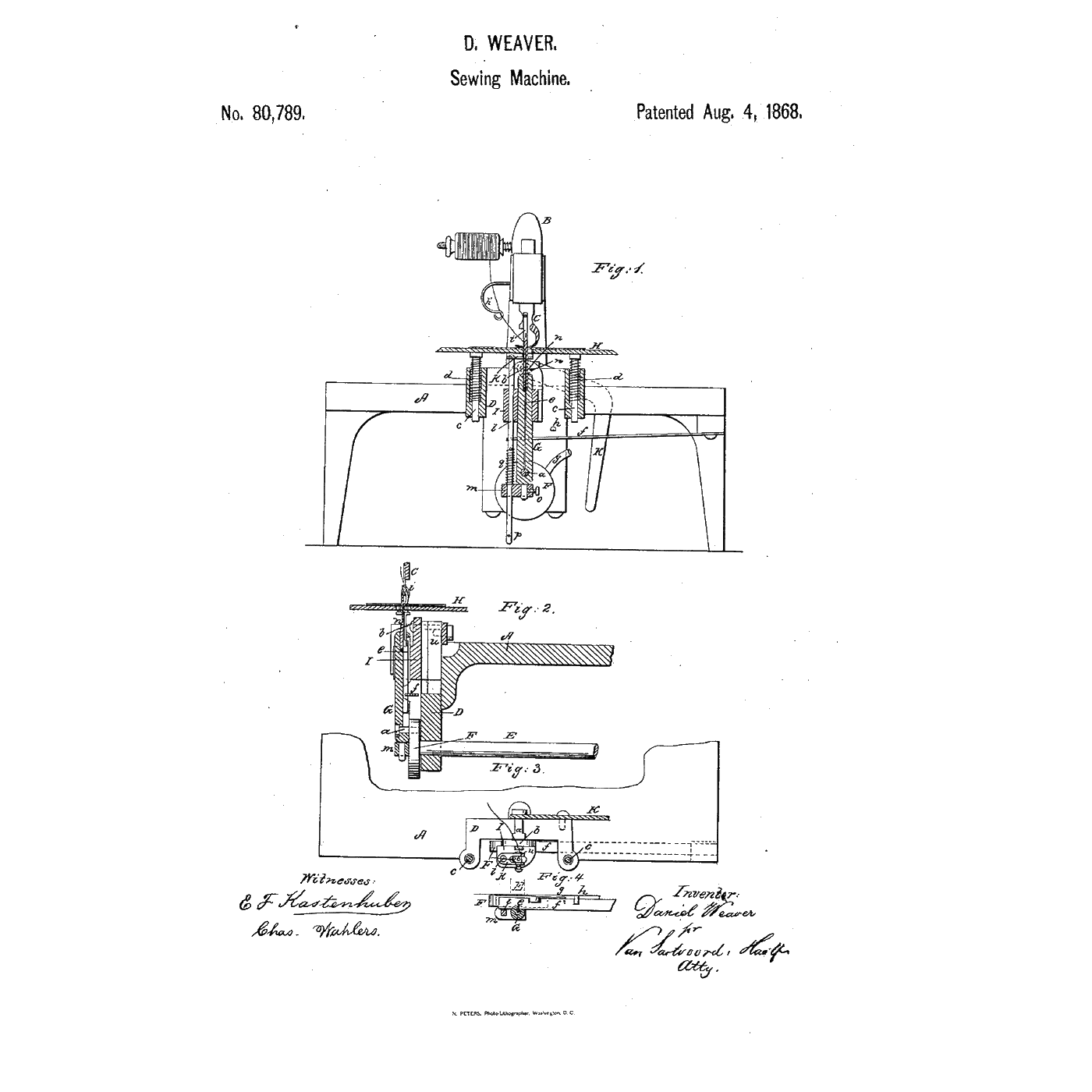
The embedded blueprint closes a hook needle's latch with the cloth itself, so it draws its loop down without catching. Wickham closes a hand crochet needle's barb with a sliding bridge moved by the finger.
3
3
Read US 677,832
Read US 677,832
"In the drawings, 1 designates the crochet needle, having the ordinary external shape, and the front end of the needle has a longitudinal bore 2, beginning at the tapered or reduced part 1a thereof and extending into the handle-portion of the needle to a predetermined point, and the inner end of the said bore merges with a horizontal elongated slot 3."
"In use the bridge is normally held back by the spring 6, the user, after throwing the required number of loops or stitches about the needle end and having picked the thread with the needle end that is to be pulled through the said loops, presses the finger-piece 8 forward until the bridge-piece covers the barbed end of the needle, at which time the finger member 8 will engage with the lock-shoulder of the slot 3 and hold the bridge-piece in position"
4
4
Build the needle and crochet with it
Build the needle and crochet with it
**Needle.** Cut 20 cm of 12 mm aluminium rod. File its front 2 cm down along one side to a 5 mm shank, leaving a step, and at the end of the shank file a hook with a throat about 3 mm deep, the barb pointing back toward the step. With the rod in the vise, drill a 4 mm hole 7 cm deep from the step, parallel to the shank and in line with the barb. Over the bore's last 3 cm drill a row of 3 mm holes through the side into it and file them into a slot. At the slot's front end file a short notch turning off at an angle, ending in a shoulder.
**Bridge.** Cut 7 cm of 4 mm steel rod and file its front end to the slope of the step. File 2.5 cm down to 2.5 mm, leaving the last 5 mm full size as a head, and drill and tap that head M3. Slide a compression spring 25 mm long over the thin part, push the bridge in until its front is flush with the step, and drive two 1.5 mm pins across the bore in front of the spring, beside the thin part. Screw an M3 screw through the slot into the head as the finger-piece, and file until the bridge slides about 15 mm forward over the barb and springs back.
**Test.** Measure the push that closes the bridge with the spring scale. Then crochet 20 stitches of fluffy yarn twice, drawing each loop through with the bridge open and then closed over the barb, and count the loops that catch.
Materials for this step:
 Aluminium Rod0.2 meter
 Mild Steel Rod0.1 meter
 Compression Spring Assortment1 pieceMild Steel Rod2 pieces
 Machine Screws1 piece
 Yarn1 piece
Tools needed:
 Hacksaw
 Bench Vise
 Files (Hand File)
 Needle File Set
 Cordless Drill
 Drill Bit Set
 Tap and Die Set
 Hammer
 Digital Caliper 6-Inch
 Spring Scale
 Crochet Hook Set
 Clear Safety Glasses
5
5
A bridge that sticks, will not lock or will not return
A bridge that sticks, will not lock or will not return
Bridge-closed crochet needle troubleshooting.
Flow
Loading...
6
6
History and honest limits
History and honest limits
**John J. Wickham** of Washington, District of Columbia, filed US 677,832 on 11 October 1900; it is dated 2 July 1901. His bridge 4 has a bolt-like part 4a the size of the bore, tapered in the plane of the needle's taper, and a reduced shank 4c whose shoulder 4b takes the rear end of the spring 6; the spring's front end bears on stop-pins 7 through the handle. The finger-button 8 screws through the slot 3 into the shank, and the slot ends in an angled portion 3a and a lock-shoulder 3b. A second form, for silk or linen thread, has a two-piece body whose rear part screws on so the bridge and spring can be put in from behind. He noted that an ordinary needle can be converted by boring it and cutting the slot. His claims cover the sliding bridge with its spring, finger member and detent.
**Honest limits.** A large aluminium needle for thick yarn stands in for his, and the bridge's head and pins are simplified. The notebook takes the spring as linear; its rate and strokes are examples. Your caught loops are the result.
Materials
5- 0.2 meterPlaceholder
- 2 piecesPlaceholder
- Placeholder
- 1 piecePlaceholder
- 1 piecePlaceholder
Tools Required
12- Placeholder
- Placeholder
- Placeholder
- Placeholder
- 1 vendor sell this, none ship to you yetPlaceholder
- Placeholder
- Placeholder
- Placeholder
- Placeholder
- Placeholder
- Placeholder
- Placeholder
Related Blueprints
These blueprints share knowledge with this one — techniques, materials, or principles that connect them in the learning graph.

CC0 Public Domain
This blueprint is released under CC0. You are free to copy, modify, distribute, and use this work for any purpose, without asking permission.
Support the Maker by purchasing products through their Blueprint where they earn a Maker Commission set by Vendors, or create a new iteration of this Blueprint and include it as a connection in your own Blueprint to share revenue.