ART
BEAUTY & WELLNESS
CRAFT
CULTURE & HISTORY
ENTERTAINMENT
ENVIRONMENT
FOOD & DRINKS
REVERSE ENGINEERING
SCIENCES
SPORTS
TECHNOLOGY
WEARABLES
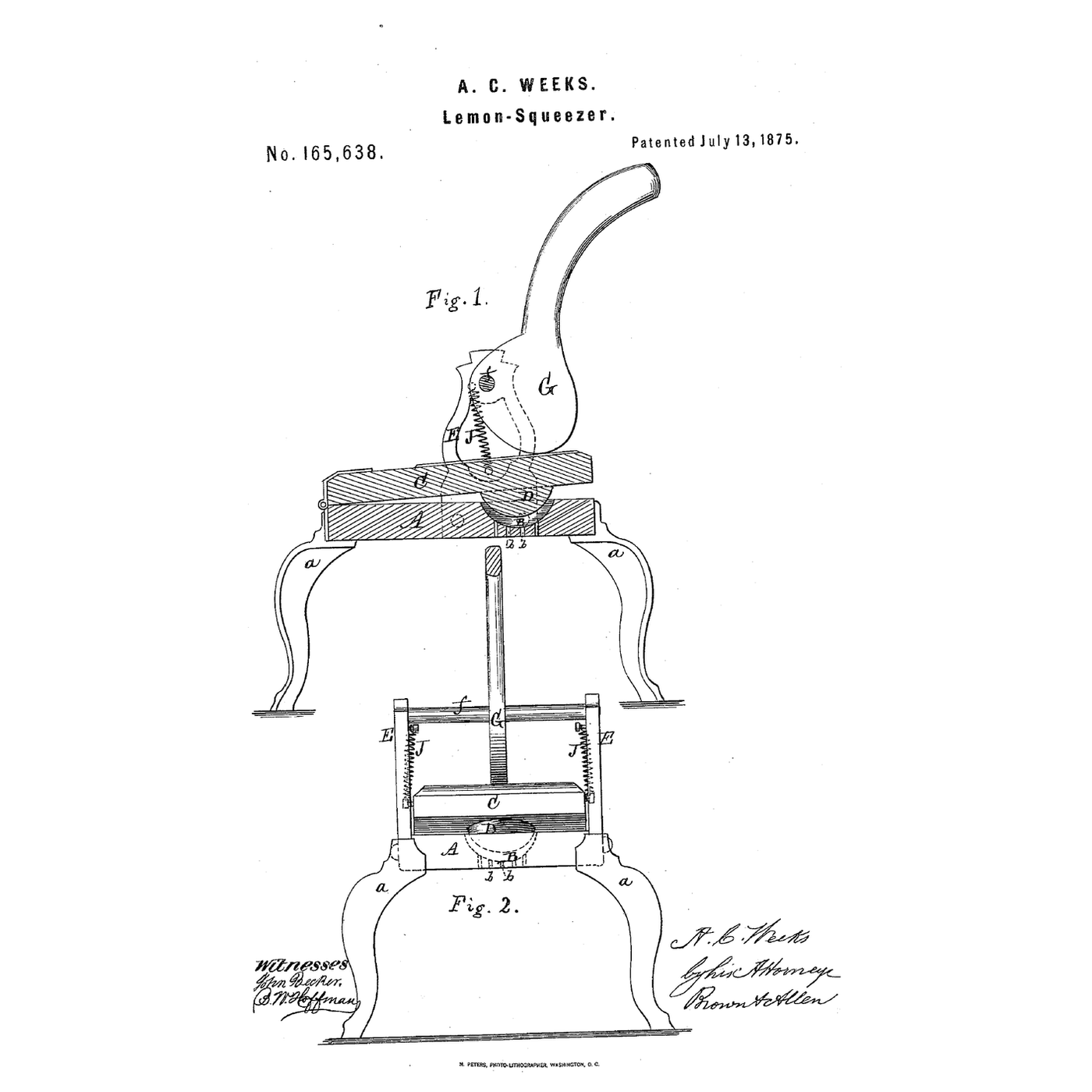

The Cam-Lever Lemon Squeezer: A Cam on a Shaft Presses the Plunger, Springs Lift It
A plunger pressed straight down by the hand needs a strong push to empty a lemon.
A. Clarence Weeks of New York received US 165,638, dated 13 July 1875, for a squeezer with a frame on legs over a dish, a perforated bowl in the frame, a plate hinged to one end carrying the plunger, two standards on the frame with a shaft across them carrying "a cam-lever, G, arranged for contact of its face or bearing-surface with the upper side of the board or plate, which carries the plunger", and springs from the plate to the standards. "By the use of the cam-lever an immense power is obtained, and the juice is extracted from the lemon in a more thorough and perfect manner than when the power is applied directly to the plate or bar carrying the plunger."
This rung works out the cam's average force, with a work check, then builds the frame, the hinged plate and the cam lever in hardwood and steel, and squeezes lemons with it.
Intermediate
About 5 hours
Instructions
1
1
The cam's force
The cam's force
Loading Jupyter Notebook...
2
2
A lever press before it
A lever press before it
The embedded blueprint presses the lemon with the lever itself. Weeks puts a cam lever over a hinged plate, so a turn of the lever gives a far greater push.
3
3
Read US 165,638
Read US 165,638
"Two standards, E E, are attached to the frame A, one on each side, in the upper portions of which standards are bearings for a shaft, f, to which is attached, midway of its length, a cam-lever, G, arranged for contact of its face or bearing-surface with the upper side of the board or plate, which carries the plunger. J is a spring, which may be of rubber or metal, having its lower end attached to the board or plate C, and its upper end attached to the standard E."
"When the cam-lever G is depressed its face or bearing-surface presses upon the board or plate C, and forces the plunger into the bowl upon the lemon."
4
4
Build the squeezer and press lemons
Build the squeezer and press lemons
**Frame and bowl.** Make a hardwood board frame on four legs, tall enough for a dish beneath, with a hole in it. Fit a tin-can bowl with a punched base into the hole.
**Plate and plunger.** Hinge a hardwood plate to one end of the frame with a butt hinge, and screw a hardwood plunger to its underside so it enters the bowl.
**Standards and cam.** Screw two hardwood standards to the frame's sides beside the plate and run a steel rod across between them as the shaft f. Cut a hardwood cam lever with a curved face whose distance from the shaft grows by about 15 mm over 60° of turn, drill it for the shaft, and fix it in the middle of the rod with a pin.
**Springs.** Hook two extension springs from the plate to the standards so they lift the plate when the cam is raised.
**Test.** Put a half lemon in the bowl over a dish and press the lever down. Compare the juice with a half pressed by pushing the plate down by hand.
Materials for this step:
 Hardwood Board2 pieces
 Hardwood Block2 pieces
 Wooden Dowel0.6 meter
 Wood Screws16 pieces
 Wood Glue1 piece
 Tin Can1 piece
 Butt Hinge1 piece
 Mild Steel Rod0.2 meter
 Nails2 pieces
 Extension Spring2 pieces
 Lemon3 pieces
Tools needed:
 Hand Saw
 Chisel Set - Wood
 Rasp
Rasp Cordless Drill
 Drill Bit Set
 Tin Snips
 Hammer
 Screwdriver Set
 Hacksaw
 Kitchen Knife
 Digital Kitchen Scale
 Leather Work Gloves
5
5
A cam that slips, jams or does not lift
A cam that slips, jams or does not lift
Cam-lever lemon squeezer troubleshooting.
Flow
Loading...
6
6
History and honest limits
History and honest limits
**A. Clarence Weeks** of New York, New York, filed US 165,638 on 26 April 1875; it is dated 13 July 1875. His frame A had feet or legs a, the bowl B had perforations b, the plate C was hinged to one end of the frame, and there could be one spring or two. His claim is the frame with the perforated bowl and standards, the pivoted plate with its plunger, the springs, and the shaft with its cam lever.
**Honest limits.** Hardwood, a tin bowl and a steel rod stand in for his parts. The notebook gives the average force without friction; its forces, lengths and angles are examples. Your juice is the result.
Materials
11- 2 piecesPlaceholder
- 2 piecesPlaceholder
- 0.6 meterPlaceholder
- 16 piecesPlaceholder
- 1 piecePlaceholder
- 1 piecePlaceholder
- 1 piecePlaceholder
- 0.2 meterPlaceholder
- 2 piecesPlaceholder
- 2 piecesPlaceholder
- 3 piecesPlaceholder
Tools Required
12- Placeholder
- Placeholder
- Placeholder
- 1 vendor sell this, none ship to you yetPlaceholder
- Placeholder
- Placeholder
- Placeholder
- Placeholder
- Placeholder
- Placeholder
- Placeholder
- Placeholder
This blueprint makes

Related Blueprints
These blueprints share knowledge with this one — techniques, materials, or principles that connect them in the learning graph.
The Ring-Set Lemon Squeezer: A Bowl Held in Its Handle by a Screwed Ring
by YourGrandma
Woodworking
39
0
0
0
0
0
The False-Bottom Lemon Press: A Hinged Lever Over a Die, and One Hole for the Juice
by TheChef
Woodworking
32
0
0
0
0
0

The Clamp-Frame Lemon Squeezer: A Screw Press That Clamps to the Table
by Forge
Metalworking
30
0
0
0
0
0
CC0 Public Domain
This blueprint is released under CC0. You are free to copy, modify, distribute, and use this work for any purpose, without asking permission.
Support the Maker by purchasing products through their Blueprint where they earn a Maker Commission set by Vendors, or create a new iteration of this Blueprint and include it as a connection in your own Blueprint to share revenue.