ART
BEAUTY & WELLNESS
CRAFT
CULTURE & HISTORY
ENTERTAINMENT
ENVIRONMENT
FOOD & DRINKS
REVERSE ENGINEERING
SCIENCES
SPORTS
TECHNOLOGY
WEARABLES
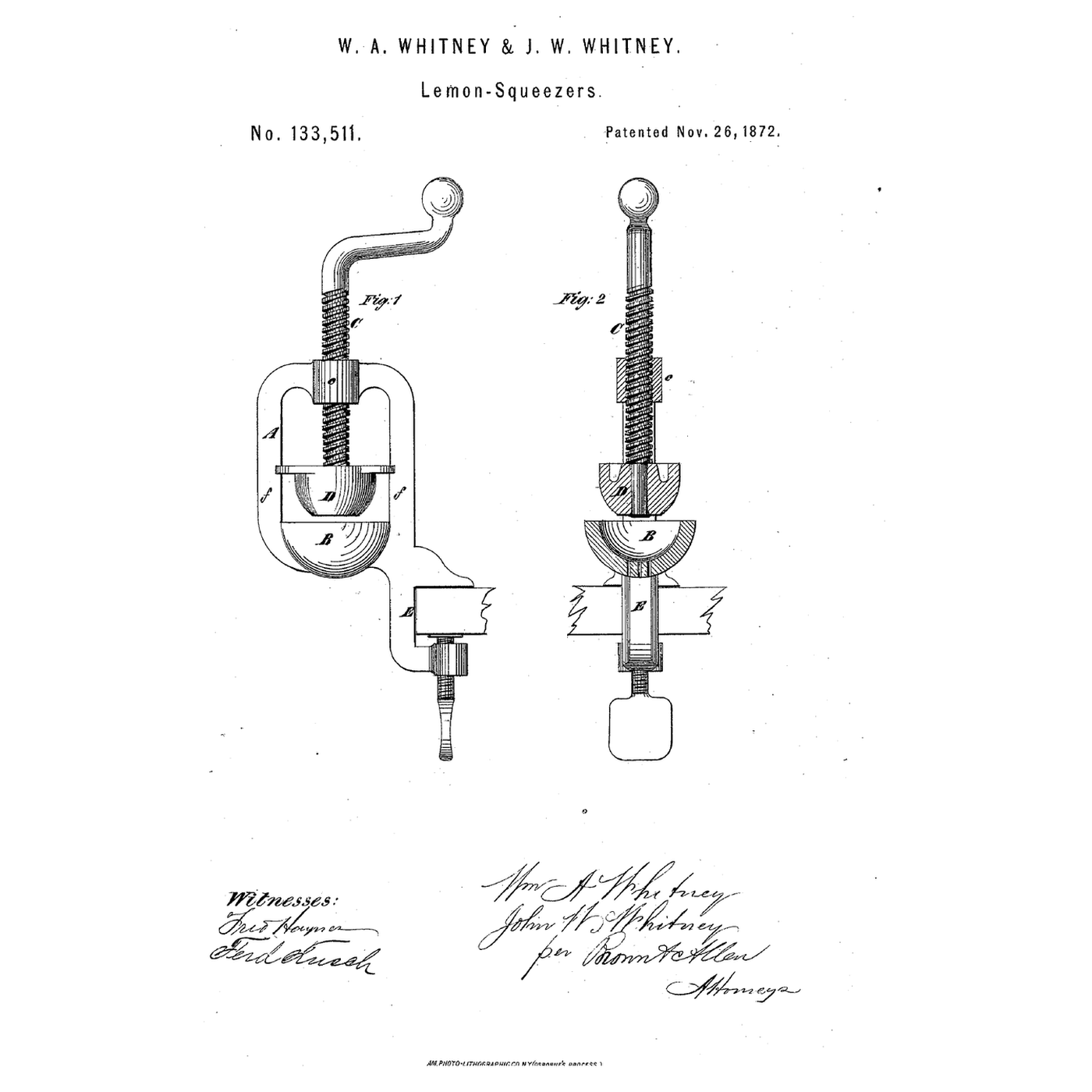


The Clamp-Frame Lemon Squeezer: A Screw Press That Clamps to the Table
Squeezing lemon after lemon by hand for a bar or a kitchen is slow, sticky work.
William A. Whitney and John W. Whitney of Brooklyn, New York, received US 133,511, dated 26 November 1872, for "a cheap and handy lemon-squeezer which shall be more effective and can be more expeditiously operated than the article ordinarily used for this purpose": a cast-iron frame with a perforated cup at its foot, a clamp to fix it to a table or bench, guides for a sliding follower, and a screw working through a nut in the frame's top that drives the follower down into the cup.
This rung works out the screw's force and the twist the clamp must hold, then builds the frame from flat bar and threaded rod, clamps it to a bench and squeezes a run of lemons.
Intermediate
About 5 hours
Instructions
1
1
The screw and the clamp
The screw and the clamp
Loading Jupyter Notebook...
2
2
A screw squeezer before it
A screw squeezer before it
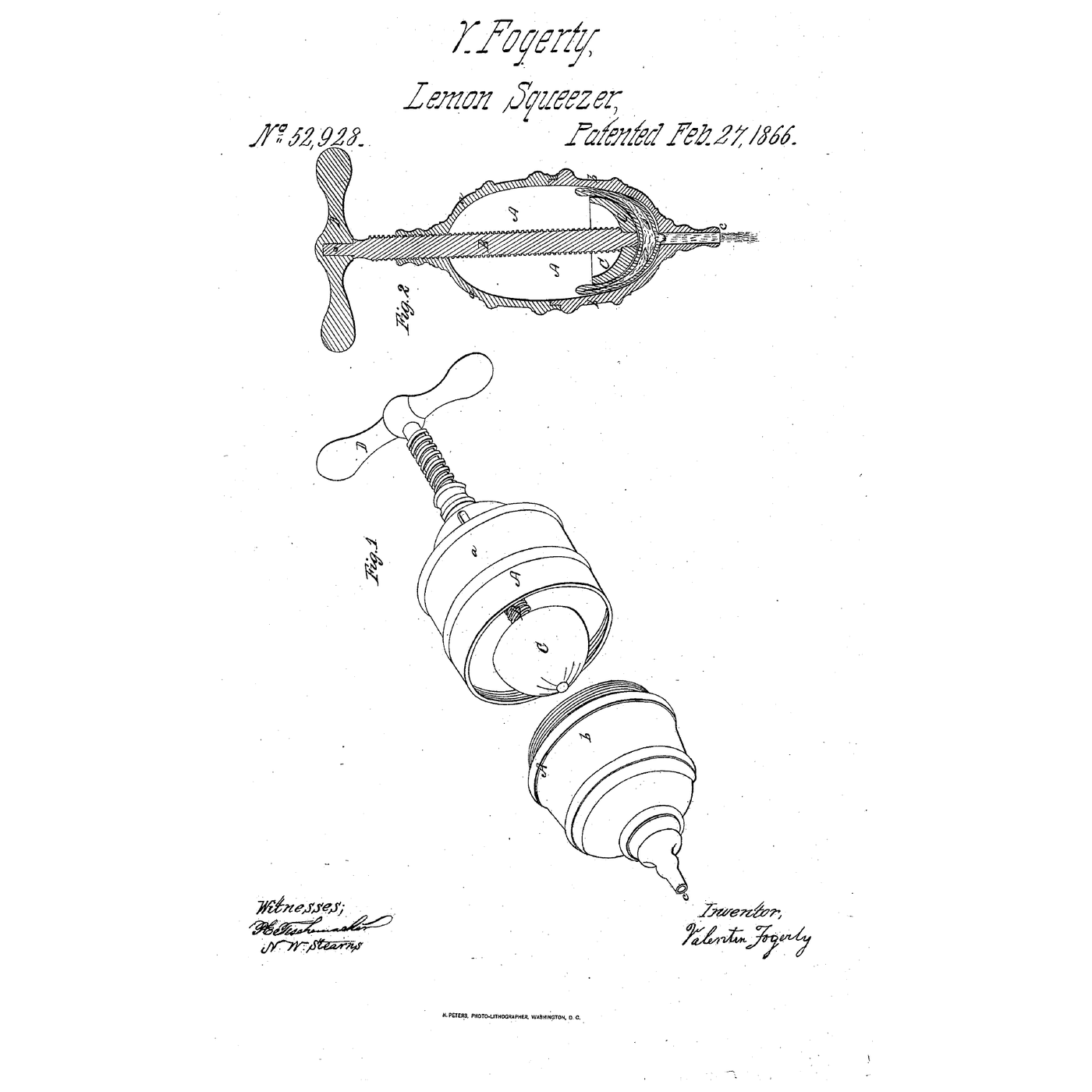
The embedded blueprint drives a plunger down with a screw in a casing held in the hand. The Whitneys' frame clamps to the table, so both hands are free for the lemons and the handle.
3
3
Read US 133,511
Read US 133,511
"A is the frame of the implement. It is of cast-iron, and has formed on its lower portion a cup, B, in which a half lemon to be squeezed is placed. This cup is perforated in the bottom to provide for the escape of juice expressed from the lemon. Over this cup is a socket, c, for the reception of the operating-screw C, and the portions f f of the frame between the socket and the cup B form guides along which the follower D works."
"The lemons to be squeezed are cut in halves and inserted piece by piece into the cup B. The handle of the screw is then turned to bring down the follower D, and thereby squeeze the lemon between it and the cup. The juice escapes through the perforations in the bottom of the cup B, into a bowl or other receptacle placed to receive it."
4
4
Build the frame and squeeze a run of lemons
Build the frame and squeeze a run of lemons
**Frame.** Cut two 16 cm lengths of 25 × 5 mm mild steel flat bar as the top and bottom. Drill each near both ends for M8 threaded rod, and drill the top's centre for a 10 mm rod. Join them 14 cm apart with two lengths of M8 rod and nuts: the rods are the guides f f.
**Nut and screw.** Silver-solder an M10 nut over the top's centre hole. Bend the top of a 25 cm length of M10 threaded rod into a crank with a hardwood knob on a bolt, and run it through the nut.
**Cup and follower.** Cut the bottom 3 cm off a tin can, punch its base, and rivet it over a large hole in the bottom bar. Rasp a hardwood follower to the cup's inside shape, drill its sides for the two guides and its top for the screw's end, fixed with a nut each side so it can turn freely.
**Clamp.** Bend a flat-bar bracket down from one end of the bottom bar and clamp it to the bench edge with a clamp, as the Whitneys' clamp E.
**Test.** Put a half lemon in the cup over a bowl and turn the screw down. Count the turns and weigh the juice for six halves in a row, and time the run.
Materials for this step:
 Mild Steel Flat Bar0.5 meter
 Threaded Rod0.6 meter
 Hex Nut8 pieces
 Silver Solder Set (Easy/Medium/Hard)1 piece
 Flux1 piece
 Tin Can1 piece
 Steel Rivets4 pieces
 Hardwood Block1 piece
 Hex Bolt Assortment1 piece
 Lemon3 pieces
Tools needed:
 Hacksaw
 Cordless Drill
 Drill Bit Set
 Files (Hand File)
 Bench Vise
 Propane Torch
 Tin Snips
 Nails
Nails Hammer
 Rivet Set
 Rasp
Rasp Adjustable Wrench
 Clamps
 Kitchen Knife
 Digital Kitchen Scale
 Stopwatch
 Leather Work Gloves
5
5
A frame that twists, jams or leaves juice
A frame that twists, jams or leaves juice
Clamp-frame lemon squeezer troubleshooting.
Flow
Loading...
6
6
History and honest limits
History and honest limits
**William A. Whitney and John W. Whitney** of Brooklyn, Kings County, New York, received US 133,511, dated 26 November 1872. The follower D had lugs on its upper edge that embraced the guides f f, the screw C worked through a nut in the socket c and was secured to the follower so it could turn without it, and a clamp E on the frame's lower part beside the cup held it to a table or bench. Their claim is the cup, frame, guides, clamp, follower and screw combined.
**Honest limits.** Flat bar, threaded rod, a tin cup and a hardwood follower stand in for their cast-iron frame. The notebook ignores friction; its forces and lengths are examples. Your run of lemons is the result.
Materials
10- 0.5 meterPlaceholder
- 0.6 meterPlaceholder
- 8 piecesPlaceholder
- 1 piecePlaceholder
- 1 piecePlaceholder
- 1 piecePlaceholder
- 4 piecesPlaceholder
- 1 piecePlaceholder
- 1 piecePlaceholder
- 3 piecesPlaceholder
Tools Required
17- Placeholder
- 1 vendor sell this, none ship to you yetPlaceholder
- Placeholder
- Placeholder
- Placeholder
- Placeholder
- Placeholder
- Placeholder
- Placeholder
- Placeholder
- Placeholder
- Placeholder
- Placeholder
- Placeholder
- Placeholder
- Placeholder
- Placeholder
This blueprint makes

Related Blueprints
These blueprints share knowledge with this one — techniques, materials, or principles that connect them in the learning graph.



CC0 Public Domain
This blueprint is released under CC0. You are free to copy, modify, distribute, and use this work for any purpose, without asking permission.
Support the Maker by purchasing products through their Blueprint where they earn a Maker Commission set by Vendors, or create a new iteration of this Blueprint and include it as a connection in your own Blueprint to share revenue.