ART
BEAUTY & WELLNESS
CRAFT
CULTURE & HISTORY
ENTERTAINMENT
ENVIRONMENT
FOOD & DRINKS
REVERSE ENGINEERING
SCIENCES
SPORTS
TECHNOLOGY
WEARABLES
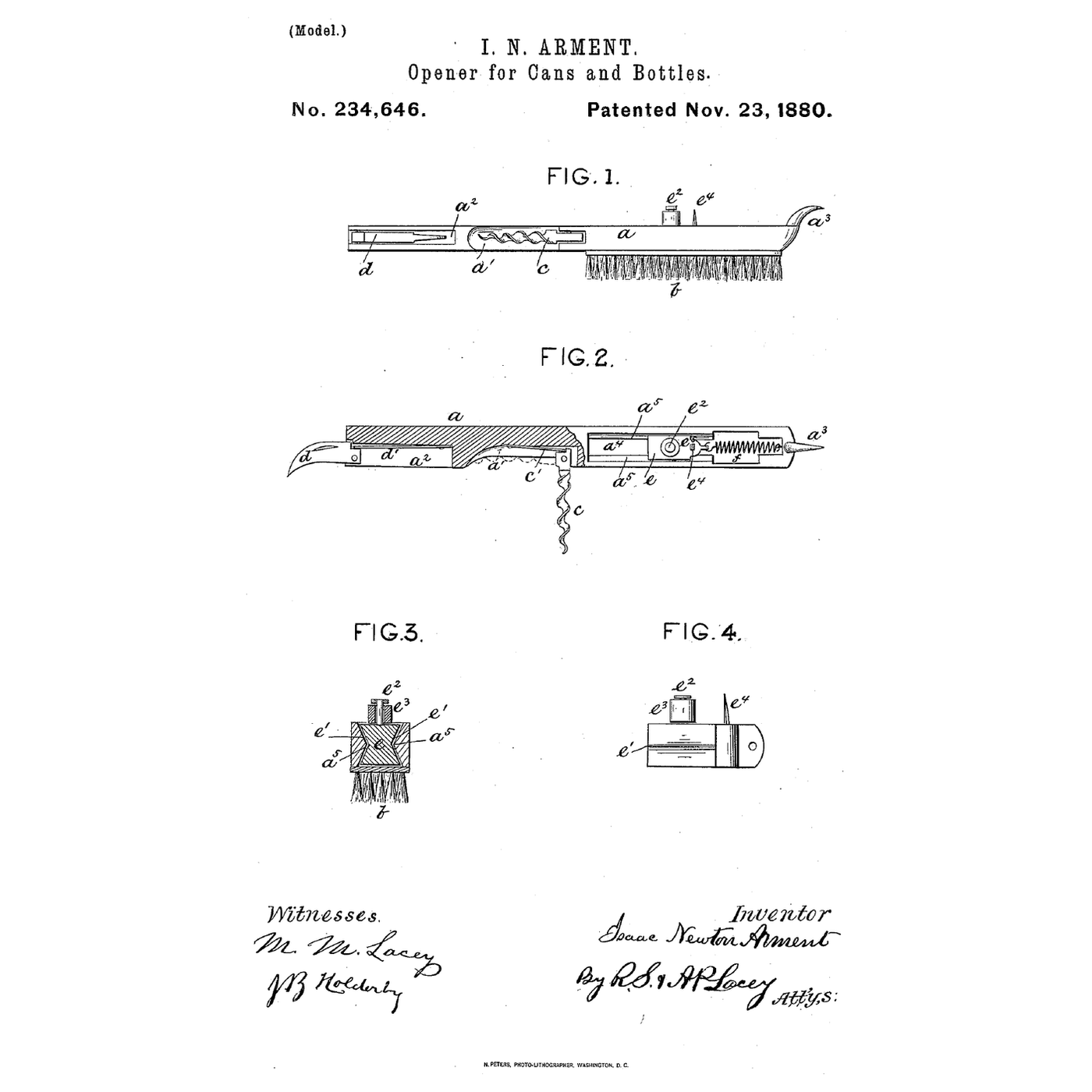


The Circle-Cutting Can Opener: A Spur at the Centre and a Blade Set to the Can's Size
Cutting a can's lid by hand round its edge leaves a ragged line, and one tool rarely does for cans of every size and for bottles too.
Isaac N. Arment of Dayton, Washington Territory, received US 234,646, dated 23 November 1880, for "a substantial device for opening cans and bottles": a bar with a sharp curved spur at one end, thrust through the top of the can, and next to it a slot in which a head block slides, carrying a bearing stud that runs down the can's side and a two-edged blade that is pressed through the top beside it. "By pushing the bar sidewise the blade moves in a circle and cuts the top open." The bar also carries a corkscrew, a stub blade for cutting wax from bottle corks, and a brush.
This rung works out the blade's force as the bar turns about the spur, with a work check, then makes the bar with a sliding blade block and a folding corkscrew, and opens cans of two sizes.
Advanced
About 5 hours
Instructions
1
1
Turning about the spur
Turning about the spur
Loading Jupyter Notebook...
2
2
A can opener before it
A can opener before it
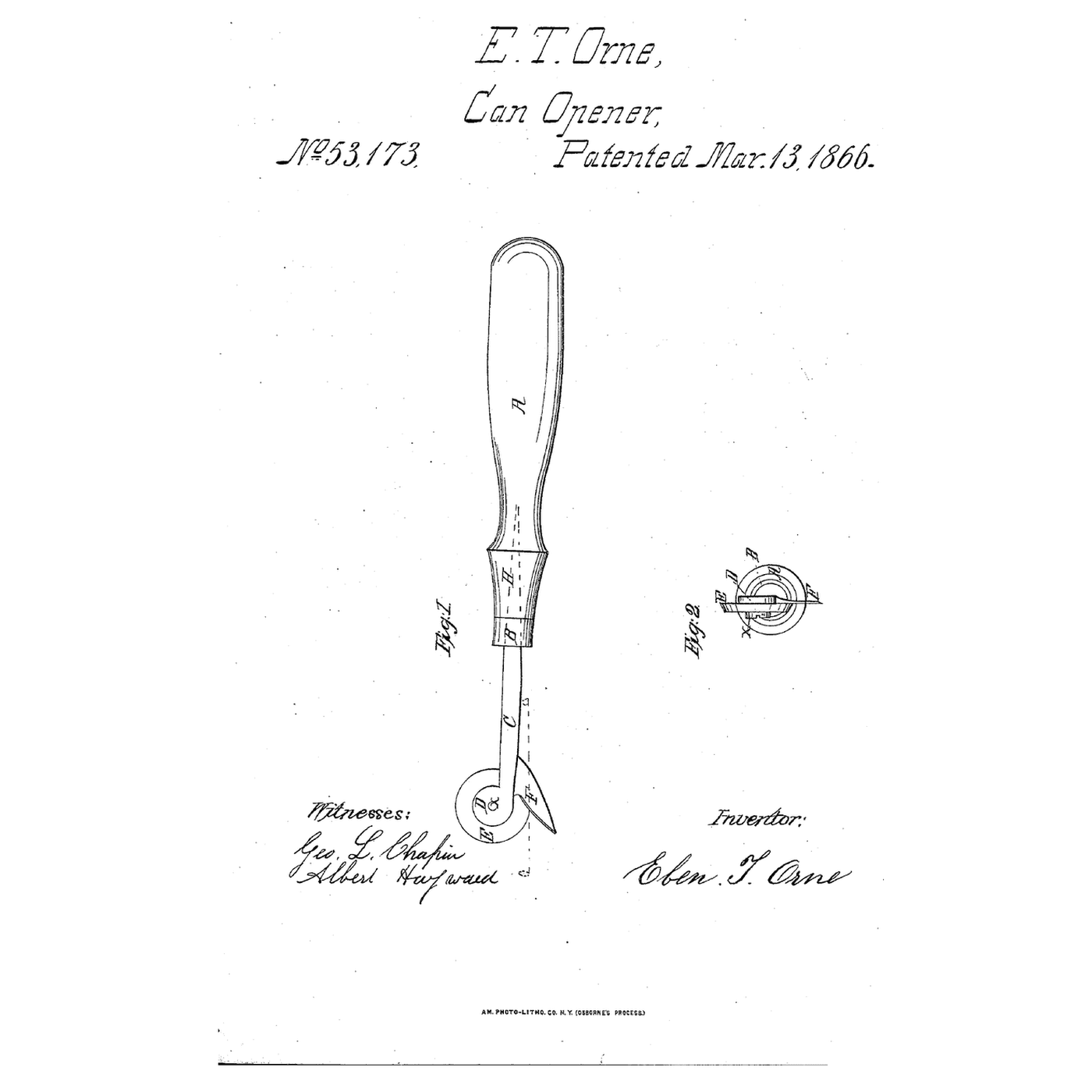
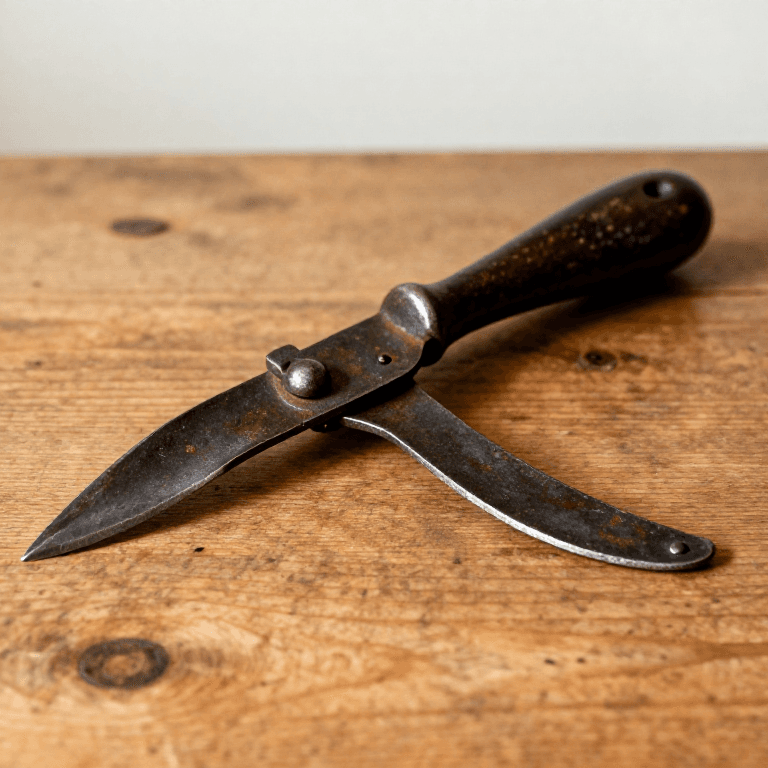
The embedded blueprint pushes a shear round the lid by hand. Arment fixes a spur at the centre so the blade cuts a true circle, sized by a sliding block.
3
3
Read US 234,646
Read US 234,646
"On the opposite end of the bar a, and on the under side, is fixed a sharp spur, a3, curved outward, and designed to be thrust through the top of the can. When it is thrust through, the bar a can be turned down against the top of the can."
"The device can be employed on any size of can. The spur a3 is thrust through the top of the can and the block e is drawn outward till the stud e2 will pass down on the outside of the can. The bar is then pressed down against the can. This movement pushes the blade e4 through the top and the stud e2 down on the outside of the can. By pushing the bar sidewise the blade moves in a circle and cuts the top open."
4
4
Make the opener and open two cans
Make the opener and open two cans
**Bar.** Cut 22 cm of 20 × 5 mm mild steel flat bar. At one end, file a curved spur a3 on the underside, pointed and hardened. Next to it, saw and file a slot a4 8 cm long along the bar, and file its edges to a bevel as the guides a5.
**Head block and blade.** File a block of flat bar with V grooves on its edges that slide on the guides. Screw a short stud e2 to its underside, and fix a small two-edged blade e4, filed from spring steel and hardened, just inside the stud. Fit a thumb screw and plate to lock the block anywhere along the slot, in place of Arment's spring f.
**Corkscrew and wax blade.** Wind a small steel-wire helix and pivot it in a recess filed in the bar's other end so it folds away; fix a short stub blade d beside it.
**Test.** Push the spur through the middle of a small can's lid, slide the block out until the stud is outside the can's rim, press the bar down so the blade pierces the lid, and swing the bar round. Reset the block and open a larger can.
Materials for this step:
 Mild Steel Flat Bar0.35 meter
 Spring Steel Strip0.1 meter
 Machine Screws1 piece
 Hex Nut2 pieces
 Steel Wire0.3 meter
 Steel Rivets2 pieces
 Tin Can2 pieces
Tools needed:
 Hacksaw
 Files (Hand File)
 Needle File Set
 Bench Vise
 Cordless Drill
 Drill Bit Set
 Propane Torch
 Round-nose Pliers
 Screwdriver Set
 Heat-Resistant Gloves
 Leather Work Gloves
 Clear Safety Glasses
 Rivet Set
 Riveting Hammer
5
5
An opener that wanders, jams or will not pierce
An opener that wanders, jams or will not pierce
Circle-cutting can opener troubleshooting.
Flow
Loading...
6
6
History and honest limits
History and honest limits
**Isaac N. Arment** of Dayton, Columbia County, Washington Territory, filed US 234,646 on 24 September 1880; it is dated 23 November 1880. His block e had channels e′ fitting the guides a5, a friction roller e3 on the stud e2, and a spring f coupling it to the bar's end to hold the stud against the can's side; the brush b cleaned the can or bottle top. His claims cover the bar, slot, guides and spur with the adjustable block, stud and blade, and the whole opener with its blade d, corkscrew, block and spring.
**Honest limits.** Filed flat bar and a thumb-screw lock stand in for his spring-held block, and the brush is left out. The notebook ignores friction; its forces and lengths are examples. Your opened cans are the result.
Materials
7- 0.35 meterPlaceholder
- 0.1 meterPlaceholder
- 1 piecePlaceholder
- 2 piecesPlaceholder
- 0.3 meterPlaceholder
- 2 piecesPlaceholder
- 2 piecesPlaceholder
Tools Required
14- Placeholder
- Placeholder
- Placeholder
- Placeholder
- 1 vendor sell this, none ship to you yetPlaceholder
- Placeholder
- Placeholder
- Placeholder
- Placeholder
- Placeholder
- Placeholder
- Placeholder
- Placeholder
- Placeholder
This blueprint makes
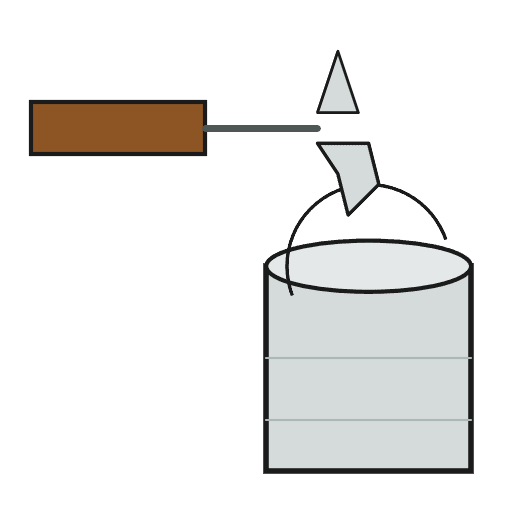
Related Blueprints
These blueprints share knowledge with this one — techniques, materials, or principles that connect them in the learning graph.

CC0 Public Domain
This blueprint is released under CC0. You are free to copy, modify, distribute, and use this work for any purpose, without asking permission.
Support the Maker by purchasing products through their Blueprint where they earn a Maker Commission set by Vendors, or create a new iteration of this Blueprint and include it as a connection in your own Blueprint to share revenue.