ART
BEAUTY & WELLNESS
CRAFT
CULTURE & HISTORY
ENTERTAINMENT
ENVIRONMENT
FOOD & DRINKS
REVERSE ENGINEERING
SCIENCES
SPORTS
TECHNOLOGY
WEARABLES
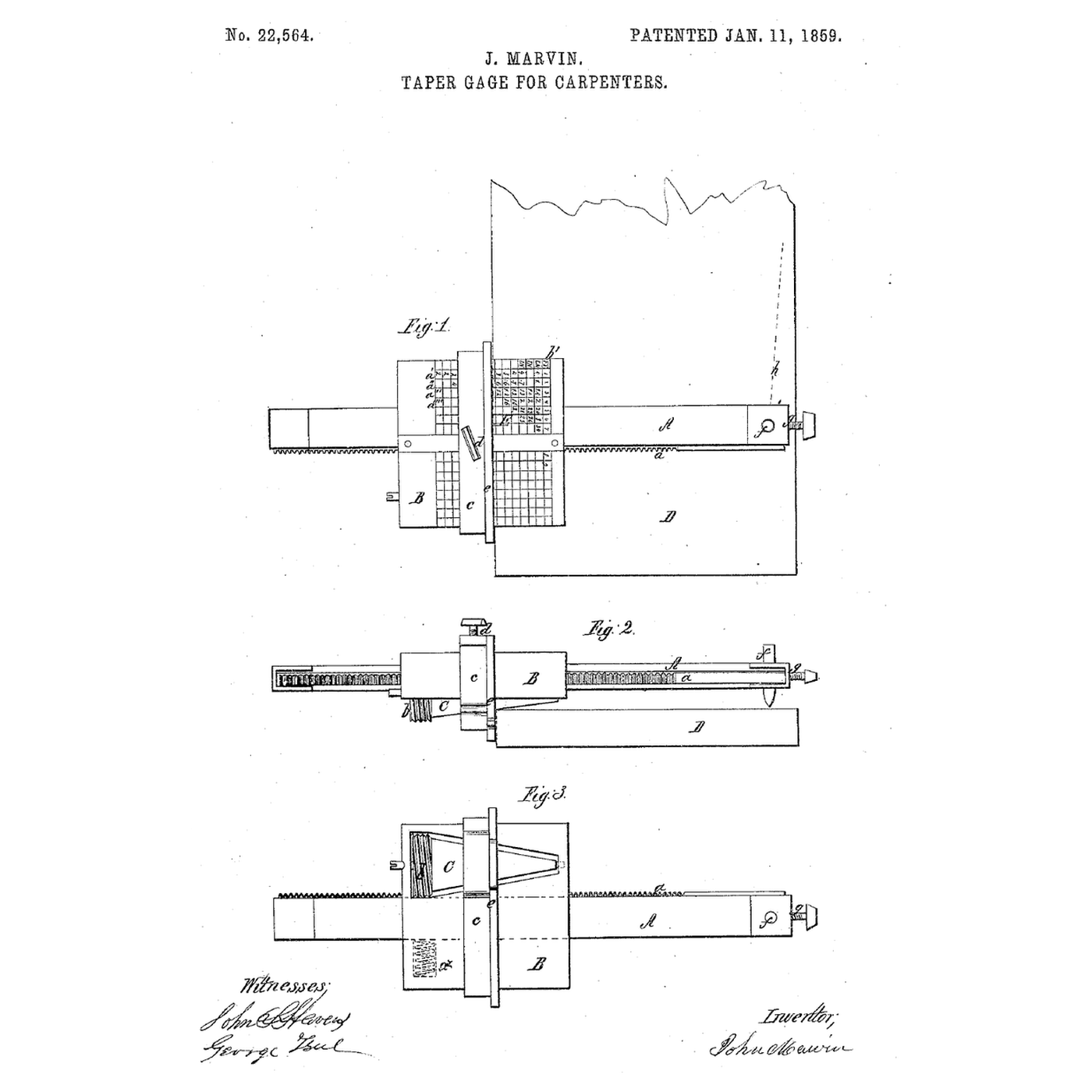


The Cone-Roller Taper Gauge: A Pencil Line That Closes In as It Goes
Marking a tapered board, what joiners called "diminished" work, meant measuring off both ends and drawing between them with a straight edge or chalk line.
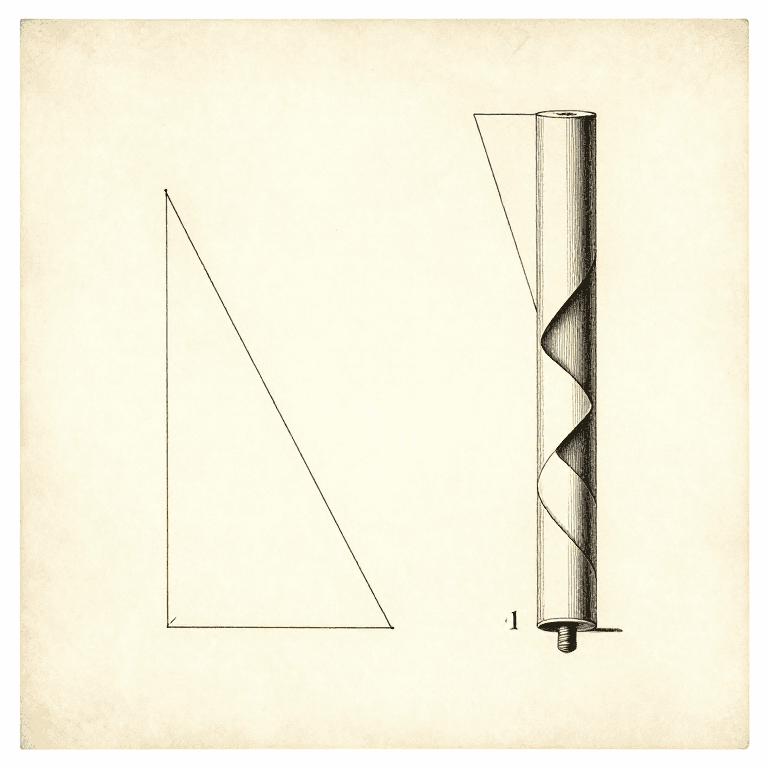
John Marvin of Bellport, New York, received US 22,564, dated 11 January 1859, for a taper-gage "that will scribe a line having an oblique position relatively with the edge of the 'stuff'": a conical roller rides on the board, and a screw at its base gears into a rack on the gauge bar, so that as the gauge is shoved along the pencil on the bar's end moves in and draws the taper. Sliding the fence along the cone gives more or less taper.
This rung works out the taper from the cone's diameter, then builds the gauge with a cone on an M6 threaded rod whose nut carries the pencil, and marks tapers on a board.
Advanced
About 5 hours
Instructions
1
1
Taper from the cone
Taper from the cone
Loading Jupyter Notebook...
2
2
Marking out before it
Marking out before it
The embedded blueprint sets a rafter's length and cuts once for every rafter. Marvin's gauge marks a taper along a board without measuring either end.
3
3
Read US 22,564
Read US 22,564
"A, represents a bar which may be of rectangular form of any suitable length and having a rack at one side of it. The bar A, passes through a mortise in a square block or stock B, in which a conical roller C, is placed, the axis of the cone being parallel with the bar A, as shown clearly in Fig. 3."
"The line h, may be made more or less taper by adjusting the bar c, and fence e, on the block or stock B. By this adjustment the conical roller C, may be made to bear upon the 'stuff' D, at any point on its periphery and the bar A, moved with a quicker or slower speed, according to the diameter of the portion of the roller C, that bears on the stuff".
4
4
Build the gauge and mark tapers
Build the gauge and mark tapers
**Stock.** Saw a stock 12 × 8 × 4 cm from hardwood block and screw a fence strip along one edge of its underside.
**Cone.** Rasp and sand a cone 6 cm long, 10 mm across at the small end and 40 mm at the large, from hardwood block, and drill it through its axis. Glue it on 25 cm of M6 threaded rod and mount the rod in two holes through blocks screwed under the stock, so the cone's underside just touches the board and the rod runs parallel to the fence.
**Pencil carriage.** Drill a small hardwood block to slide on a strip of hardwood glued under the stock, epoxy an M6 nut into it on the rod, and fix a pencil through it pointing down. As the cone rolls, the rod turns and the nut walks the pencil in.
**Test.** Set the cone so its 20 mm section touches, hold the fence on a pine board's edge and push the gauge 1 m. Measure how far the line closed in with the ruler and compare with the notebook. Move the stock so the 40 mm section touches and do it again.
Materials for this step:
 Hardwood Block3 pieces
 Hardwood Board1 piece
 Threaded Rod0.25 meter
 Hex Nut1 piece
 Epoxy Resin5 ml
 Wood Glue5 ml
 Wood Screws6 pieces
 Pine Board1 piece
Tools needed:
 Hand Saw
 Rasp
Rasp Sandpaper
 Cordless Drill
 Drill Bit Set
 Screwdriver Set
 Pencil
 Ruler
Ruler Digital Caliper 6-Inch
 Tape Measure
5
5
A gauge that slips, wanders or draws the wrong taper
A gauge that slips, wanders or draws the wrong taper
Cone-roller taper gauge troubleshooting.
Flow
Loading...
6
6
History and honest limits
History and honest limits
**John Marvin** of Bellport, Suffolk County, New York, received US 22,564, dated 11 January 1859. His stock carried a table graduated in feet and inches for setting the band and fence to the taper wanted, a spiral spring kept the stock from slipping on the bar, and he wrote that it "may be cheaply constructed at a cost not much exceeding the ordinary parallel gage."
**Honest limits.** A cone on an M6 threaded rod with a nut-borne pencil stands in for Marvin's screw and rack; the kinematics, one pitch per turn, are the same, and no taper table is given. The notebook ignores slip; its pitches and diameters are examples. Your measured tapers are the result.
Materials
8- 3 piecesPlaceholder
- 1 piecePlaceholder
- 0.25 meterPlaceholder
- 1 piecePlaceholder
- 5 mlPlaceholder
- 5 mlPlaceholder
- 6 piecesPlaceholder
- 1 piecePlaceholder
Tools Required
10- Placeholder
- Placeholder
- Placeholder
- 1 vendor sell this, none ship to you yetPlaceholder
- Placeholder
- Placeholder
- 1 vendor sell this, none ship to you yetPlaceholder
- Placeholder
- Placeholder
- 1 vendor sell this, none ship to you yetPlaceholder
Related Blueprints
These blueprints share knowledge with this one — techniques, materials, or principles that connect them in the learning graph.

CC0 Public Domain
This blueprint is released under CC0. You are free to copy, modify, distribute, and use this work for any purpose, without asking permission.
Support the Maker by purchasing products through their Blueprint where they earn a Maker Commission set by Vendors, or create a new iteration of this Blueprint and include it as a connection in your own Blueprint to share revenue.