ART
BEAUTY & WELLNESS
CRAFT
CULTURE & HISTORY
ENTERTAINMENT
ENVIRONMENT
FOOD & DRINKS
REVERSE ENGINEERING
SCIENCES
SPORTS
TECHNOLOGY
WEARABLES
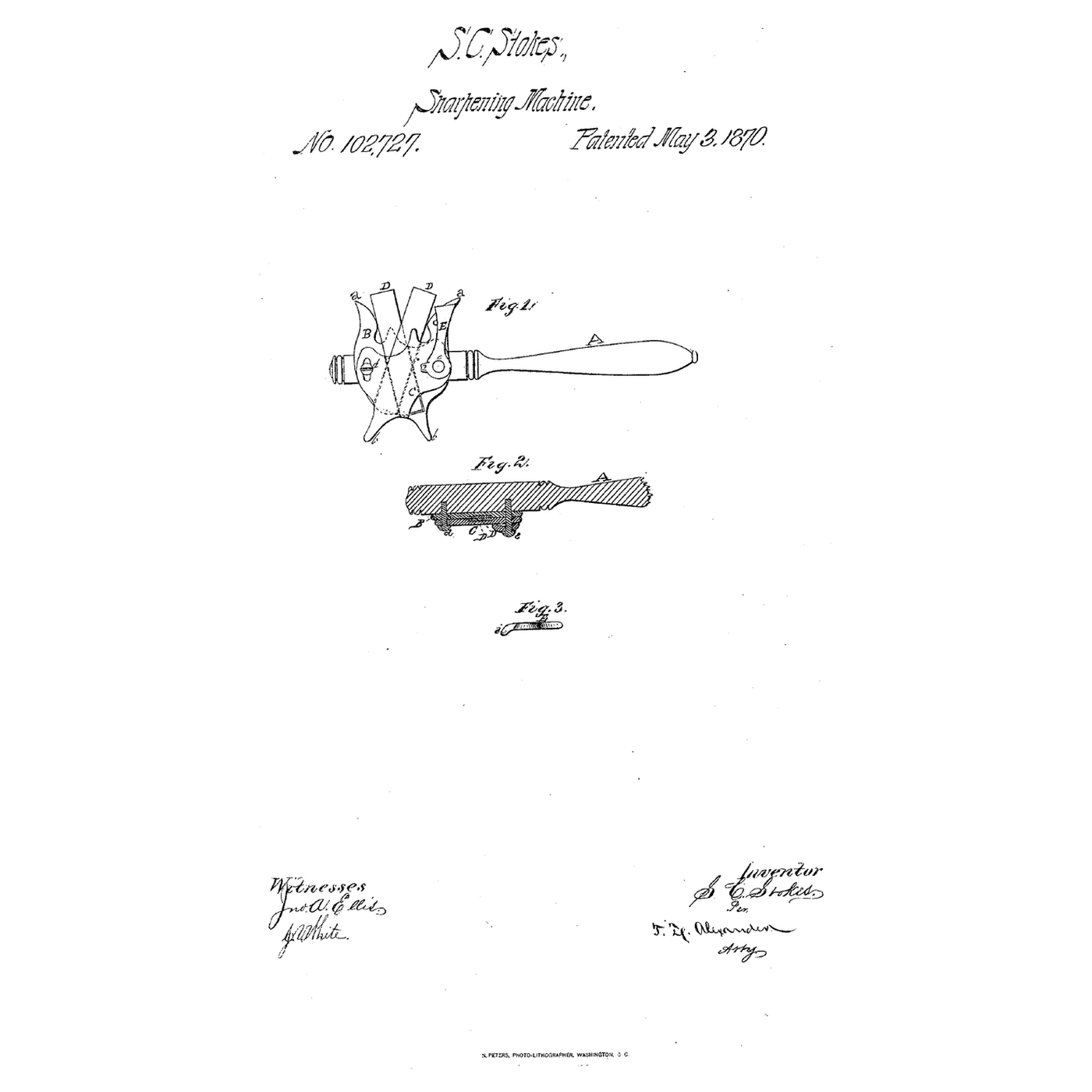


The Crossed-Bar Knife Sharpener: Two Steels Make a V
A pull-through sharpener sets the edge angle for you: two hard bars cross in a V, and the knife is drawn down through it.
Septimus C. Stokes of Manchester, New Hampshire, received US 102,727, dated 3 May 1870, for a knife-sharpener with two plates pivoted on a handle, each carrying a steel bar in an inclined recess, so that "the bars cross each other, forming an angle in which to sharpen the knife", and a lever that locks "the plates and steel bars together" or frees them to be adjusted.
This rung works out how the V's angle trades sharpness against strength, then sets a V with two steel rods and tests the edge on paper.
Beginner
About 1 hour
Instructions
1
1
Angle, thinness and push
Angle, thinness and push
Loading Jupyter Notebook...
2
2
Which angle for which blade
Which angle for which blade
The embedded blueprint compares edge angles for razors, chisels, knives and axes; the sharpener fixes one of them.
3
3
Read US 102,727
Read US 102,727
"On the side of the handle A are attached two plates, B and C", "both pivoted to the handle by bolts or screws". "It will thus be seen that the two plates are pivoted in opposite edges, and that the projections or thumb-pieces a a and b b may be brought closer together or farther apart, as may be desired."
"On the outer face of the inner plate, B, and on the inner face of the outer plate, C, is an inclined recess, in which the steel bars D D are inserted. Said recesses running in opposite directions, the bars cross each other, forming an angle in which to sharpen the knife."
A lever E has a projection that, "when the lever is turned up in proper position", will "firmly lock the plates and steel bars together, while when the lever is turned down the plates are loosened, and the plates and bars may be adjusted as desired."
4
4
Set a V and test the edge
Set a V and test the edge
Clamp two round steel rods in the vise so they cross in a V, and set the angle between them with the protractor: start at 40 degrees.
Hold a kitchen knife upright and draw it down and back through the V ten times with light pressure. Slice a sheet of paper held by one corner and note how cleanly it cuts. Open the V to 60 degrees and repeat on the same knife. Look at the edge under the loupe after each and compare with the notebook: which cut better, and which edge looked more robust?
Materials for this step:
 Paper2 sheets
 Steel Bar Stock2 pieces
Tools needed:
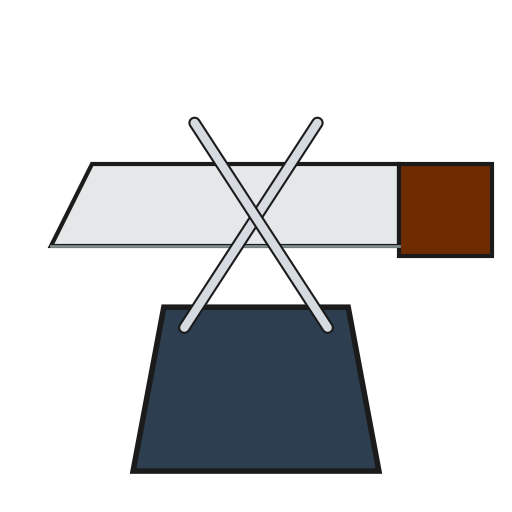 Knife Sharpener
 Kitchen Knife
 Bench Vise
 Protractor
 Magnifying Loupe
5
5
An edge that stays dull, chips or goes ragged
An edge that stays dull, chips or goes ragged
Pull-through sharpener troubleshooting.
Flow
Loading...
6
6
History and honest limits
History and honest limits
**Septimus C. Stokes** of Manchester, New Hampshire, received US 102,727, dated 3 May 1870. His claims are the locking lever and the combination of handle, plates, bars and lever.
**Honest limits.** That the edge takes the V's angle is an approximation: how the knife is held and the bars' shape change it. The patent does not state the angle; the angles and the 0.1 mm distance in the notebook are examples. Your paper test is the measurement.
Tools Required
5- Placeholder
- Placeholder
- Placeholder
- Placeholder
- Placeholder
Related Blueprints
These blueprints share knowledge with this one — techniques, materials, or principles that connect them in the learning graph.
CC0 Public Domain
This blueprint is released under CC0. You are free to copy, modify, distribute, and use this work for any purpose, without asking permission.
Support the Maker by purchasing products through their Blueprint where they earn a Maker Commission set by Vendors, or create a new iteration of this Blueprint and include it as a connection in your own Blueprint to share revenue.