ART
BEAUTY & WELLNESS
CRAFT
CULTURE & HISTORY
ENTERTAINMENT
ENVIRONMENT
FOOD & DRINKS
REVERSE ENGINEERING
SCIENCES
SPORTS
TECHNOLOGY
WEARABLES
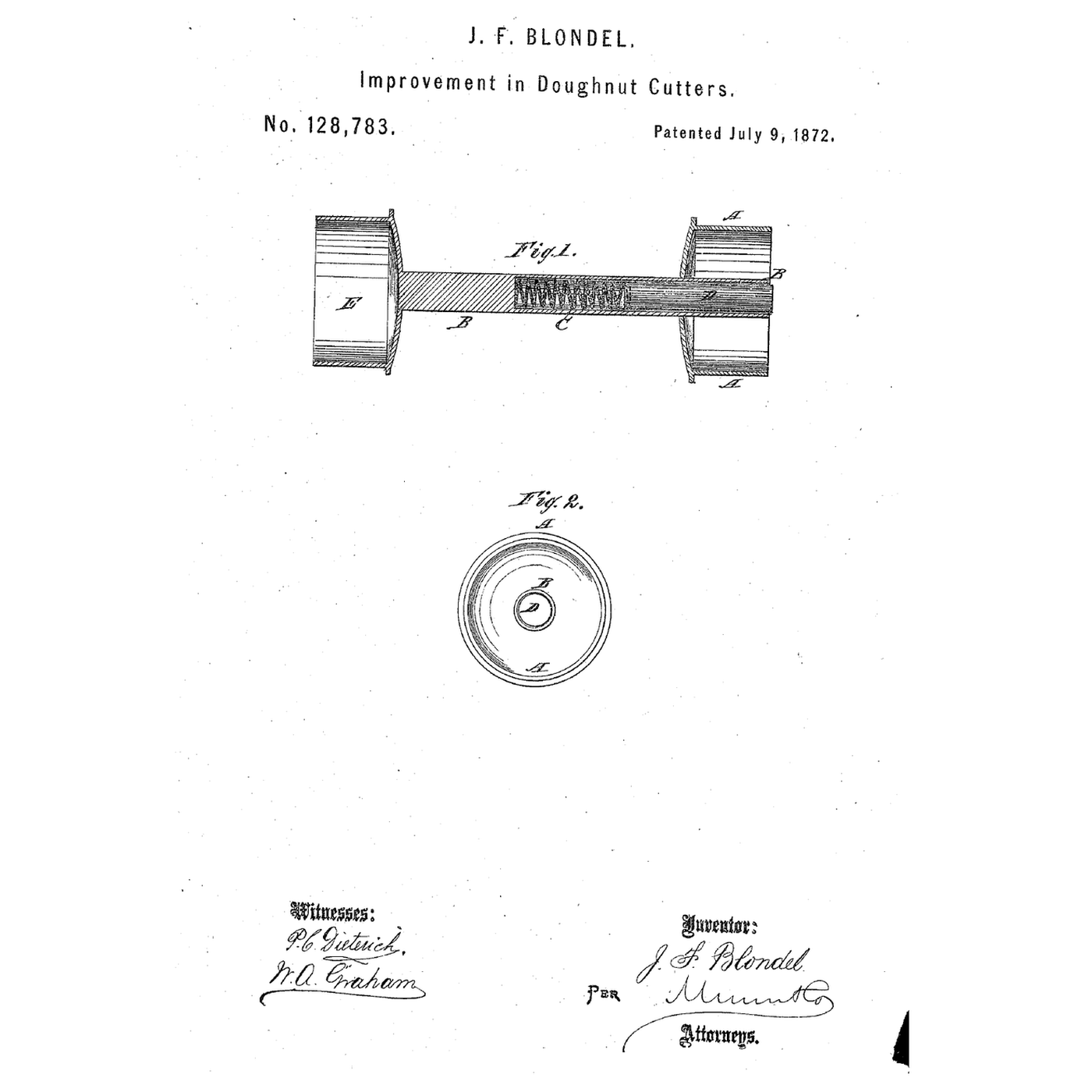


The Doughnut Cutter: A Spring That Pushes the Hole Back Out
A doughnut cutter cuts the ring and its hole in one push. The hole's plug of dough stays in the centre tube, and has to be poked out before the next cut.
John F. Blondel of Thomaston, Maine, received US 128,783, dated 9 July 1872, for a doughnut-cutter whose centre tube holds "a coiled spring" and a plunger, so that "when the cutter is forced through the dough, the follower D is forced inward, compressing the spring", and as it is raised "the spring pushes the dough out of the center tube".
This rung computes how much of the dough the hole takes and how fast plugs jam a plain tube, then cuts doughnuts both ways.
Beginner
About 2 hours
Instructions
1
1
Ring, hole and jammed tube
Ring, hole and jammed tube
Loading Jupyter Notebook...
2
2
A punch and a die
A punch and a die
The embedded blueprint covers punching shapes out of sheet with a punch and die; a doughnut cutter does the same to dough, with the ejector built in.
3
3
Read US 128,783
Read US 128,783
"My invention has for its object to furnish an improved device for removing the dough from the cutter-tube automatically, and which shall be simple in construction and convenient in use; and it consists in the combination of a spring and follower with the center-tube".
"By this construction, when the cutter is forced through the dough, the follower D is forced inward, compressing the spring C. As the cutter is raised from the dough, the spring C pushes the dough out of the center tube B, leaving said center tube free for making another cut."
"The cutter A may be made plain or scalloped, according to the kind of cake to be cut."
4
4
Cutting, as a program
Cutting, as a program
Blockly Workspace
Loading Blockly workspace...
5
5
Cut and count
Cut and count
Make a soft dough from flour, sugar, egg and a little water, rest it, and roll it to about 12 mm.
Cut doughnuts with a plain two-ring cutter and count how many cuts it takes before the centre tube jams with plugs. Then push each plug out as you go, as a follower would, and count how many you can cut from the sheet. Weigh the rings and the holes separately and compare the share with the notebook.
Materials for this step:
 Flour500 g
 White Sugar60 g
 Egg2 pieces
 Water1 piece
Tools needed:
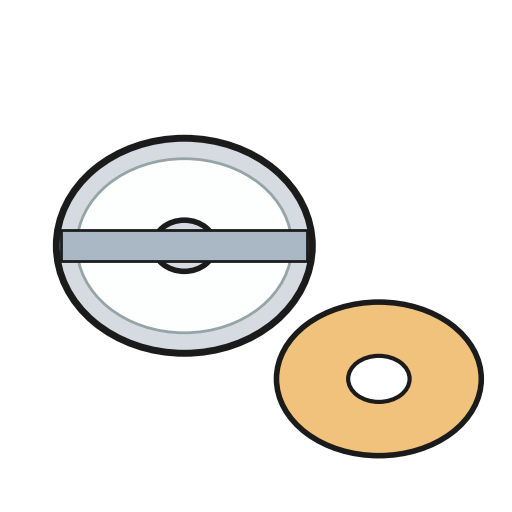 Doughnut Cutter
 Rolling Pin
 Digital Kitchen Scale
 Steel Ruler
6
6
Doughnuts that tear, stick or come out lopsided
Doughnuts that tear, stick or come out lopsided
Doughnut cutter troubleshooting.
Flow
Loading...
7
7
History and honest limits
History and honest limits
**John F. Blondel** of Thomaston, Knox County, Maine, received US 128,783, dated 9 July 1872. He notes a second cutter may be formed on the other end of the tube.
**Honest limits.** The notebook treats the dough as a flat sheet of even thickness and the plugs as stacking neatly; real dough squashes and sticks. Sizes are examples. Your counts and weights are the measurement.
Materials
4- 500 gPlaceholder
- 60 gPlaceholder
- 2 piecesPlaceholder
- 1 piecePlaceholder
Tools Required
4- Placeholder
- Placeholder
- Placeholder
- Placeholder
This blueprint makes

Related Blueprints
These blueprints share knowledge with this one — techniques, materials, or principles that connect them in the learning graph.





CC0 Public Domain
This blueprint is released under CC0. You are free to copy, modify, distribute, and use this work for any purpose, without asking permission.
Support the Maker by purchasing products through their Blueprint where they earn a Maker Commission set by Vendors, or create a new iteration of this Blueprint and include it as a connection in your own Blueprint to share revenue.