ART
BEAUTY & WELLNESS
CRAFT
CULTURE & HISTORY
ENTERTAINMENT
ENVIRONMENT
FOOD & DRINKS
REVERSE ENGINEERING
SCIENCES
SPORTS
TECHNOLOGY
WEARABLES


The Fulcrum-Plate Needle Feed: Raise the Plate and the Stitch Grows
The cheapest sewing machines fed the cloth with the needle itself, and their stitch length and stripping of the cloth were hard to adjust without extra screws that worked loose.
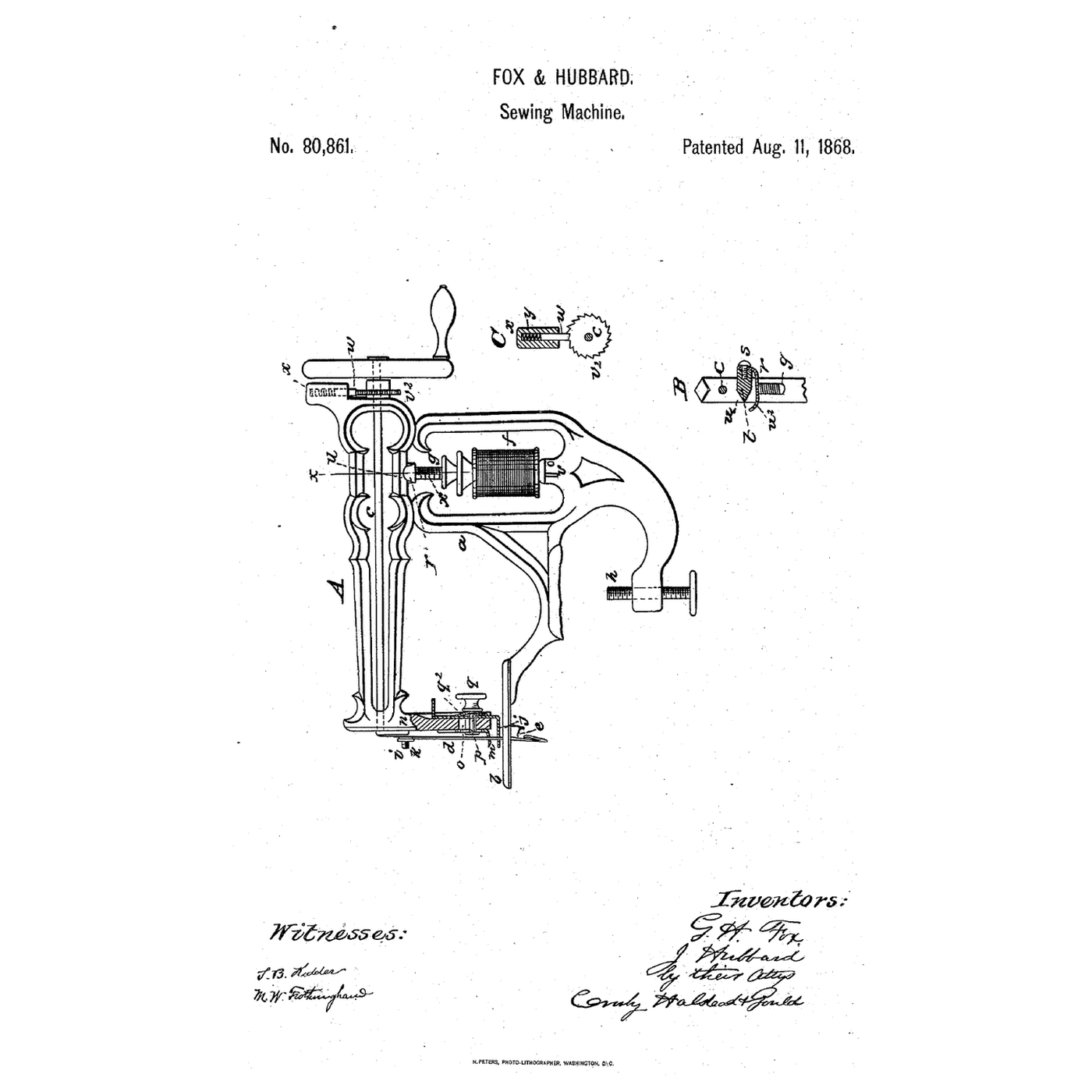
George H. Fox and Joseph Hubbard of Boston received US 80,861, dated 11 August 1868, for improvements to a single-thread tambour-stitch machine in which "the needle is the feeding-instrument, the needle being the only device in the stitch-forming mechanism that has positive movement": the needle hangs by a round eye on the crank-pin at the end of the driving shaft and passes through a guide-hole in a fulcrum plate, so its lower end swings and carries the cloth. The fulcrum plate and a stripper plate are clamped by one screw and nut through a long slot, with a friction spring so either can be moved alone; moving the fulcrum plate up or down changes the stitch.
This rung works out how the plate's height sets the stitch, then builds a hand-cranked needle on a crank-pin with a slotted fulcrum plate, and measures the stitch at three heights.
Intermediate
About 5 hours
Instructions
1
1
The needle as a lever
The needle as a lever
Loading Jupyter Notebook...
2
2
A chain-stitch looper before it
A chain-stitch looper before it
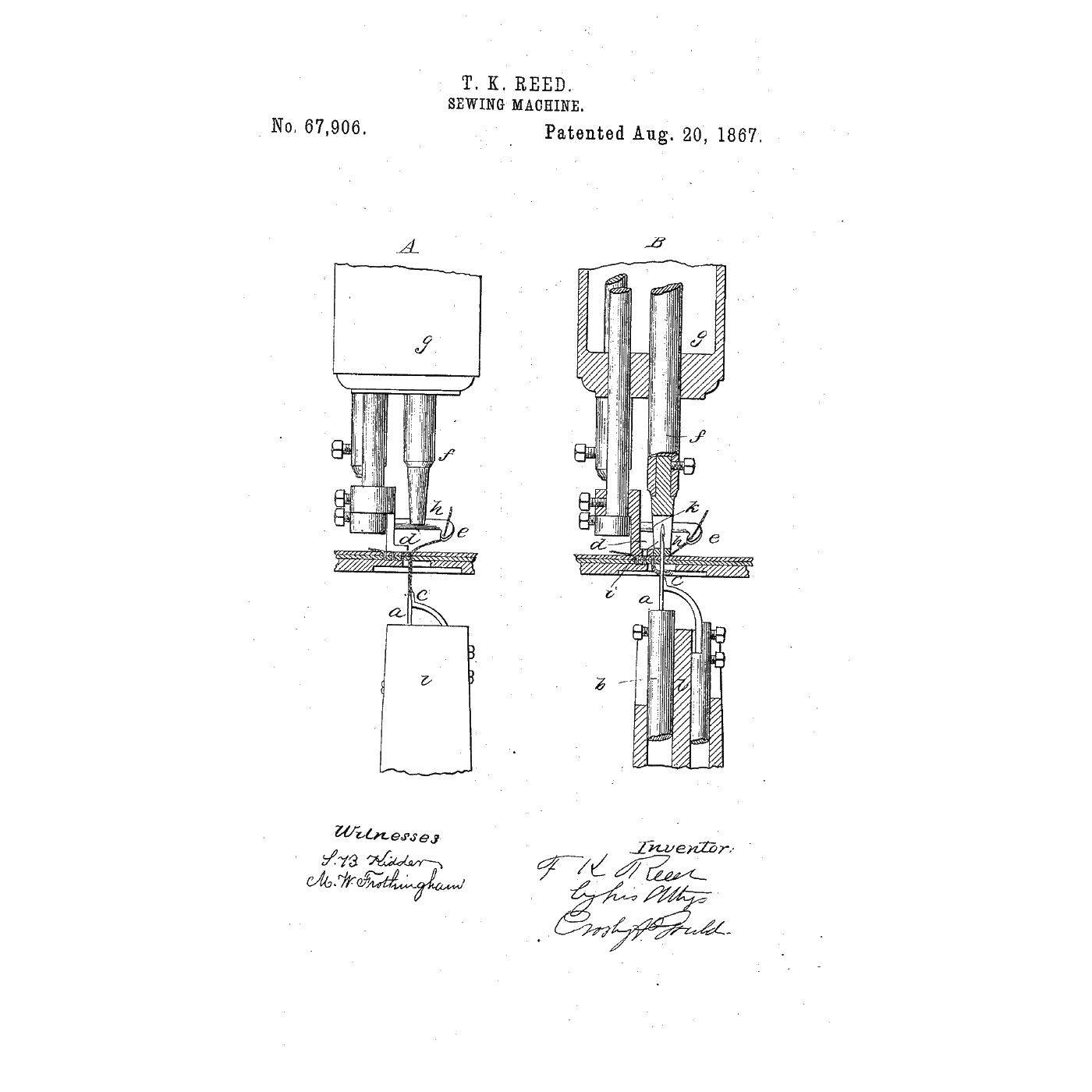
The embedded blueprint holds the loop open with sprung prongs. Fox and Hubbard's machine uses a stationary looper and lets the needle feed the cloth by swinging on a fulcrum.
3
3
Read US 80,861
Read US 80,861
"The top of the needle being thus hung and supported, and being by motion of the shaft driven rotatively, the bottom of the needle extends through a guide-hole in a stationary plate, m, fastened to the head n. As the top of the needle, in working up and down, also works to and fro (laterally,) its lower end vibrates against the plate m as a fulcrum, and these vibrating movements impart the feed or progressive movements to the cloth"
"As the amount of lateral movement of the lower end of the needle is dependent upon the position of the fulcrum and guide-plate m, such plate is made adjustable in height to change the length of the stitch, to effect which it is made with a long slot, o, through which the head a screw, p, passes, a nut, q, on the screw serving to clamp the plate to the head."
4
4
Build the feed and measure the stitch
Build the feed and measure the stitch
**Frame and crank.** Screw a hardwood head to an upright on a baseboard clamped to the table's edge. Bend a steel rod into a crank with a 3 mm throw, run it through the upright in a drilled bearing, and thread the crank-pin's end for a nut.
**Needle.** Bend a round eye in the top of a long stout needle, or of a length of steel wire filed to a point, and hang it on the crank-pin under the nut.
**Fulcrum and stripper plates.** Cut two small plates of sheet steel, one with a guide-hole the needle passes through, the other with a notch that strips the cloth, and cut a long slot in each. Clamp both to the head with one screw and nut through the slots, with a small bent spring between the back plate and the nut so either plate can be moved while the other holds.
**Ratchet.** Fit a toothed wheel on the shaft and a straight wire pawl with a bent tooth in a socket, pressed by a spring, so the crank can turn only one way.
**Test.** Lay card under the needle on a smooth plate and turn the crank; measure how far the card moves each turn. Raise the fulcrum plate, measure again, and compare with the notebook.
Materials for this step:
 Hardwood Board1 piece
 Hardwood Block2 pieces
 Wood Screws8 pieces
 Mild Steel Rod0.3 meter
 Steel Wire0.3 meter
 Steel Sheet1 piece
 Machine Screws1 piece
 Hex Nut2 pieces
 Spring Steel Strip0.05 meter
 Card Stock1 piece
Tools needed:
 Hand Saw
 Cordless Drill
 Drill Bit Set
 Bench Vise
 Hammer
 Hacksaw
 Files (Hand File)
 Needle File Set
 Tin Snips
 Round-nose Pliers
 Clamps
 Digital Caliper 6-Inch
5
5
A feed that slips, jams or will not change
A feed that slips, jams or will not change
Fulcrum-plate needle feed troubleshooting.
Flow
Loading...
6
6
History and honest limits
History and honest limits
**George H. Fox and Joseph Hubbard** of Boston, Suffolk County, Massachusetts, received US 80,861, dated 11 August 1868; their machine had the general form of one in US 67,535. The head n held the plates m and j by the screw p and nut q, with the friction spring q²; the spool spindle g was hinged to swing out and was held upright by a bent spring r; the ratchet v² had a straight wire pawl w in a socket, pressed by a spring y, as hinged pawls broke. Their claims cover the adjustable fulcrum and stripper plates with the screw and nut, and the friction spring.
**Honest limits.** A wooden head, a bent-rod crank and a filed needle stand in for their cast machine. The notebook treats the needle as a straight lever; its sizes are examples. Your measured stitches are the result.
Materials
10- 1 piecePlaceholder
- 2 piecesPlaceholder
- 8 piecesPlaceholder
- 0.3 meterPlaceholder
- 0.3 meterPlaceholder
- 1 piecePlaceholder
- 1 piecePlaceholder
- 2 piecesPlaceholder
- 0.05 meterPlaceholder
- 1 piecePlaceholder
Tools Required
12- Placeholder
- 1 vendor sell this, none ship to you yetPlaceholder
- Placeholder
- Placeholder
- Placeholder
- Placeholder
- Placeholder
- Placeholder
- Placeholder
- Placeholder
- Placeholder
- Placeholder
Related Blueprints
These blueprints share knowledge with this one — techniques, materials, or principles that connect them in the learning graph.

The Spring-Prong Looper: Two Springs That Take the Loop Off the Hook and Hold It Open for the Needle
by Tex
Sewing
38
0
0
0
0
0
The Needle Brace Bar: A Sliding Bar That Holds the Needle Near the Cloth While It Feeds
by Tex
Sewing
34
0
0
0
0
0
The Tubular Presser Foot: Hold the Leather Flat Round the Hole So the Needle Raises No Burr
by Martin
Textile & Leather
35
0
0
0
0
0
CC0 Public Domain
This blueprint is released under CC0. You are free to copy, modify, distribute, and use this work for any purpose, without asking permission.
Support the Maker by purchasing products through their Blueprint where they earn a Maker Commission set by Vendors, or create a new iteration of this Blueprint and include it as a connection in your own Blueprint to share revenue.