ART
BEAUTY & WELLNESS
CRAFT
CULTURE & HISTORY
ENTERTAINMENT
ENVIRONMENT
FOOD & DRINKS
REVERSE ENGINEERING
SCIENCES
SPORTS
TECHNOLOGY
WEARABLES
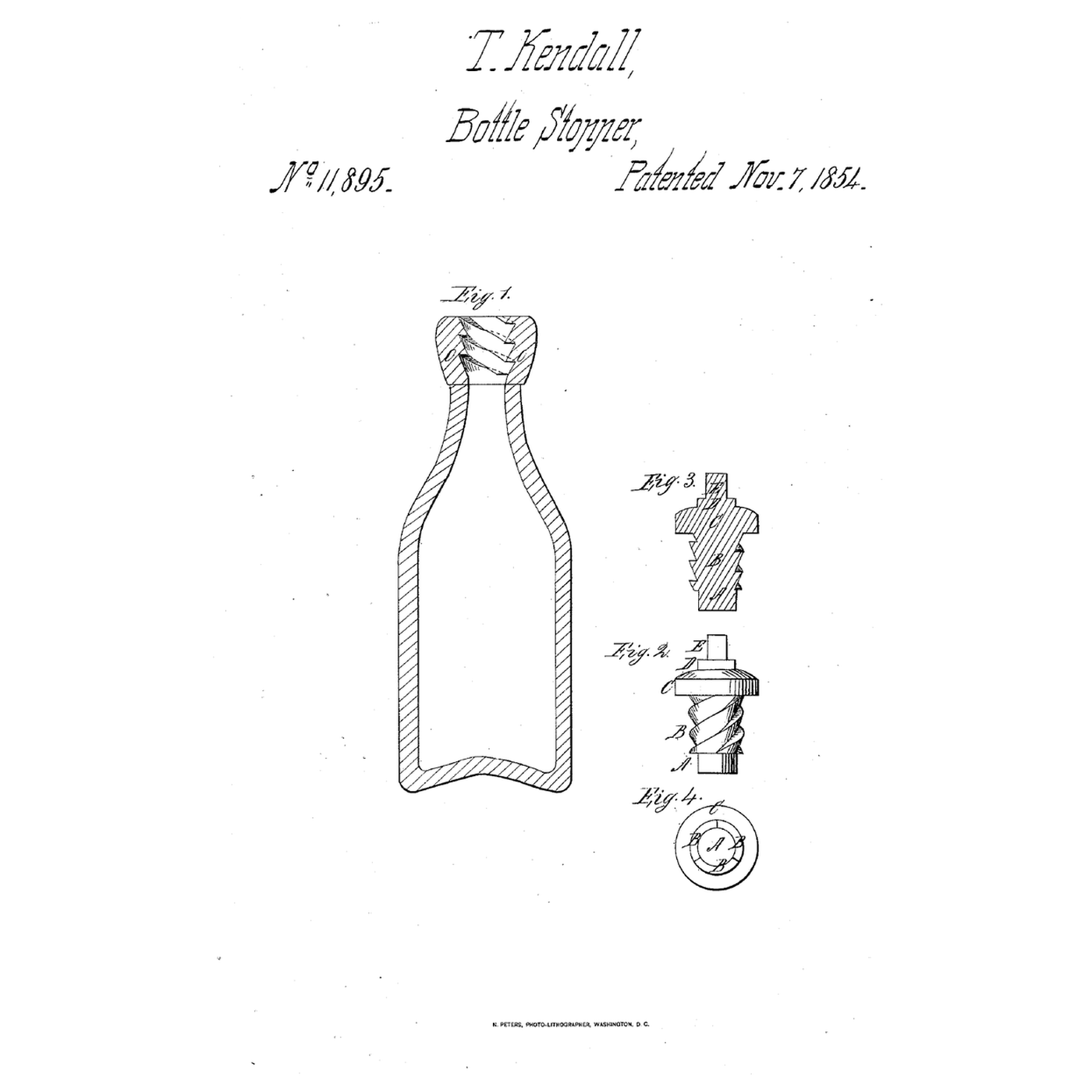


The Groove-Necked Bottle: Three Threads in the Neck That Hold the Cork
Corks in bottles of liquor liable to gasify or ferment had to be tied or wired down, which cost time and material, and then drawn with a corkscrew.
Thomas Kendall of San Francisco received US 11,895, dated 7 November 1854, for "Kendall's Groove-Necked Bottles", whose neck "is so formed or constructed that it will retain its cork or stopper without other fastening by wire, twine, or other material": three parallel grooves, bevelled and a little dovetailed, winding once round the inside of the neck. The squeezed cork slides down easily, expands into the grooves and cannot be forced out, "until external aid is furnished by unscrewing it."
This rung works out why the gas cannot turn the cork out, then prints a neck with three grooves on a bottle cap and tries a cork in it under pressure.
Intermediate
About 4 hours
Instructions
1
1
Self-locking grooves
Self-locking grooves
Loading Jupyter Notebook...
2
2
A neck before it
A neck before it
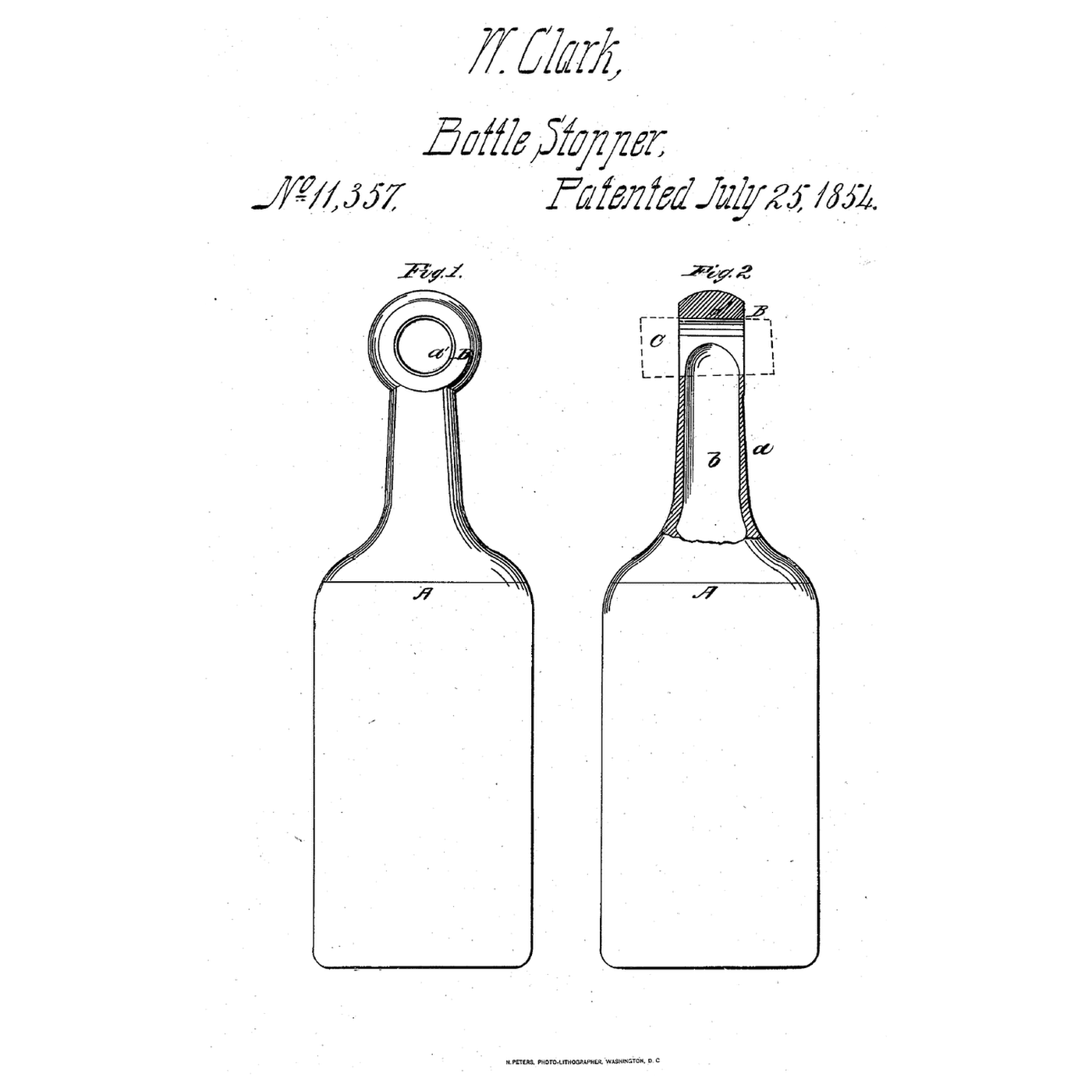
The embedded blueprint holds the cork crosswise in an eye. Kendall keeps the cork in the neck and holds it with grooves the cork expands into.
3
3
Read US 11,895
Read US 11,895
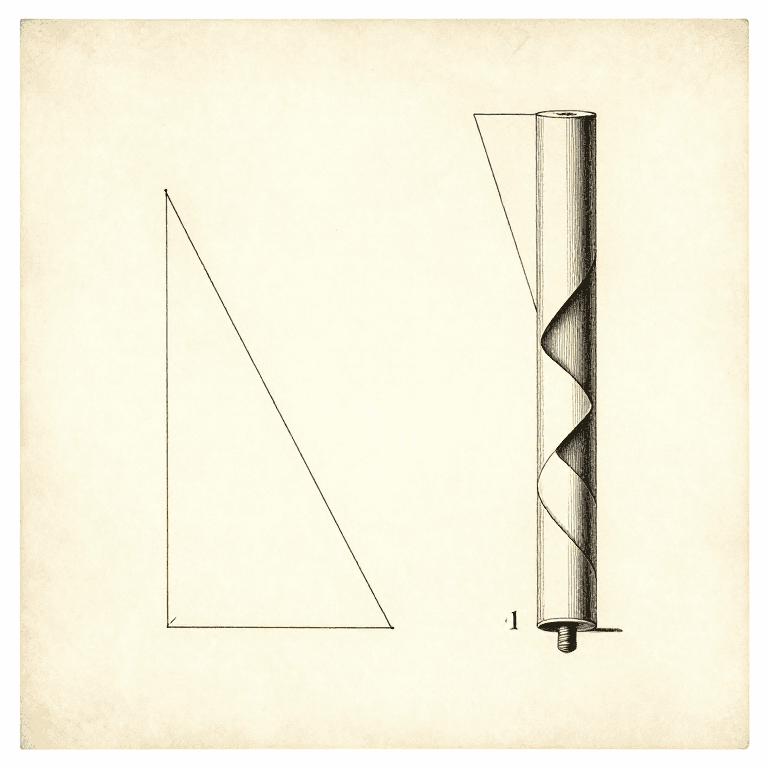
"Lastly, between sections A and C is placed section B, constituted of three parallel grooves or worms extending from section C to section A in the form of the screw. These grooves are one-eighth of an inch in depth and wind once around this section of the tool, and each groove or wire is beveled from the lower part of itself to the outer part of the next above parallel groove. All the grooves are cut or shaped a little dove-tailing, so that when the neck of the bottle or other vase is molded or formed to the tool or pattern there will be in the neck of the complete bottle an edge which will hold the cork to its place."
"The cork, having been compressed, easily descends the neck of the bottle, meeting from this formation of the neck of the bottle with no obstruction in its downward progress; but once there, it expands from its own elasticity, so as readily to fill these grooves, and the wire of the grooves, formed as above, there confines it securely; nor can it escape, however great the upward pressure applied below, until external aid is furnished by unscrewing it."
4
4
Print the neck and try it under pressure
Print the neck and try it under pressure
**Neck.** Model a block 35 × 35 × 45 mm with a bore through it shaped like Kendall's core: 14 mm across at the bottom (his 9/16 inch), widening at a shoulder to 21 mm (13/16 inch), and above the shoulder three parallel grooves 3 mm deep (1/8 inch) that wind once round in 25 mm, each bevelled so that it narrows upward and has a square edge facing up. Print it in PETG, with the bore upright.
**Cap.** Drill a 12 mm hole in a carbonated-drink bottle cap and epoxy it under the block, holes lined up.
**Bottle.** Fit a snap-in tyre valve through the base of the bottle so it can be pumped.
**Test.** Squeeze a cork a little wider than the grooved bore with pliers, push it down the neck past the grooves, and let it swell for an hour. Wearing safety glasses and pointing the neck away, pump the bottle in steps of 0.5 bar up to 2 bar, reading the pump's gauge, and watch the cork. Let the air out, then take the cork out by twisting it with a corkscrew and note which way it has to turn.
Materials for this step:
 PET Bottle (Carbonated Drink)1 piece
 PETG Filament1 piece
 Two-Part Epoxy1 piece
 Corks2 pieces
Tools needed:
 FDM 3D Printer
 Cordless Drill
 Drill Bit Set
 Bicycle Floor Pump
 Digital Caliper 6-Inch
 Combination Pliers
 Clear Safety Glasses
 Tire Valve
5
5
A neck that leaks, cracks or lets the cork out
A neck that leaks, cracks or lets the cork out
Groove-necked bottle troubleshooting.
Flow
Loading...
6
6
History and honest limits
History and honest limits
**Thomas Kendall** of San Francisco, California, received US 11,895, dated 7 November 1854. His core, tap or tool could be of clay, stone or mineral; section A at its base was 9/16 inch across, the shoulder 13/16 inch, and a flange C above the grooves carried a tenon for a handle. His claim is the bottle, jug or jar with a tri-threaded screw in the neck of the bevelled form given by the core.
**Honest limits.** A printed PETG neck on a plastic bottle's cap stands in for a neck moulded to his core, and pumped air for the gas of the drink. The notebook treats the grooves as a plain screw; its diameters and friction coefficients are examples. Your cork under pressure is the result.
Materials
4- Placeholder
- 1 piecePlaceholder
- 1 piecePlaceholder
- 2 piecesPlaceholder
Tools Required
8- Placeholder
- 1 vendor sell this, none ship to you yetPlaceholder
- Placeholder
- Placeholder
- Placeholder
- Placeholder
- Placeholder
- Placeholder
Related Blueprints
These blueprints share knowledge with this one — techniques, materials, or principles that connect them in the learning graph.


CC0 Public Domain
This blueprint is released under CC0. You are free to copy, modify, distribute, and use this work for any purpose, without asking permission.
Support the Maker by purchasing products through their Blueprint where they earn a Maker Commission set by Vendors, or create a new iteration of this Blueprint and include it as a connection in your own Blueprint to share revenue.